
Candy Crush looks simple. You swap a few colorful candies, match three or more, watch them pop, and move on to the next level. But behind that simple gameplay is a surprisingly complex product. A successful Candy Crush-like game needs hundreds of carefully designed game levels, smooth animations, boosters, rewards, a strong progression system, analytics, payments, backend services, and regular content updates.
So, what does it actually cost to build a game like Candy Crush? The answer depends on how much of that complexity you build on day one and how much you add later.
This guide breaks down the Candy Crush clone development cost, development timeline, technology choices, features, monetization options, and ongoing expenses so you can plan your mobile game development project with a realistic budget.
Candy Crush-Style Game Development Cost Estimate in 2026
| Game Type | Estimated Cost (USD) | Timeline |
|---|---|---|
| Basic Match-3 MVP | $20,000–$40,000 | 3–5 months |
| Standard Candy Crush-style game | $35,000–$70,000 | 5–8 months |
| Advanced puzzle game | $75,000–$160,000 | 8–12 months |
| Large live-service game | $170,000–$250,000 | 12+ months |
These are planning ranges rather than fixed quotes. The final app development cost or game development cost depends on the features, design requirements, technology stack, number of platforms, and development team you choose. A game development company can give a more accurate estimate after reviewing your requirements.

Why Are Candy Crush-Style Games So Popular
The appeal of Candy Crush Saga isn’t based on complicated controls. The core idea is actually very simple:
Easy to learn + gradually harder to master = players who keep coming back.
That formula works particularly well for casual gamers and smartphone users. A new player can understand the basic matching mechanics within seconds. After that, the game introduces new obstacles, limited moves, special candies, boosters, challenges, and increasingly difficult levels.
This gradual difficulty progression gives players a reason to continue. Daily rewards, lives, events, and leaderboards can further increase player engagement without making the basic game mechanics difficult to understand.
From a business perspective, this is what makes a casual puzzle game attractive. You’re not simply creating a one-time game app. You’re creating a product that can continue growing through new content, improved gameplay, and a thoughtful retention strategy.
The same principles can be applied to a new match-3 puzzle game without copying Candy Crush Saga itself. The goal is to understand what makes the genre enjoyable and then create your own gameplay experience for your target audience.
How Much Money Does Candy Crush Make (Candy Crush Revenue)
Candy Crush Saga has earned more than $1 billion a year for six years in a row. According to Apps estimates, its revenue was about $1.19 billion in 2020 and $1.21 billion in 2021, dipped to roughly $1.01 billion in 2022, and then recovered to $1.04 billion in 2023 and $1.09 billion in 2024. For 2025, AppMagic data reported by MobileGamer puts the game at about $1 billion in net in-app purchase revenue. AppMagic counts revenue differently (it excludes platform fees and ads), so the 2025 figure is not directly comparable with the earlier years, but it confirms that the game is still earning around $1 billion annually, more than a decade after its launch.
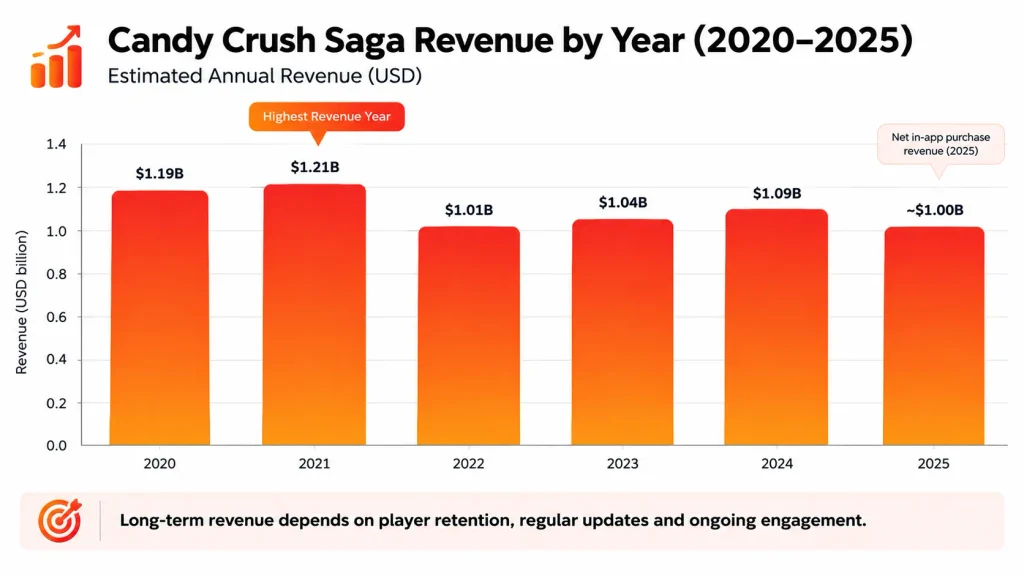
The takeaway for anyone planning a similar game is that this kind of long-term revenue comes from keeping players engaged year after year, not from launch-day downloads alone. That is why the real cost of a match-3 game goes beyond the first release.
Game Development Cost Breakdown: Stage-by-Stage Pricing
Instead of looking at one large development budget, it is easier to understand the development expenses by looking at each part of the development process.
| Development Stage | Estimated Cost (USD) |
|---|---|
| Concept & planning | $1,000–$4,000 |
| UI/UX design | $2,000–$8,000 |
| Core game mechanics | $6,000–$18,000 |
| Graphics & animation | $4,000–$16,000 |
| Level design | $3,000–$11,000 |
| Backend & APIs | $3,000–$9,000 |
| Monetization (IAP + ads) | $2,000–$6,000 |
| Admin panel & analytics | $2,000–$6,000 |
| Testing & QA | $2,000–$7,000 |
| Launch & deployment | $1,000–$2,500 |
Don’t simply add these numbers together. Development stages often overlap, and some agencies package design, development, testing, and deployment into one combined estimate.
Real example: game design, UI/UX work, and initial level design can happen while the development team is building the core game architecture. The final development budget therefore depends on how the project is organized rather than being a simple total of every individual line item.
What Factors Affect Match-3 Game Development Cost
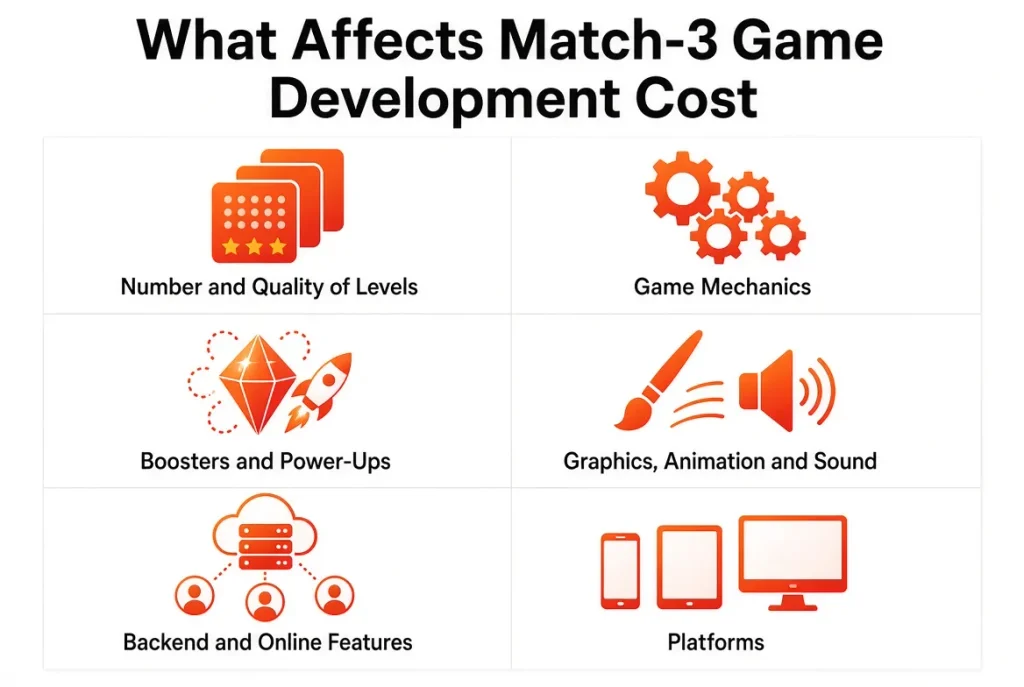
The basic match-3 mechanic is relatively straightforward. The budget increases when you start adding the systems that make the game more engaging, scalable, and commercially viable.
Number and quality of levels
Creating 100 levels does not simply mean making 100 game boards. Every level needs to be playable, balanced, tested, and positioned correctly within the overall level progression. Twenty carefully designed levels can require less work than 500 poorly planned ones.
The number of levels also affects content production, QA testing, difficulty progression, and future maintenance. If you plan to release new content regularly, your architecture should allow the team to add game levels without changing the core code every time.
Game mechanics
Basic matching, cascades, scoring, and simple objectives are common. Costs rise with bombs, rockets, locked pieces, ice blocks, chain reactions, timed challenges, or other unique mechanics. Each one needs development, animation, balancing, and testing.
Boosters and power-ups
Boosters can make a casual game much more engaging, but each one needs its own logic, animation, UI treatment, testing, and balancing. If boosters can be purchased using virtual currency or real money, they also become part of your monetization system.
Graphics, animation, and sound
Players notice how a casual game feels as much as how it works. Smooth transitions, satisfying match effects, responsive controls, colorful candies, particle effects, reward animations, and good sound design all contribute to the user experience.
Original characters, custom artwork, music, and detailed visual design can increase the development budget significantly.
Backend and online features
A completely offline puzzle game is cheaper to build than a connected gaming application. Accounts, cloud saves, leaderboards, player profiles, remote configuration, live events, purchases, and social features require a game backend, database, APIs, and supporting game infrastructure. Developers often build this layer with tools like Node.js or Python and store player data in databases such as PostgreSQL or MongoDB.
Platforms
Will you launch on Android, iOS, or both? Supporting multiple platforms increases testing, configuration, store preparation, and device compatibility requirements.
Cross-platform development can reduce duplicate development work, but it does not eliminate the need for proper testing on real devices.
Team location
The developer hourly rate can vary significantly depending on where your development team is based.
| Region | Approx. Hourly Rate |
|---|---|
| USA / Canada | $80–$200+ |
| Western Europe | $70–$150 |
| Eastern Europe | $40–$90 |
| Latin America | $35–$85 |
| South Asia | $20–$60 |
The lowest hourly rate isn’t automatically the cheapest option. A team with strong experience in mobile game development may complete complex work faster, avoid costly mistakes, and deliver better game quality.
Essential Features of a Candy Crush-Style Game
A successful Candy Crush clone should not simply copy another game’s features. Instead, use familiar match-3 systems as a foundation and build an original experience around them.
Core Gameplay
- Match-3 mechanics with cascading matches
- Special combinations and level objectives
- Obstacles, limited moves, and timed levels
- Gradually increasing difficulty
- Smooth candy matching and responsive controls
- Special candies, boosters, and power-ups
Player features
- Guest mode or login, and player profile
- Level map showing progress
- Lives and virtual currency such as coins or gems
- Boosters and daily rewards
- Achievements and leaderboards
- Push notifications and settings
These features support engagement and give players a clear sense of what they’ve achieved and what they can unlock next.
Social features (optional at launch)
- Friend invites and friend leaderboards
- Sending lives
- Team challenges and score sharing
Social features can be added later if your MVP needs to stay small, though for some audiences they become important for long-term retention.
Admin features
- Level editor to create and update levels without changing code
- User and purchase tracking
- Reward, booster, and event management
- Revenue and retention analytics
A strong admin panel becomes particularly useful once your game development company starts releasing levels, events, offers, and other content regularly. A content management system can also reduce future development expenses because your team does not need a developer for every small level or reward change.
Best Technology Stack for Game Development
For a mobile match-3 game, a dedicated game engine is usually a better choice than a regular mobile app framework.
| Area | Common Options |
|---|---|
| Game engine | Unity (most popular), Godot, Cocos |
| Programming | C#, C++, TypeScript |
| Backend | Node.js, Python, Firebase |
| Database | PostgreSQL, MySQL, MongoDB |
| Cloud | AWS, Google Cloud, Azure |
| Analytics | Firebase Analytics, GameAnalytics |
| Notifications | Firebase Cloud Messaging, APNs |
| Payments | Google Play Billing, Apple In-App Purchase |
Why Choose Daigency for Mobile Game Development
Daigency is widely used for 2D mobile games and provides support for Android and iOS from a shared development environment. Its mature ecosystem also makes it easier to find experienced game developers and supporting tools. Unreal Engine is powerful, but it is generally more than a lightweight 2D puzzle game needs.
Turn Your Match-3 Concept into a Scalable Mobile Game
Partner with Daigency to design engaging gameplay, seamless UI/UX, and high-retention monetization systems that keep players coming back.
2D vs 3D: Which Is Better for a Match-3 Game
Choose 2D for most Candy Crush-style projects. It is usually cheaper and faster to produce, performs well on a wide range of smartphones, and fits the visual requirements of a matching game naturally.
In-App Purchase (IAP) Setup for Mobile Games
If you sell digital items such as lives, coins, boosters, or other virtual goods, Google Play and Apple require developers to follow their billing rules. Plan your IAP implementation early rather than treating payments as a last-minute feature.
Android vs iOS: Which Platform Should You Build For
- Android first: Often a practical choice for a limited development budget, especially when targeting markets with large Android user bases.
- iOS first: Makes sense when your target audience primarily uses iPhones.
- Both: Provides broader reach but requires additional testing, store preparation, and device support.
Other cross-platform technologies can make Android development and iOS development more efficient from a shared codebase. However, the final game still needs to be tested across different screen sizes, operating system versions, hardware configurations, and performance levels.
The right platform strategy ultimately depends on your gaming audience, target market, monetization strategy, and available development budget.
How Long Does It Take to Develop a Mobile Game
The development timeline depends on the scope of the game and how many features are being built at the same time.
| Stage | Approx. Time |
|---|---|
| Discovery & planning | 2–4 weeks |
| Game design | 3–6 weeks |
| UI/UX design | 3–6 weeks |
| Core development | 8–16 weeks |
| Level production | 4–12 weeks |
| Backend & monetization | 4–10 weeks |
| Art & animation | 6–14 weeks |
| QA & balancing | 4–8 weeks |
| Store submission & launch | 1–3 weeks |
Many stages run in parallel, so the total project duration is not a simple addition of every number in the table.
A small MVP can sometimes be delivered in three to five months. A polished commercial game with a large number of levels, custom graphics, backend infrastructure, monetization, and live content generally requires much longer.
Be careful with anyone who promises a fully polished game with hundreds of levels in three months. A small prototype might be possible in that timeframe, but a production-ready game with substantial content usually needs more development and testing.
How to Make a Game Like Candy Crush: Step-by-Step Guide
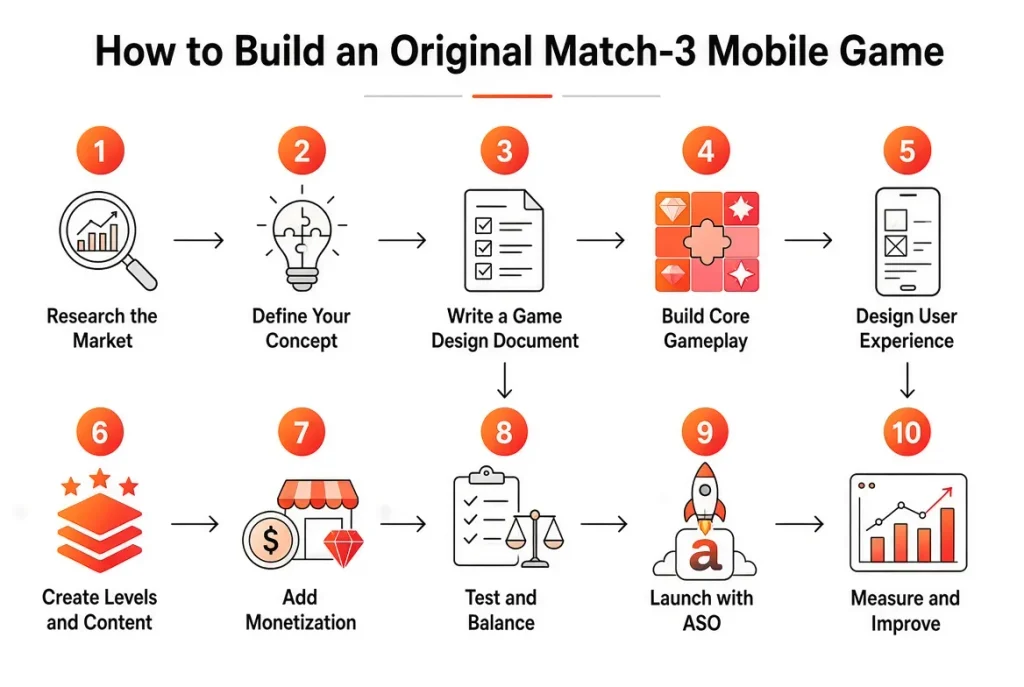
Research the market
Play competing games and study their reviews. Pay attention to what players enjoy, where they become frustrated, and what features appear repeatedly across successful puzzle games. This helps you understand the current mobile gaming market and identify an opportunity instead of creating another generic matching game.
Define your concept
Decide on your theme, target audience, core hook, progression system, platforms, and revenue model. Don’t try to make an exact Candy Crush clone. Use the familiar match-3 format and introduce your own identity through a story, visual theme, unique mechanic, characters, or social competition.
Write a game design document
Document the gameplay rules, game board, level structure, boosters, rewards, virtual currency, economy, UI screens, monetization strategy, and technical requirements. A clear game design document can prevent expensive changes later in the development process.
Build the core gameplay first
Your first playable version should prove that this loop is enjoyable:
Swap → Match → Clear → Cascade → Reward → Progress
If the basic gameplay isn’t fun, adding more features will not solve the underlying problem.
Design the user experience
Create the home screen, level map, gameplay screen, shop, rewards, profile, settings, and other key screens. The goal of good UI/UX design is to make every action feel obvious and responsive.
Create levels and content
Build a system that allows levels to be created, tested, adjusted, and released without rewriting the game’s core code. This approach creates a more scalable architecture and makes future content updates easier.
Add monetization
Plan your monetization during the game design stage rather than adding it after development. Choose whether the game will use in-app purchases, advertisements, rewarded ads, subscriptions, or a combination of these models.
Test and balance
QA is more than finding bugs. Test level difficulty, booster behavior, purchases, save/load, poor network conditions, battery usage, performance, and different screen sizes. One unfairly difficult level can make players quit, and beta testing with real players reveals problems your team may miss.
Launch with app store optimization (ASO)
Prepare your icon, screenshots, preview video, app description, keywords, privacy policy, and age rating before launch. Combine ASO with social media, influencers, paid user acquisition, and other marketing activities where appropriate.
Measure and improve
Track downloads, daily active users, retention, level completion, failed levels, booster usage, ad engagement, purchases, and crash rates. These metrics help you understand player behavior and decide which parts of the game deserve further investment.
What Is an MVP in Game Development (And What It Should Include)
You don’t need to build every feature on day one. A practical free-to-play game MVP can include:
- Core match-3 gameplay
- 30–50 well-tested levels
- A few basic boosters
- Lives and simple rewards
- Clean, simple UI
- Basic analytics
- One monetization method
- One platform (Android or iOS)
This approach gives you a chance to test the idea before committing a large development budget.
Launch the first version, study how players behave, and then invest in more levels, better animation, events, social features, and personalization based on real data. This can significantly reduce financial risk while helping you build a more scalable gaming application.
Start Small, Scale Smart with Daigency
Don’t risk your entire budget upfront. Partner with Daigency to build and launch a polished, cost-effective 30–50 level match-3 MVP then scale your content, features, and events based on real player data.
Mobile Game Monetization: How Do Candy Crush-Style Games Make Money
In-app purchases
Players can purchase extra lives, boosters, coins, extra moves, and starter packs. IAP is one of the most common monetization methods for the genre because it fits naturally into the gameplay.
Rewarded ads
Players voluntarily watch a video for something useful, like an extra life or move. Because it’s the player’s choice, it generates revenue without interrupting everyone.
Interstitial ads
Full-screen ads can appear between levels or during natural breaks. They can contribute to revenue generation, but they should be used carefully because excessive advertising can hurt the user experience and retention.
Subscriptions or premium pass
A premium plan can offer ad-free play, daily rewards, exclusive boosters, special events, or other benefits. Pricing and benefits should always be clear to the player.
Seasonal events and special offers
Holiday events, weekend challenges, limited-time bundles, and special rewards can encourage players to return and create additional opportunities for player spending.
The right mobile game monetization strategy depends on your audience and game design. A strong freemium model lets players enjoy the core game for free while offering optional purchases or premium features.
The golden rule
Optional purchases should add convenience or fun. They shouldn’t make the game frustrating simply to force players to spend money.
Mobile Game Maintenance Cost After Launch
One of the biggest mistakes in game development is spending the entire budget before launch.
A live mobile game requires ongoing investment in:
- Bug fixes and OS compatibility updates
- Server, hosting, and database costs
- New levels, boosters, events, and artwork
- Security updates and performance optimization
- Customer support
- Marketing and user acquisition
The maintenance cost is often estimated at around 15–25% of the original development cost per year, although this can vary significantly. A game with frequent content updates, live events, a large backend, or an active community can require considerably more.
Post-launch maintenance is not just about fixing bugs. It also includes keeping the game compatible with new versions of Android and iOS, monitoring performance, improving the backend system, releasing content, analyzing player behavior, and responding to changing player expectations.
A game that stops receiving meaningful updates can gradually lose player engagement and retention.
How to Reduce Game Development Cost: Smart Ways
- Start with an MVP. Validate the idea before investing in a large gaming application.
- Launch on one platform first. Starting with Android or iOS can reduce initial testing and development expenses.
- Choose 2D graphics. For a match-3 puzzle game, 2D visual design is usually sufficient and more cost-effective than unnecessary 3D development.
- Limit initial levels. A few excellent levels are more valuable than hundreds of poorly tested ones.
- Prioritize features. Must-have features include gameplay, levels, progression, and basic monetization. Boosters, achievements, and analytics can follow. Multiplayer development, large live events, and advanced personalization can come later if they support the business.
- Use ready-made assets carefully. Pre-built assets can reduce development expenses for generic elements, but your main visual identity should remain original.
- Build to expand. The cheapest first version is not always the best investment. A small but scalable architecture can make future features and content much easier to add.
- Pick an experienced game team. General app developers may know mobile development but still lack experience with game balancing, game mechanics, animation, level design, and player engagement.
Mistakes to Avoid When Building a Candy Crush-Style Game
Copying Candy Crush too closely
A Candy Crush clone should not copy the original game’s branding, characters, artwork, sound, levels, or distinctive identity. It can also create legal problems and make your own game difficult to differentiate.
Building too many features at once
More features mean more project complexity, development time, testing, and expenses.
Ignoring level design
A beautiful UI cannot compensate for poor gameplay or badly balanced levels.
Overusing ads
Aggressive advertisements may increase short-term revenue but can reduce player retention and lifetime value.
Skipping analytics
Without analytics, you have limited visibility into where players leave, which levels cause problems, and which monetization features perform well.
Treating launch as the finish line
For a live mobile game, launch is the beginning of ongoing development, content production, marketing, and optimization.
Is Developing a Candy Crush-Style Game Profitable
It can be, but there is no guaranteed return.
Downloads alone do not make a game profitable. A successful gaming business needs to move players through a broader journey:
Acquisition → Engagement → Retention → Monetization
Getting installs is only the first step. Players need to continue playing, progress through levels, respond to events, and eventually make purchases or interact with ads.
This is why player retention, level balancing, reward psychology, engagement design, and a well-planned revenue model matter as much as the initial development.
Your user acquisition strategy also matters. Acquiring a player is only worthwhile when the revenue or long-term value generated by that player can justify the acquisition expense.
Ask yourself: Why would someone download my game instead of the hundreds of puzzle games already available?
Have a clear answer before development begins. A unique theme, interesting gameplay, strong visual identity, better progression, social competition, or a fresh take on puzzle mechanics can help your game stand out in a crowded gaming market.
Building a Match-3 Game the Right Way
You can build a game in the match-3 genre because broad game mechanics are not the same thing as copying another game’s protected creative content.
However, you should not copy another game’s name, logo, characters, artwork, music, sound effects, level designs, written content, or other distinctive creative elements.
In other words, building a Candy Crush-like game is different from reproducing Candy Crush Saga itself.
Create your own identity, original game graphics, original content, and distinctive user experience. For specific intellectual property concerns, speak with an IP lawyer before launching.
Your Candy Crush-Style Game, Built with Daigency
The right Candy Crush-style game is rarely the one with the most features. It’s the one that gives players a reason to return, keeps them engaged level after level, and turns that engagement into sustainable revenue.
At Daigency, we help businesses plan and build Candy Crush-style games around their actual requirements, from focused MVPs to advanced live-service match-3 games, including game design, UI/UX design, level design, custom development, backend setup, monetization, QA testing, and launch support.
Turn Your Match-3 Concept into a Scalable Mobile Game
Partner with Daigency to design engaging gameplay, seamless UI/UX, and high-retention monetization systems that keep players coming back.
Conclusion
The cost of a Candy Crush-style game isn’t decided by the match-3 board alone. The bigger investment comes from everything around it: levels, boosters, graphics, animations, backend, monetization, QA, analytics, and post-launch content.
For most founders, the smarter approach is to start with a focused MVP instead of a full clone. Build the core gameplay, launch with a manageable number of levels, and use real player data to decide what to add next. A flexible architecture, a scalable backend, a strong progression system, and an original identity make a big difference as your player base grows.
The goal isn’t simply to build a game like Candy Crush. It’s to create a game that gives players a reason to keep playing and gives your business room to grow.
FAQs - Candy Crush Development Cost
- How much does it cost to make a game like Candy Crush?A basic match-3 MVP can cost around $20,000–$40,000. A standard Candy Crush-style game can cost $35,000–$70,000, while an advanced puzzle game with more sophisticated features, live events, and social systems can cost $75,000–$160,000. A large live-service game with full backend infrastructure can reach $170,000–$250,000 or more. The final Candy Crush game development cost depends on the development budget, feature complexity, number of levels, platform requirements, design quality, and team rates.
- How long does it take to develop one?A basic MVP can take around 3–5 months, a standard game around 5–8 months, and a more advanced project around 8–12+ months. Live-service games can take longer.
- Can I build one on a small budget?Yes. Start with core gameplay, 30–50 levels, one platform, a few boosters, and one monetization method. Add more after you get real user feedback.
- Which game engine is best?Unity is a popular option for mobile match-3 games because it supports 2D development, Android, iOS, and cross-platform development. However, the best technology ultimately depends on your team's experience and project requirements.
- Do I need a backend?Not necessarily for a completely offline game. However, accounts, cloud saves, leaderboards, purchases, live events, remote configuration, social features, and some analytics systems require backend services.
- How many levels should I launch with?There's no universal number. Around 30–50 well-balanced levels can be enough for an MVP. Quality and difficulty progression matter more than quantity.
- Is a 2D or 3D game better?For most Candy Crush-style games, 2D is more practical. It reduces cost, simplifies production, performs well on phones, and fits the genre.
- How can I make money from it?Common options include in-app purchases, IAP, rewarded ads, interstitial ads, subscriptions, premium features, special offers, seasonal events, and other free-to-play monetization methods.
- How much does maintenance cost?A common planning estimate is around 15–25% of the original development cost per year. The actual post-launch maintenance budget can be higher for games that release frequent content updates, live events, new platforms, or complex backend features.