
Quick answer: To rank a website on Google in 2026, match search intent, publish original and experience-based content, fix Core Web Vitals, build topical authority with internal links, and earn relevant backlinks. Most sites need 3 to 6 months to see stable results.
How do you rank higher on Google? Ranking higher on Google requires a combination of effective SEO strategies, high-quality content, relevant keywords, quality backlinks, and a fast, user-friendly website.
Additionally, appearing on Google’s first page can help your business attract more visitors, generate leads, and increase sales. Higher rankings also build trust and improve brand visibility.
What Has Changed in Google SEO in 2026?
Google now rewards content that shows real experience, not just keywords. AI Overviews answer many simple queries directly, so your page needs original insight, data or examples that a summary cannot replace. Sites with thin, templated or mass-produced content have lost rankings after recent core updates.
How Google Ranks Websites in 2026
Google uses bots (called crawlers) to scan websites and rank them based on relevance. However, before learning SEO techniques, it is important to understand how Google’s ranking system works. Google analyzes websites based on content quality, relevance, and user experience.
E-E-A-T, which stands for
- Experience
- Expertise
- Authoritativeness
- Trustworthiness.
Start With Search Intent, Not Just Keywords
Before writing, search your target keyword and open the top 5 results. Note the format (guide, list, tool) and the headings they share. If you miss what users actually want, even a well-optimized page will not rank.
| Intent type | What the user wants | Best content format |
|---|---|---|
| Informational | Learn something | Guide, how-to |
| Commercial | Compare options | Review, comparison |
| Transactional | Buy or hire | Service page |
| Navigational | Reach a specific site | Brand page |
Good to know: If the top results are all step-by-step guides, a sales page will not rank for that keyword.
How to do SEO for website: Step-by-Step SEO Breakdown
SEO (Search Engine Optimization) is mainly divided into three important parts that work together to improve Google rankings. Each part has its own role in helping a website perform better in search results:
On-Page SEO
On-Page SEO focuses on optimizing content on your page, such as using proper keywords, writing high-quality content, adding headings, and improving meta titles and descriptions
Off-Page SEO
Off-Page SEO involves activities outside your website that build authority, such as getting backlinks from trusted sites, social media sharing, and online mentions
Technical SEO
Make sure Google can crawl and understand your site: HTTPS, mobile-friendly design, an XML sitemap submitted in Google Search Console, no crawl errors and no accidental noindex tags.
Aim for good Core Web Vitals:
| Metric | What it measures | Good target |
|---|---|---|
| LCP | Loading speed | Under 2.5 seconds |
| INP | Responsiveness | Under 200 ms |
| CLS | Visual stability | Under 0.1 |
Content Strategy – Write Content That Deserves to Rank
High-quality content is one of the most important factors in Google rankings.
Core of Content
- Publish original, in-depth content that answers real questions
- Update old posts regularly to keep them fresh and accurate
- Use the “Skyscraper Technique”(find top-ranking content and make something better)
- Add videos, infographics, and images to increase time-on-page
- After writing for your audience, optimize the content for search engines.
- Create a content calendar and publish consistently
Grow Your Business With the Right SEO Strategy
Compare your goals and budget, and get an SEO solution built for traffic, leads, and long-term value.
Optimize for AI Overviews and Featured Snippets
Google now shows AI-generated summaries for many searches. To be a cited source:
- Put a direct 40 to 60 word answer under each H2.
- Use short paragraphs, lists and tables.
- Add original numbers, examples and expert insight that a summary cannot replace.
- Cite trusted sources.
- Add an FAQ section with real questions and schema markup.
Link Building Strategy
Backlinks are one of Google’s strongest ranking factors. These links come from other websites and point to your content. They help build authority and can improve your rankings over time.
The Power of Backlinks
. Backlinks act like “votes of trust” for your website.
· More quality backlinks = better chance to rank higher
· Google values trusted and relevant links more than random ones
Build Quality Backlinks
Publish guest posts on relevant websites within your niche to earn quality backlinks.
List your website in reputable directories such as Yelp and Google Business to improve authority.
Create link-worthy content such as guides, statistics, and infographics that naturally attract backlinks.
Connect with bloggers and journalists to build valuable relationships and gain exposure.
Avoid paid link schemes because Google may penalize websites that use them.
Use internal links between your pages to improve website structure and user navigation.
Local SEO (If You Serve a Local Area)
If customers find you by location, local SEO matters as much as your website.
- Claim and fully complete your Google Business Profile with correct name, address, phone number, hours, services and real photos.
- Ask happy customers for Google reviews and reply to every review, positive or negative.
- Use local keywords naturally, such as plumber in [your city], and create a page for each service area.
- Keep your name, address and phone number identical across all directories.
- Publish local content that answers questions your customers ask.
Use Social Media to Support SEO
Social media doesn’t directly affect Google rankings, but it plays a strong role in increasing traffic, visibility, and brand authority.
Core of Social Media
First, share every blog post on Facebook, Instagram, LinkedIn, X, and Pinterest.
Additionally, use relevant hashtags to increase your content reach and visibility.
Furthermore, engage with your audience by replying to comments and asking questions.
Moreover, pin your best-performing content to the top of your social media profiles.
As a result, social shares can create backlink opportunities when others discover and site your content.
In addition, repurpose your content by turning blog posts into reels, videos, carousels, or threads.
Finally, increased social traffic can send stronger engagement signals and help grow your online presence.
Website & Business Trust Factor
First, having a professional website makes your business appear more authentic and trustworthy.
Additionally, strong branding through a website and social media helps build customer trust.
Furthermore, a well-structured website supports SEO and improves Google visibility over time.
Moreover, businesses with both an active social media presence and a professional website often achieve better online growth and stronger Google rankings.
In addition, many businesses hire digital marketing agencies to manage SEO and social media professionally.
As a result, agencies can help with content strategy, branding, and faster online growth.
Find Out Why Your Website Is Not Ranking
Our experts review your site’s content, speed, and authority, then give you a clear plan to reach page one.
How to Improve Your Google Rankings for Free?
You can improve your rankings for free by following simple and consistent SEO practices. Paying for ads is not the only way to appear on Google. The key is to focus on quality, user experience, and regular optimization.
Step-by-Step Guidelines
- Create high-quality, helpful content that answers real user questions.
- Use relevant keywords in titles, headings, and throughout your content.
- Write clear meta titles and descriptions for every page.
- Make your website fast, mobile-friendly, and secure (HTTPS).
- Create and submit an XML sitemap to help Google index your site.
- Publish articles on free blogging platforms to gain additional visibility, drive traffic to your website, and improve your Google rankings over time.
- Build free backlinks through business directories, profile links, guest posts, and other reputable platforms to increase website authority.
- Focus on earning natural backlinks by creating useful and shareable content that helps to boost your Google ranking.
- Keep your content updated and relevant so Google continues to view your website as fresh, valuable, and worthy of higher rankings.
- Set up Google Search Console to track performance and issues.
- Share your content on social media platforms to increase reach.
- Focus on getting natural traffic instead of paid traffic.
Easy Strategy Tip
Combining quality content, free backlinks, social media promotion, and free publishing platforms can help increase your website’s authority, attract more visitors, and improve Google rankings without spending money on ads.
Google Ranking Tips for Small Businesses
Running a small business is tough, and getting found on Google can feel even tougher, but it is absolutely possible with the right steps. By focusing on SEO and Google rankings, you can attract more customers, build credibility, and expand beyond your local market. With the right strategy, a small business can gain national and even international visibility, creating new opportunities for long-term growth.

Start With Google Business Profile
- Claim your free Google Business Profile immediately
- Add your business name, address, phone number, and hours
- Upload real photos of your shop, products, or team
- Ask happy customers to leave Google reviews regularly
Target Local Keywords
- Use keywords like “best bakery in Houston” or “plumber near me”
- Add your city or area name naturally in your content and headings
- Create a dedicated location page on your website
Build a Simple but Strong Website
- Make sure your site loads fast and works perfectly on mobile
- Add your business name, address, and phone number on every page
- Write a clear homepage that tells visitors exactly what you do and where
Create Helpful Local Content
- Write blog posts answering questions your local customers ask
- Cover local events, tips, or news related to your business
- Fresh content keeps Google coming back to your site
Get Listed in Online Directories
- Submit your business to Yelp, Bing Places, and local directories
- Keep your name, address, and phone number consistent everywhere
- Even small directory listings build trust with Google
Collect Reviews and Respond to Them
- More positive reviews directly boost your local ranking
- Always respond to every review, good or bad
- Never ignore a negative review, handle it professionally
The secret for small businesses is to go local and go deeper. You just need to be the best answer for your city, your neighborhood, your customer, and turn your vision into real online growth.
How to Get on Google’s First Page?
Getting to Google’s first page is not magic. Instead, it is a combination of the right strategy, consistent effort, and patience. Success comes from doing the right things in the right order. The goal is not just to appear on Google, but to become the best answer for what people are searching for.
Here is exactly what you need to focus on:
- Keyword Research First: Find what your audience is searching for and build your content around those exact words.
- Quality Content: Write helpful, original, and problem-solving content that actually gives value to your reader
- Fast and Mobile-Friendly Website: Google rewards sites that load quickly and work smoothly on every device
- Backlinks: Get other trusted websites to link to you because Google treats every backlink as a vote of confidence
- Social Media: Share your content on every platform to drive traffic and increase your visibility
- Google Search Console: Set it up for free to track your rankings and catch any technical issues early
- Stay Consistent: Post regularly, update old content, and never stop improving
The websites sitting on Google’s first page today did not get there by luck. They got there by following these exact steps repeatedly and patiently. SEO takes time, but every small action you take today brings you one step closer to Google’s first page tomorrow.
Common SEO Mistakes to Avoid
- Targeting a keyword with the wrong intent.
- Publishing mass AI content with no human review or original input.
- Keyword stuffing and spammy anchor text.
- Buying low-quality backlinks.
- Ignoring mobile speed.
- Having several posts compete for the same keyword.
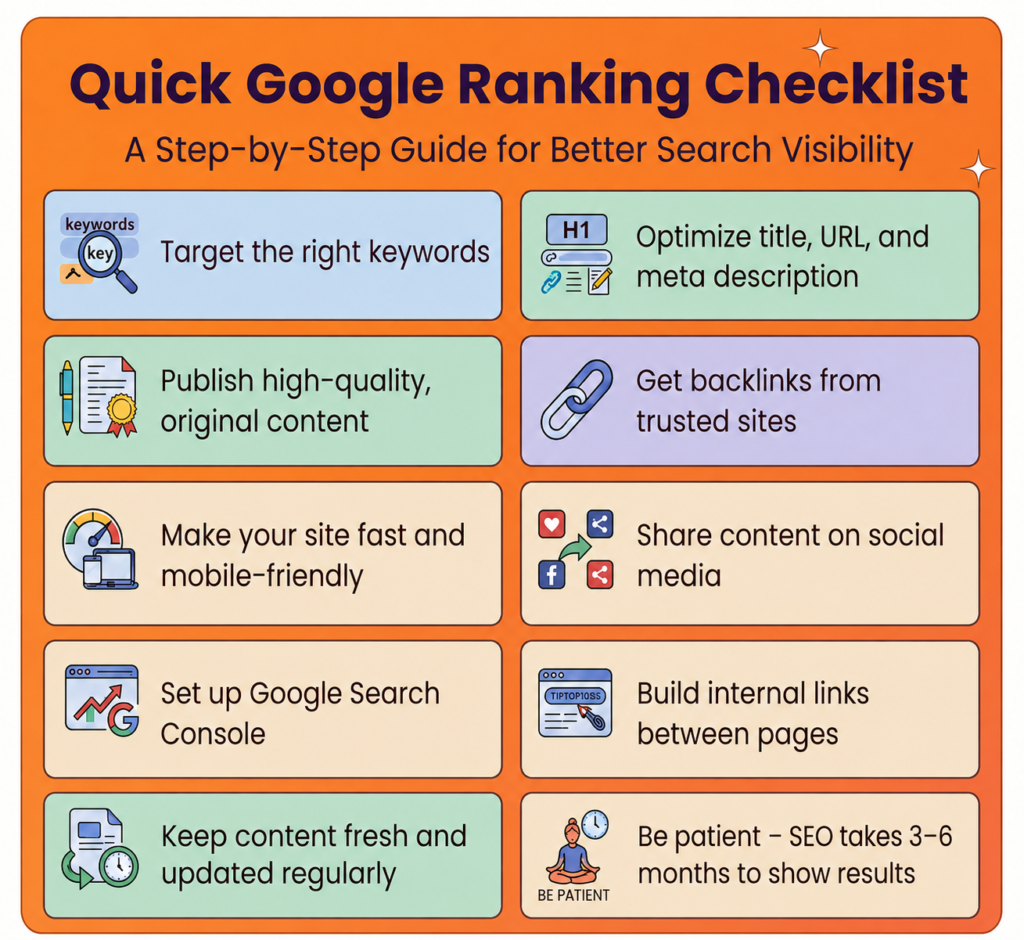
Quick Google Ranking Checklist
Daigency – Your Digital Success Partner
Looking for professional digital marketing support? Daigency provides SEO, website development, content strategy, and social media management services to help businesses grow online. It is a reliable choice for businesses looking to build a strong and authentic digital presence.
Get Your Website Ranking on Google’s First Page
Get a custom SEO plan that balances content, technical health, and backlinks for long-term rankings.
Conclusion
The road to Google’s first page is built on consistency, quality, and patience. By focusing on SEO, valuable content, quality backlinks, and a strong online presence, you can steadily improve your rankings and grow your business. Every small step you take today brings you closer to long-term success on Google.
The best time to start was yesterday. The second best time is right now.
FAQs.
- How long does it take to rank a website on Google?
Most websites start seeing SEO improvements within 3–6 months, but competitive industries may take longer depending on content quality, backlinks, and website authority.
- Can I rank on Google without paying for ads?
Yes. You can rank organically by publishing high-quality content, optimizing your website for SEO, building quality backlinks, and improving user experience.
- What is the most important Google ranking factor in 2026?
There is no single ranking factor. Google considers helpful content, E-E-A-T, page experience, backlinks, mobile usability, and search intent together when ranking websites.
- How often should I update my website content?
Review and update important pages every 3–6 months or whenever information becomes outdated to keep your content fresh and relevant.
- Does website speed affect Google rankings?
Yes. A fast-loading website improves user experience and is a confirmed ranking factor that can help increase search visibility.
- Why is keyword research important for SEO?
Keyword research helps you understand what your audience is searching for so you can create content that matches their search intent.
- Do backlinks still matter for SEO in 2026?
Yes. High-quality backlinks from trusted and relevant websites remain one of the strongest signals for improving domain authority and search rankings.
- What is the difference between indexing and ranking?
Indexing means Google has discovered and stored your page, while ranking determines where your page appears in search results.
- Is Google Search Console necessary for SEO?
Yes. Google Search Console helps monitor indexing, keyword performance, technical issues, and overall website health for better SEO results.
- How can small businesses rank higher on Google?
Small businesses should focus on Local SEO, optimize their Google Business Profile, create helpful content, earn customer reviews, and maintain consistent business information across the web.