
Quick answer: A travel website costs between $500 and $100,000+ in 2026. A basic informational site with destination pages, an inquiry form, and a CMS usually starts around $1,000–$4,000. A custom travel agency website with stronger design, SEO, and CRM integration can cost $4,000–$12,000. A booking-enabled website with online payments, availability management, and customer accounts typically costs $10,000–$30,000+. A full travel marketplace or OTA with multiple suppliers, live inventory, and vendor dashboards can reach $30,000–$100,000+. Annual maintenance generally adds another 10–20% of the original development cost.
A travel website can cost anywhere from $500 to $100,000+ in 2026. For most professional travel agencies and tour operators, a realistic budget is $3,000 to $15,000.
The range is wide because the cost depends far more on what your website needs to do than on how many pages it has. A site that showcases destinations and collects enquiries is a very different project from a platform that checks live availability, accepts payments, and confirms bookings automatically.
Want to know how much it costs to build a Travel App? Explore our complete guide to How Much Does a Travel App Development Cost, including features, timelines, APIs, and development costs.
This guide explains what a travel website costs, what drives the price, which expenses appear after launch, and how to set a practical budget without paying for features you don’t need.
Travel Website Cost at a Glance in 2026 – The Complete Pricing Guide
| Website type | Estimated cost | Typical timeline | Best for |
|---|---|---|---|
| DIY / website builder | $300 – $1,500 | 1–3 weeks | New consultants and very small businesses |
| Basic professional website | $1,000 – $4,000 | 2–6 weeks | Small agencies and local tour operators |
| Custom agency website | $4,000 – $12,000 | 4–12 weeks | Growing agencies that want a real sales tool |
| Booking-enabled website | $10,000 – $30,000+ | 2–4 months | Businesses taking bookings and payments online |
| Travel marketplace or OTA | $30,000 – $100,000+ | 6–12+ months | Large platforms with multiple suppliers |
These are planning ranges, not fixed quotes. Prices vary by region, team, and scope, and a smaller website can cost more than a larger one if it needs complex booking workflows or multiple API integrations.
What Type of Travel Website Do You Need?
A consultant who takes bookings by phone doesn’t need the same website as an online agency selling flights and hotels. Start with your business model, your customers, and the features you truly need.
DIY Website: $300 – $1,500
Website builders like Wix, Squarespace, or a WordPress template are a practical starting point for a small travel business. You can launch pages for destinations, packages, contact details, and a blog without a large investment.
The trade-off is flexibility. DIY platforms can become restrictive when you need custom design, advanced SEO, or booking features. They work best for new consultants who mainly need an online presence.
Basic Professional Website: $1,000 – $4,000
A basic professional site is designed to build trust and turn visitors into enquiries. It commonly includes:
- 5–10 pages (home, about, destinations, tour packages, gallery, contact)
- Mobile-responsive design
- An inquiry form and WhatsApp button
- Basic SEO, analytics, a blog, and Google Maps
- A CMS such as WordPress, so you can update content yourself
This suits businesses that take bookings by phone, email, or WhatsApp. A customer finds your package on Google, reviews the itinerary, and sends an enquiry, with no online checkout needed.
Custom Travel Agency Website: $4,000 – $12,000
At this level, your website becomes a real marketing and lead-generation tool rather than an online brochure. You would typically get:
- Custom UI/UX design built around your brand
- Destination search and filtering
- Detailed itinerary pages and package management
- Quote request forms and customer reviews
- CRM and email marketing integration
- SEO-friendly architecture and speed optimization
- Multilingual content, if needed
For many established agencies, this is where strategy and conversion-focused design start to pay off.
Booking-Enabled Website: $10,000 – $30,000+
Once customers can search, select, book, and pay online, the project becomes much more complex. It may include:
- Availability calendars and date selection
- Dynamic or seasonal pricing
- Online payments, deposits, and refunds
- Customer accounts and automatic confirmation emails
- Cancellation workflows and promo codes
- An admin dashboard for managing bookings
The exact cost depends on how the booking system works. A simple booking form is straightforward. A system that checks real-time availability, calculates prices, processes payments, and updates reservations automatically needs far more development and testing. If you sell a limited number of fixed tours, a well-designed enquiry and payment flow may be enough.
Travel Marketplace or OTA: $30,000 – $100,000+
Here you are building a software product, not a standard website. It may include:
- Multiple suppliers, hotels, or tour operators
- Real-time inventory through APIs or GDS integrations
- Separate dashboards for customers, vendors, and admins
- Commission management, reviews, and advanced search
- Multi-currency and multi-language support
- Scalable cloud infrastructure and mobile apps
Projects with extensive integrations can go beyond $100,000. If you need flight or hotel inventory through supplier APIs, budget separately for integration, licensing, and transaction fees.
Travel website vs. travel booking portal
A website presents your company, destinations, and packages and generates enquiries. A portal is built around transactions, suppliers, and live inventory. Their costs shouldn’t be compared directly, because they solve different business problems.
Ready to Build Your Travel Website?
Get a website designed around your travel business, features, and budget.
What Actually Drives the Travel Website Cost?
Two businesses can ask for a “travel website” and receive completely different quotes. The difference comes down to scope, functionality, integrations, design, and development approach.
Design and user experience
Travel is a visual industry, and people want to see destinations and experiences before they book. A template costs less because much of the design is done. Custom design takes longer because layouts, navigation, and the booking journey are planned around your business. Expect roughly $500 to $3,000+ for design alone.
Booking functionality
This is one of the biggest cost drivers. Compare “Request a quote” with “Select dates → choose travelers → check availability → pay → receive confirmation.” The first needs a simple form. The second needs a booking engine, payment systems, availability logic, notifications, and admin tools, and can add $2,000 to $10,000+.
Payment integration
Online payments need a secure gateway such as Stripe, PayPal, or a local provider. A basic setup is inexpensive, but deposits, refunds, multiple currencies, and invoices cost more. Transaction fees charged by your provider are separate from development costs.
Third-party integrations and APIs
Travel sites often connect to CRM, email tools, WhatsApp, Google Maps, review platforms, and hotel or flight suppliers. Each integration adds development, testing, and maintenance, and some charge setup or per-use fees. A company selling its own safari packages may not need external inventory at all, so integrate only what your business genuinely requires.
Pages and content
Fifteen carefully built pages with custom functionality can take more work than fifty simple ones. A single tour page may include an itinerary, pricing, inclusions, departure dates, FAQs, a gallery, and a booking form. Writing and uploading guides, itineraries, and blog posts can become a big part of the budget. Professional photography adds cost but helps travelers imagine the experience.
Mobile experience
Many travelers research on their phones, so your site needs readable text, simple navigation, fast images, and easy forms. Responsive design is standard, but app-like mobile experiences cost more.
SEO
Building SEO in from the start is far cheaper than fixing structure later. Technical SEO covers URLs, titles, meta descriptions, headings, internal linking, sitemap, image optimization, and page speed. Initial setup often runs $500 to $2,500+, while ongoing SEO typically costs $300 to $2,000+ per month. Treat it as an ongoing marketing activity, not a one-time task.
Multilingual and multi-currency support
Selling internationally means more than translating a few buttons. Descriptions, forms, metadata, prices, taxes, and payment methods must all work for each market, which increases development and testing.
Technology and platform
WordPress works well for many travel businesses, typically costing $1,000 to $15,000+ depending on themes, plugins, and customization. Custom-built applications make sense when you need complex booking logic, supplier integrations, or dashboards a CMS can’t handle. The best technology is the one that fits your business, not the most advanced one.
Feature-by-Feature Cost Breakdown
| Feature | Cost impact |
|---|---|
| Contact form | Low |
| Blog / CMS | Low–Medium |
| Destination pages | Low–Medium |
| Interactive maps | Medium |
| Multilingual website | Medium |
| Advanced inquiry forms | Medium |
| CRM integration | Medium |
| Payment gateway | Medium |
| Online booking | High |
| Real-time availability | High |
| Third-party travel APIs | High |
| Customer dashboard | High |
| Vendor dashboard | Very high |
| Marketplace functionality | Very high |
You don’t need every feature. A small agency may win more business from a fast, well-designed site with strong destination pages and an easy enquiry process than from an expensive booking system customers rarely use.
Hidden Costs and Their Ongoing Impact After Launch
The development invoice is not the full cost of owning a website. Plan for:
| Cost | Typical range or frequency |
|---|---|
| Domain | About $10–$30 per year |
| Hosting | About $10–$100+ per month, more for busy booking platforms |
| SSL / security | Often included with hosting; advanced security costs extra |
| Updates, backups, monitoring | Monthly or as needed |
| Premium plugins and tools | Booking, forms, SEO, CRM, translation |
| SEO and marketing | Monthly or project-based |
| Payment processing and API fees | Per transaction / depends on provider |
Maintenance deserves special attention. A common rule of thumb is to reserve 10–20% of the original development cost per year. In monthly terms, expect roughly $50–$150 for a basic site, $100–$300 for a professional travel site, $300–$1,000+ for a booking site, and $1,000+ for a large platform. Booking sites cost more because problems with payments or availability directly affect revenue.
That’s why you should think in terms of total cost of ownership, not just the initial price.
How Much Do Developers Charge?
Freelancers typically charge $20 to $100+ per hour, while agencies and specialist teams charge more depending on location and expertise. For example, 150 development hours at $50 per hour comes to about $7,500, and that may not include content, plugins, API fees, photography, or SEO.
This is why comparing quotes by total price alone can be misleading. Look at what is actually included.
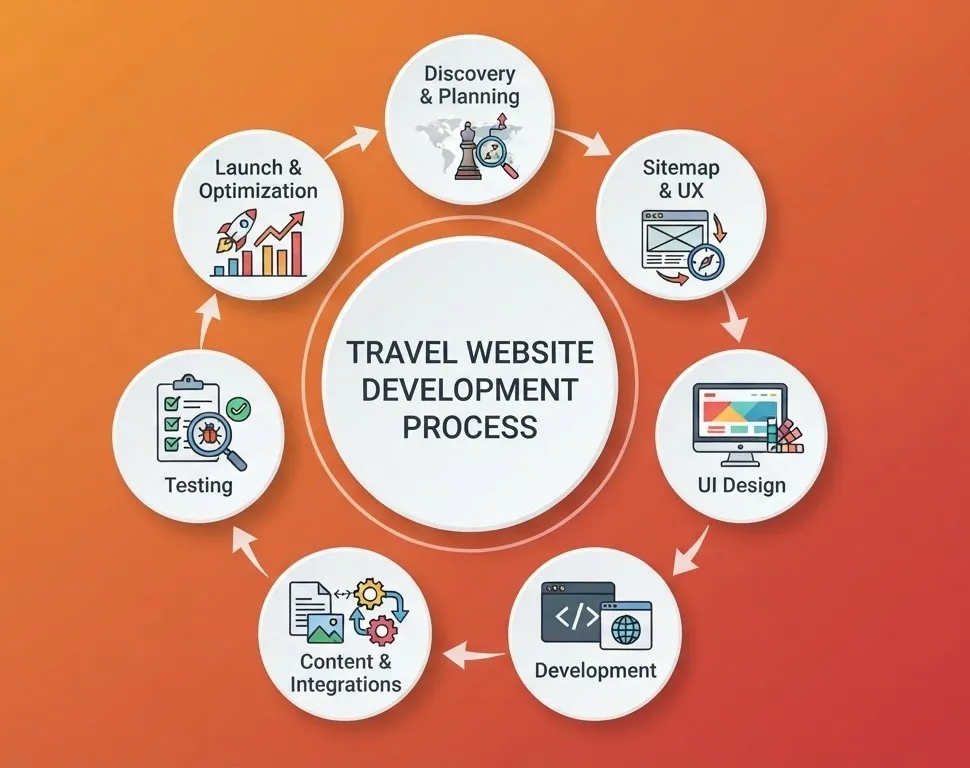
Travel Website Development Timeline
| Project type | Approximate timeline |
|---|---|
| Basic website | 2–6 weeks |
| Professional agency website | 4–12 weeks |
| Booking-enabled website | 8–16 weeks |
| Advanced platform | 3–6 months |
| Marketplace / OTA | 6–12+ months |
Content readiness, revisions, API approvals, and scope changes can all affect the timeline. Booking platforms need extra testing because payments, availability, and accounts must work reliably before launch.
How to Reduce Travel Website Costs
You don’t have to sacrifice quality to control your budget. Prioritize what your business needs now:
- Build in phases. Launch with a professional site, tour pages, inquiry forms, and an SEO foundation. Add booking and payments in phase two, then supplier integrations or mobile apps as you grow.
- Start with an MVP. Launch the essentials and expand based on how real users behave.
- Start with your most important pages. You don’t need 30 pages on day one.
- Use existing tools where they fit. Established plugins can cost far less than custom development.
- Choose APIs carefully. Don’t integrate a service just because it’s available.
- Get your content ready early. Prepared descriptions, prices, images, and FAQs reduce delays and extra costs.
- Plan integrations, SEO, and growth from day one. If you may add online booking later, tell your developer at the start, since the structure and database may need to support it.
From custom design to booking systems and SEO, build a website that helps travelers discover and book your services.
Common Mistakes That Increase the Real Cost
A cheap website can become expensive if it creates problems later. Watch out for:
- Choosing a template without thinking ahead. It may limit your booking or SEO options later.
- Installing too many plugins. Conflicting plugins create security and speed problems.
- Ignoring mobile performance. A beautiful desktop site doesn’t help if phone users struggle.
- Treating SEO as an afterthought.
- Using low-quality images. Weak photography makes good packages less appealing.
- Skipping the enquiry plan. Visitors should always know what to do next.
Can a Travel Website Pay for Itself?
A website’s value should be tied to the results it generates, not just its cost. For example, if your average booking earns $1,000 in gross profit and your website costs $8,000, you’d need about eight additional profitable bookings to recover the investment. Your real return depends on booking value, margins, traffic, and conversion rate.
Website ROI = (Revenue attributable to the website − Website costs) ÷ Website costs × 100
Track organic traffic, enquiries, quote requests, online bookings, conversion rate, cost per lead, and returning visitors to see whether your site is driving growth.
How to Choose a Travel Website Developer
Don’t choose the lowest quote, and don’t assume the highest will deliver better results. Ask:
- Have you built websites for travel businesses? Can I see examples?
- Is the design custom or template-based?
- What exactly is included: design, development, content, SEO, hosting, testing, and support?
- Are payment gateway fees and third-party API costs included?
- Who provides the content and images?
- Can I update tours and content myself?
- Who owns the source code, design files, domain, and hosting account?
- What happens after launch, and how are future changes charged?
A clear proposal should list design, development, integrations, content, SEO, hosting, and support separately. A cheaper quote isn’t really cheaper if important services are left out.
Is a More Expensive Website Always Better?
No. A $20,000 website isn’t automatically a better investment for a small tour company than a $4,000 one. If you only need to showcase tours and generate enquiries, paying for complex APIs or booking infrastructure makes little sense. But if your business depends on real-time availability and automated reservations, a very basic site won’t be enough.
The goal isn’t the most expensive website. It’s the right website for the way your travel business sells.
So, What Should You Budget?
- New consultant or small startup: $1,000–$3,000
- Established agency or tour operator: $4,000–$12,000
- Businesses needing online booking and payments: $10,000–$30,000+
- Marketplaces and OTAs: $30,000–$100,000+
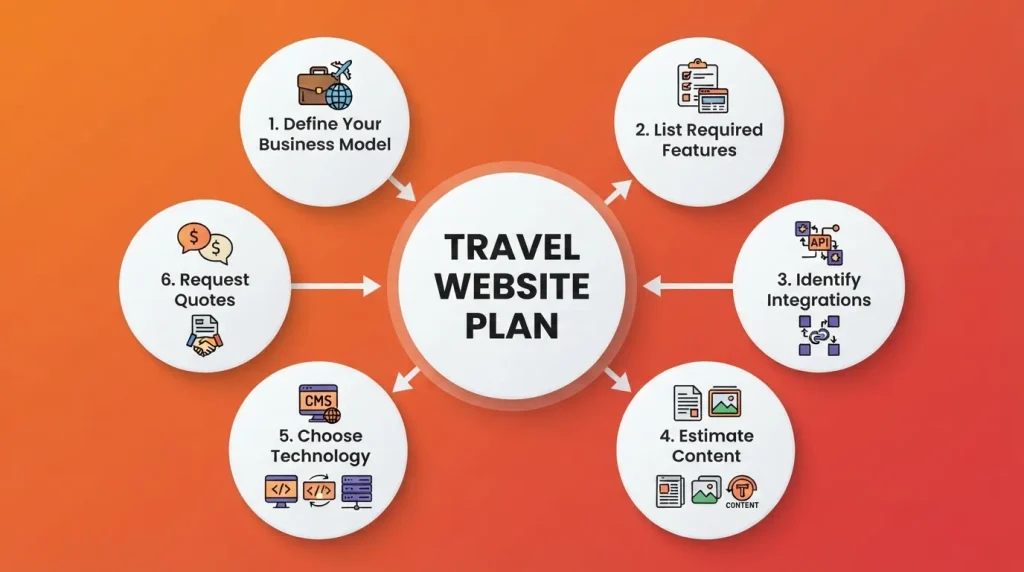
This helps you compare similar proposals instead of random prices.
Build a Website Around Your Business Goals
The right travel website is rarely the one with the most features. It’s the one that helps the right customers discover you, trust you, and take the next step.
At Daigency, we help travel businesses plan and build websites around their actual requirements, from professional informational sites to advanced booking platforms, including UI/UX design, custom development, CMS setup, integrations, booking functionality, and SEO.
Ready to plan your travel website?
Tell us your goals, features, and budget, and we’ll help you plan the right solution.
Conclusion
Travel website costs range from a few hundred dollars to six figures because “travel website” can describe very different projects. A simple site that presents destinations and collects enquiries sits at the lower end. Once you add online booking, payments, live availability, supplier APIs, or marketplace features, complexity and cost rise quickly.
Start by deciding what your website needs to accomplish: how customers will find you, what they need to know, how they will book, and which tasks you want to automate. Once your scope is clear, you can choose the right technology without spending on features your business doesn’t need.
FAQs - Travel Website Cost
- How much does a travel website cost in 2026?Roughly $500 to $100,000+, depending on type, design, functionality, and integrations. Most professional agency websites fall between $3,000 and $15,000.
- How much does a travel agency website cost?A basic professional site typically costs $1,000–$4,000, and a custom agency website costs $4,000–$12,000.
- How much does a travel booking website cost?Usually $10,000 to $30,000+, depending on the booking workflow, payment system, availability management, and integrations. Platforms with real-time inventory can cost more.
- How much does a travel marketplace cost?Typically $30,000 to $100,000+, because it needs vendor dashboards, commission management, listings, reviews, and payments.
- What is the most expensive part of a travel website?Custom booking workflows, real-time availability, supplier and GDS integrations, dynamic pricing, and dashboards are the biggest cost drivers.
- Can I build a travel website without online booking?Yes. Many agencies take bookings through forms, phone, WhatsApp, or email. Online booking is only necessary if it fits your business model.
- Do I need GDS or API integration?Only if you need external inventory such as live flight or hotel availability. A site selling your own packages doesn't.
- Is WordPress good for a travel website?Yes. It offers flexible content management, SEO tools, and a large plugin ecosystem. Advanced booking may need specialized plugins or custom development.
- What other costs should I consider besides development?Domain, hosting, security, maintenance, content updates, SEO, payment fees, and API charges. Plan about 10–20% of the development cost per year for maintenance.
- Is SEO included in website development?Basic technical SEO often is. Keyword research, content strategy, link building, and ongoing SEO usually cost extra.
- How long does it take to build a travel website?Basic sites take 2–6 weeks, agency sites 4–12 weeks, and booking platforms or marketplaces several months or longer.
- Can I build a travel website for under $1,000?Yes, with a DIY builder or simple template. But a highly customized site with booking or integrations is unlikely to fit that budget.
- How can I reduce development costs?Focus on essential features, use a CMS, prepare content early, plan integrations upfront, and add advanced functionality in phases.