
Quick answer: In 2026, an e-commerce website in the UAE costs AED 8,000–19,000 for a basic store, AED 20,000–55,000 for a professional store, and AED 60,000–180,000+ for a marketplace or custom platform. Most small and mid-sized UAE businesses land between AED 20,000 and 55,000 once payment gateways, Arabic support and shipping are included. Budget another 15–20% of the build cost per year for maintenance and hosting.
If you have contacted a few web design agencies in Dubai, Sharjah or Abu Dhabi for an e-commerce website, you may have noticed a big difference in their quotes. One agency might charge AED 5,000, while another asks for AED 50,000 for a store that looks quite similar at first glance.
So, why is there such a big difference in price? In most cases, it comes down to what each agency is offering. One might use a ready-made theme, while another builds a custom design. The number of products, payment methods, delivery options, Arabic language support and ongoing maintenance can also affect the final cost.
In this guide, we will break down e-commerce website development costs in the UAE for 2026, explain what you get at different price points and cover the extra expenses you should consider before starting your project.
E-commerce Website Cost in the UAE at a Glance
| Store type | Cost (AED) | Typical timeline | Best for |
|---|---|---|---|
| Basic online store | 8,000–19,000 | 2–4 weeks | First-time sellers with up to around 100 products and a ready-made theme |
| Professional e-commerce store | 20,000–55,000 | 4–10 weeks | Established businesses needing custom design, Arabic and English support, BNPL and delivery integrations |
| Marketplace / custom platform | 60,000–180,000+ | 3–8 months | Businesses with multiple sellers, large product catalogues or complex ERP and CRM requirements |
These figures are estimated planning ranges for businesses in the UAE, rather than fixed agency prices. Your actual cost will depend on the platform you choose, the features you need and the amount of work involved.
What You Actually Pay For in an E-commerce Build
When you receive a quote from a web development agency, it helps to know exactly where your money is going. A proper quotation should explain the main costs instead of giving you one total without any details.
Here is an example of how a mid-range e-commerce project with a budget of around AED 25,000 might be broken down.
| Line item | Typical range (AED) |
|---|---|
| UI/UX design (theme customisation or custom design) | 4,000–8,000 |
| Front-end and back-end development | 8,000–14,000 |
| Payment gateway setup and testing (per gateway) | 1,500–3,000 |
| Shipping/courier integration | 1,500–3,000 |
| Product upload, categories and basic content | 1,000–3,000 |
| Arabic / RTL setup (if needed) | 3,000–6,000 |
| QA testing, launch and training | 1,000–2,000 |
These are illustrative estimates, and the actual breakdown will vary depending on the project. Some tasks may also be included within the development fee rather than charged separately.
If an agency in Dubai or elsewhere in the UAE gives you a single lump-sum price, ask for an itemised quotation. It makes it much easier to compare offers and spot anything that has been left out.
Ready to Launch Your Online Store in 2026?
Turn your e-commerce idea into a professional online store and discuss your website requirements and development budget.
What every e-commerce quote should include
Even if you are starting with a small online store, there are a few things you should expect from your development package:
- A CMS or admin panel so you can manage products, prices and orders yourself.
- SSL and HTTPS to help protect information exchanged between your website and its visitors.
- A mobile-friendly design that works properly on phones, tablets and desktops.
- Help uploading your initial products and basic training on how to manage the store.
- Basic on-page SEO, including clean URLs, meta titles, meta descriptions and a proper heading structure.
- A post-launch bug-fix warranty. A period of 30–90 days is a useful benchmark to discuss with your agency.
Make sure these items are confirmed in writing before you agree to the project.
What Factors Affect the Cost of an E-commerce Website in the UAE?
Platform
The platform you choose has a direct impact on the initial development cost and how much you spend maintaining your store later.
| Platform | Approx. build cost (AED) | Best for | Main trade-off |
|---|---|---|---|
| Shopify | 8,000–30,000 | Quick launches and small to medium product catalogues | Monthly subscription and app fees can increase over time |
| WooCommerce (WordPress) | 8,000–35,000 | Businesses wanting more control or already using WordPress | Hosting, plugins, updates and security require ongoing attention |
| Magento / Adobe Commerce | 40,000+ | Large catalogues and complex inventory requirements | Powerful but expensive, and often unnecessary for smaller stores |
| Fully custom (React, Next.js, Laravel, etc.) | 60,000+ | Businesses with unique workflows or complex ERP/CRM requirements | Greater flexibility but higher development and maintenance costs |
For many small businesses in Dubai, Shopify is a practical option when the priority is to get selling quickly. WooCommerce can be a better fit if you already use WordPress or want more control over your website.
Custom development is worth considering when ready-made platforms cannot handle your business requirements properly. Before finalising your budget, check the platform’s current pricing because subscription plans and app charges can change.
Template vs custom design
A ready-made theme is often the more affordable choice, and it can still give your store a clean, professional appearance. Depending on the project, using a suitable theme can reduce design costs by 30% or more compared with a fully custom approach.
Custom design takes more time because the pages, layouts and user experience are developed around your brand. For businesses selling luxury products, fashion, premium food or other competitive products, that extra investment may be worthwhile.
Catalogue size
The number of products you sell also affects the amount of work involved.
Adding 50 products to a new store is relatively straightforward. Importing 5,000 products, each with different SKUs, sizes, colours, variations and stock details, requires more preparation and testing.
If you already have product data in a spreadsheet or another system, share it with your agency before the project begins. It may help reduce the time needed for product uploads.
Features
A basic store with product pages, a shopping cart and checkout will usually cost less than one with advanced features.
Product filters, customer reviews, wishlists, subscriptions, loyalty programmes, multiple currencies and ERP integrations can all increase development time. Instead of adding everything at launch, focus on the features your customers actually need and introduce additional functionality as your business grows.
Content
Website content is another cost that businesses sometimes overlook.
Product photography, descriptions, category pages, banners and promotional copy may not be included in your development package. If you need an agency to create these materials as well, ask for the additional charges before work starts.
Preparing your product information and images in advance can help keep the project on schedule and within budget.
Hidden Costs in UAE E-commerce Most Guides Skip (Payments, Arabic, VAT)
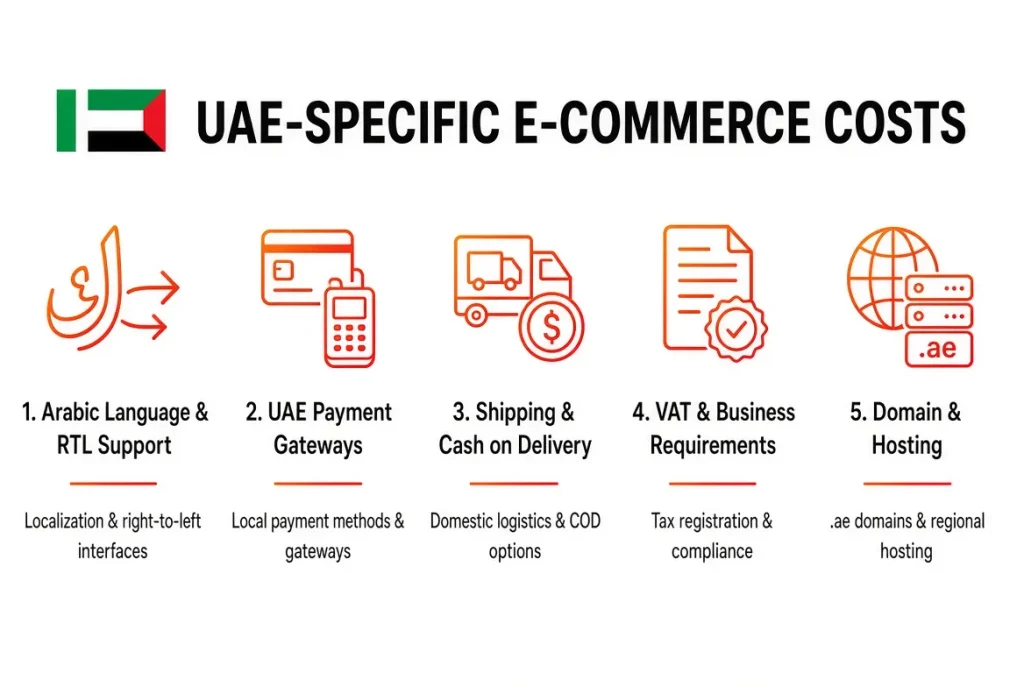
Building an online store for customers in the UAE involves more than choosing a platform and designing a few pages. Payment preferences, delivery arrangements, Arabic support and local business requirements should all be considered before launch.
Payment gateways and BNPL
Customers shopping online in the UAE expect convenient payment options. Depending on your target audience, you may want to accept debit and credit cards, Apple Pay and buy-now-pay-later payments.
Common payment providers and services to explore include Telr, PayTabs, Network International, Stripe, Tabby and Tamara. Availability, eligibility and supported payment methods depend on the provider and your business setup.
For planning purposes, payment gateway integration and testing may cost around AED 1,500–3,000 per gateway. This is separate from the provider’s transaction charges and any applicable monthly fees.
Before choosing a provider, compare its pricing, settlement times, supported payment methods and business approval requirements. A slightly cheaper integration is not necessarily the best option if the payment service does not meet your needs.
Shipping, couriers and cash on delivery
Delivery is an important part of the online shopping experience, particularly for businesses serving customers across Dubai, Sharjah, Abu Dhabi and other Emirates.
Depending on your business model, you may need courier integrations with providers such as Aramex or local delivery companies. Features such as automatic shipping rates, tracking updates, delivery notifications and cash-on-delivery order handling can add to the delivery app development cost.
If you plan to offer same-day delivery in Dubai or serve customers across the UAE, discuss your delivery process with the developer before finalising the website requirements.
Arabic and RTL support
If your business serves both Arabic- and English-speaking customers, it is worth planning for both languages from the beginning.
Arabic support involves more than translating the website’s text. Page layouts need to work from right to left, fonts must display correctly, and menus, product pages, forms and checkout need to be tested in both languages.
Depending on the amount of work involved, Arabic and RTL implementation may add around AED 3,000–6,000 to the project. Adding it after the English website has already been built can require additional design and development work.
VAT, licence and legal pages
Businesses selling online in the UAE should understand the local tax and licensing requirements that apply to their activities.
The UAE’s standard VAT rate is 5%, where applicable. Your website’s pricing, invoices and tax settings should reflect your business’s VAT registration status and relevant requirements.
You may also need a valid trade or e-commerce licence from the relevant mainland or free zone authority. Privacy policies, terms and conditions, and returns and refund policies should be prepared according to your e-commerce business guide and applicable regulations.
Requirements can vary depending on your activity and licensing authority, so confirm the details with the relevant authority or a qualified accountant before launching.
Domain
Your domain is another small but necessary expense. A .com domain will often cost less than AED 150 per year, depending on the registrar and renewal price.
If you want a .ae domain for your UAE business, register through a provider accredited by the .ae Domain Administration (.aeDA), under the Telecommunications and Digital Government Regulatory Authority (TDRA).
Check the renewal price as well as the first-year price, especially if your registrar offers a discounted introductory rate.
Get the Right E-commerce Solution for Your Budget
From a small online shop to a feature-rich e-commerce platform, Daigency can help you plan your next step.
Ongoing Cost Impact of Running an E-commerce Website in the UAE
What Year Two Looks Like
Your website development bill is only part of the overall investment. Once the store is live, you will still need to account for hosting, renewals, maintenance, payment fees and marketing.
Here is a general estimate of the recurring costs you may face.
| Ongoing cost | Typical range |
|---|---|
| Hosting | A few hundred AED per year for basic shared hosting; AED 1,500–5,000+ per year for managed or cloud hosting for busier stores |
| Domain and SSL | Often under AED 150 per year for a .com domain; SSL is frequently included with hosting |
| Maintenance (updates, backups, security and bug fixes) | Around 15–20% of the build cost per year as a planning benchmark, or roughly AED 500+ per month for small stores |
| Plugins and apps (reviews, email and chat) | AED 2,000–15,000 per year, depending on the tools used |
| Payment gateway fees | Transaction-based charges, sometimes with an additional monthly fee |
| SEO and advertising | A separate budget, often AED 2,000+ per month |
These figures are estimates rather than fixed rates. Your actual expenses will depend on the platform, website traffic, integrations and services you use.
Maintenance is one area where cutting costs can backfire. An outdated plugin on a WooCommerce website can create security problems or cause checkout issues. If customers cannot complete their orders during a busy sales period, the lost revenue may outweigh what you would have spent on regular maintenance.

How Much Will Your Store Actually Cost? 3 Typical Budget Scenarios
To make the numbers easier to understand, let’s look at three common situations for businesses planning an e-commerce website in the UAE.
| Scenario | Year 1 all-in (AED) | Year 2+ (AED/year) |
|---|---|---|
| Starter store: Shopify or WooCommerce, template design, 20–50 products and one payment gateway | 10,000–22,000 | 3,000–8,000 |
| Growing brand: Custom-designed store, 100–500 products, two payment options including BNPL, and Arabic/English support | 28,000–60,000 | 8,000–15,000 |
| Marketplace or custom build: Multi-vendor functionality or headless architecture, ERP integration and high traffic | 70,000–180,000+ | 15–20% of build cost |
These budgets are intended for planning and comparison. Actual costs can vary, and some expenses, such as advertising, transaction fees or major feature upgrades, may fall outside these estimates.
When comparing agencies in Dubai or elsewhere in the UAE, look at the expected cost over two years rather than focusing only on the initial development fee. This gives you a clearer picture of what each option will actually cost your business.
How Long Does It Take?
The time required to build an e-commerce website depends on its size, functionality and how quickly you can provide the information your developer needs.
| Project | Typical timeline |
|---|---|
| Basic online store | 2–4 weeks |
| Professional e-commerce store | 4–10 weeks |
| Custom web application | 2–6 months |
| Marketplace | 3–8 months or more |
These timelines assume that the project scope is reasonably clear and that the necessary content and approvals are available.
Delays often happen because product information is incomplete, design approvals take longer than expected or payment gateway accounts are not ready. If you are planning a launch around Ramadan, Eid, the Dubai Shopping Festival or another busy sales period, give yourself enough time for development, testing and final changes.
It is also a good idea to start your payment gateway application early, as approval times can vary between providers.
8 Ways to Reduce Your E-commerce Website Cost
You do not need to spend a huge amount to launch a useful online store. A few practical decisions can help you manage your budget without compromising the shopping experience.
- Launch with the essentials. Start with product pages, a shopping cart, checkout and one or two suitable payment methods. Add advanced features when there is a clear reason to do so.
- Use a quality theme. A well-designed theme can save 30% or more compared with a fully custom design, depending on your requirements.
- Pick the right platform. Shopify or WooCommerce may be enough for your business. Avoid investing in an expensive custom platform if a standard solution can handle your needs.
- Prepare content early. Have your product photos, descriptions, prices and category information ready before development begins. This helps avoid unnecessary delays and extra charges.
- Build in phases. You can add loyalty points, subscriptions, advanced filters and other features after you have a better understanding of customer behaviour.
- Use free or low-cost plugins carefully. Choose reliable tools and avoid installing unnecessary plugins. Too many poorly maintained plugins can affect website performance and security.
- Apply for gateway accounts early. Payment provider approval can take days or weeks, so do not leave it until the website is almost ready.
- Choose a team that stays after launch. A slightly higher initial quote may offer better value if it includes reliable support, security updates and ongoing assistance.
The aim is not simply to spend less. It is to invest in the parts of your website that will help your business sell more effectively.
9 Questions to Ask Before You Sign With Any Agency
Before choosing an e-commerce development company in Dubai, Sharjah, Abu Dhabi or another part of the UAE, take the time to understand exactly what you are paying for.
These questions can help you make a more informed decision.
- Is the design based on a ready-made theme or will it be created specifically for my brand?
- Which payment gateways and shipping integrations are included in the quote?
- Is Arabic and RTL support included in the price, or will it cost extra?
- Who will own the domain, hosting accounts, design files and source code after launch?
- Is the quotation fixed-price, or will the final bill depend on the hours worked?
- What does post-launch support cover, and how long does it last?
- How much will monthly maintenance cost once the warranty ends?
- Who will upload the products, and will training be provided?
- Can you show me e-commerce projects similar to my business?
A lower quotation may look attractive at first, but the total can increase if important features and services are excluded. Compare the scope, support and long-term costs before making your decision.
Which Option Is Right for You?
The right choice depends on your business goals, available budget and the kind of shopping experience you want to offer.
- Testing a product idea? A basic Shopify or WooCommerce store costing around AED 8,000–19,000 may be a sensible starting point.
- Running an established brand with a larger catalogue? A professional store costing AED 20,000–55,000 can accommodate more customised design, Arabic and English support, and additional payment options.
- Planning a multi-vendor marketplace or a platform with complex integrations? A custom solution or marketplace costing AED 60,000–180,000+ may be more appropriate.
You do not necessarily need the most expensive website to compete in the UAE market. A store that loads quickly, displays products clearly and makes checkout easy can provide a better experience than a more complicated website filled with features customers rarely use.
Partnership with Daigency
Planning an online store for your business in Dubai, Sharjah, Abu Dhabi or elsewhere in the UAE? Daigency can help you choose a suitable platform, plan the features you need and understand the likely development cost before the project begins.
We build Shopify, WooCommerce and custom e-commerce websites for businesses looking to establish or grow their online presence. Whether you are launching your first store or upgrading an existing website, the aim is to create a store that fits your business requirements and gives your customers a smooth shopping experience.
Share your product count, preferred platform and must-have features with our team, and we will prepare an itemised estimate based on your requirements.
Ready to Build Your E-Commerce Website?
From simple store setups to advanced multi-vendor platforms, we build fast and responsive e-commerce websites designed to generate real sales. Partner with Daigency for modern website development in Dubai & UAE.
Conclusion
Do not start by choosing a budget. First, think about what your customers need to browse, trust, and buy from your business. A simple online store with a clean design and an easy checkout can perform better than a website with too many features that is difficult to use.
Build what your business needs today and leave space to add more features later. Your website is also only one part of your online plan. SEO and digital marketing are also important if you want to reach more customers and compete in the growing e-commerce industry.
FAQs- E-commerce Website Cost
- How much does a website cost in the UAE in 2026?
A website can cost anywhere from AED 1,500 for a basic business website to AED 180,000+ for a custom platform or marketplace. Most small businesses may spend around AED 5,000 to 13,000.
- Is Shopify or WooCommerce cheaper?
Both can have a similar starting cost. Shopify has subscription and app fees, while WooCommerce has costs for hosting and premium plugins. The better option depends on how you plan to use the website.
- How much does an e-commerce website cost in UAE?
An e-commerce website development cost in UAE can be around AED 8,000–55,000+, depending on the number of products, design, payment gateways, shipping, website features, and custom functionality.
- Do I need Arabic language support?
Not always. However, if many of your customers speak Arabic, it is better to include Arabic language and RTL support from the beginning.
- Does website development include hosting and domain?
Not always. Some agencies include them in their packages, while others charge separately. It is better to confirm this before starting the project.
- How can I keep costs down without hurting quality?
Start with the important features, use a good ready-made theme instead of a fully custom design when suitable, and add advanced features in phases as your business grows.
- How long does an e-commerce site take to build?A basic online store can take around 2–4 weeks, while a professional store can take 4–10 weeks. A fully custom website with advanced integrations can take 2–6 months.
- Do I need a trade licence to sell online in the UAE?
In general, businesses carrying out online commercial activities in the UAE need an appropriate licence. The specific requirements depend on your business activity and whether you operate through a mainland or free zone authority. Check the current requirements with the relevant licensing authority before launching. This information is for general guidance and is not legal advice.
- Can I build an e-commerce website on a small budget?
Yes. You can start with a suitable Shopify or WooCommerce theme, a manageable product catalogue and the essential payment and delivery options. You can then add advanced features as your business grows. When comparing low-cost offers, make sure the quotation covers the basics, including checkout, mobile responsiveness, product uploads, training and post-launch support.
- How much does it cost to add Tabby or Tamara?
Payment integration and testing may cost around AED 1,500–3,000 per provider, depending on the website and integration requirements. This does not include the provider's merchant fees or other applicable charges. Before development begins, check the provider's eligibility requirements, approval process and transaction fees to make sure the service suits your business.
- How much does website maintenance cost?
A common budgeting benchmark is around 15–20% of the original development cost per year. For a small store, maintenance packages may start at roughly AED 500 per month, depending on what is included. Maintenance can cover updates, backups, security checks, bug fixes and technical support. Stores with complex integrations or higher traffic may require a larger budget.