
Ordering food online has become part of everyday life in the UAE. Apps like Talabat, Deliveroo, and Careem. Food have made people used to convenient ordering, fast delivery, easy payments, and live order tracking. As online food delivery continues to grow, restaurants, cloud kitchens, home chefs, and startups have a good opportunity to enter this digital ecosystem with their own food delivery app or digital platform.
Before hiring a development team, however, there are three things you need to know: How much will the food delivery app development cost? How long will the app development process take? And which app features are really needed? The final app development cost depends on factors such as the technology stack, development requirements, platform, features, and regional development rates.
This guide explains the food delivery app development cost in the UAE, important features, technology requirements, development process, and other factors you should consider. Whether you operate a local restaurant, quick service restaurant, food service business, grocery chain, or startup, it can help you understand the investment and plan your food delivery business.
How Much Does a Food Delivery App Cost in the UAE?
There is no fixed price for a food delivery application. The app prices depend on how many apps you need, how complex the features are, and who develops the product. Here is a general estimate:
| App Type | Estimated Cost | Development Time |
| Basic MVP | AED 35,000 – 100,000 | 3–4 months |
| Mid-level multi-restaurant app | AED 100,000 – 210,000 | 4–7 months |
| Advanced multi-vendor platform | AED 220,000 – 480,000+ | 6–10 months |
A basic MVP includes the main functions such as browsing restaurants, placing orders, online payments, and delivery tracking. A mid-level app can support multiple restaurants, promotions, and reviews. An advanced platform normally includes separate apps for customers, restaurants, and riders, along with real-time GPS, analytics, and loyalty programs.
These average app prices are only a starting point. Your actual development budget can change depending on the business model, app features, technology requirements, and development rates.
What a Complete Food Delivery Platform Includes
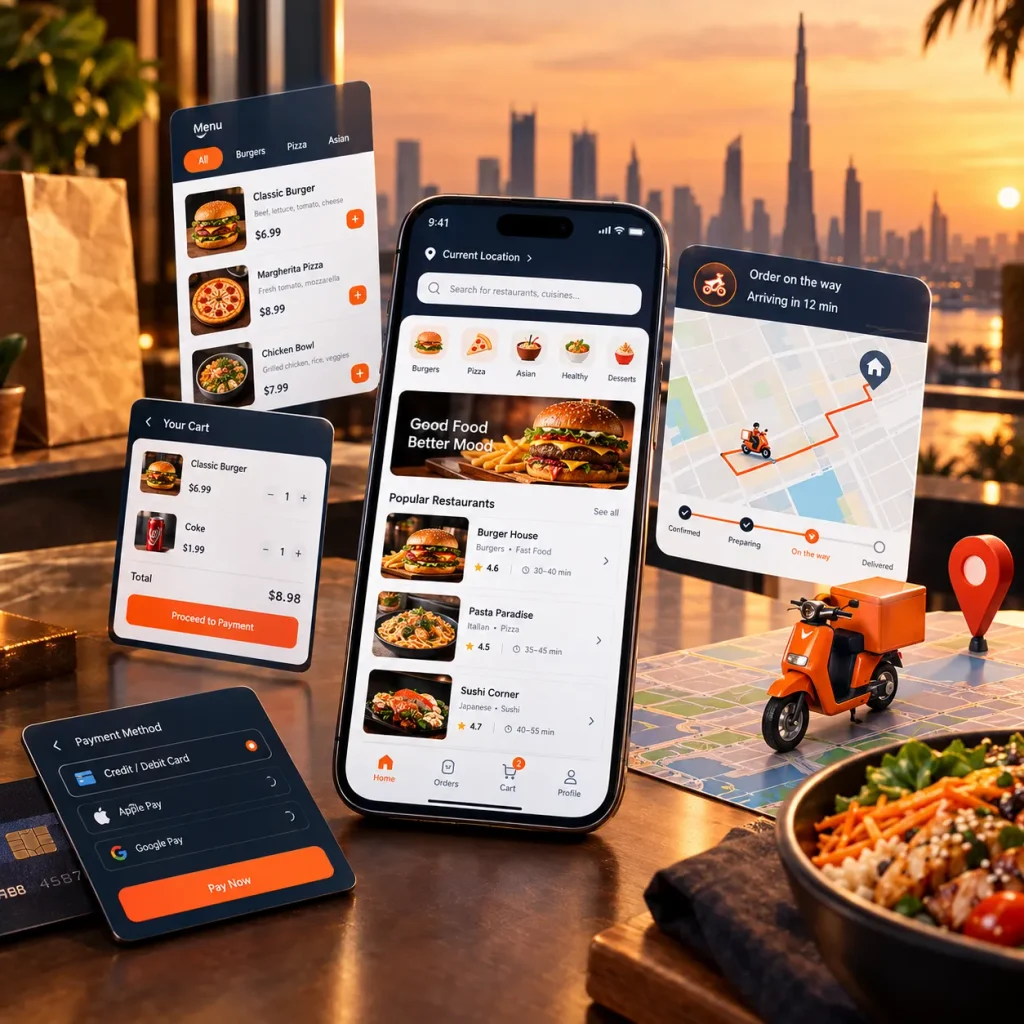
When people think about a food delivery app, they usually think about the customer mobile app. In reality, a complete food delivery platform can include four connected systems:
- Customer App – restaurant browsing, food ordering, payments, live tracking, and order history
- Restaurant Panel – menu and price updates, order acceptance, and earnings reports
- Rider App – order requests, navigation, delivery status, and earnings tracking
- Admin Dashboard – user management, commissions, payments, and promotions
Building all four parts requires more app development services than creating a single mobile application. However, each part plays an important role in smooth delivery management.
Choosing the Right Business Model
Before starting the app building process, decide which food delivery business model fits your idea:
- Multi-restaurant marketplace – customers can order from different restaurants, similar to Talabat
- Restaurant-owned app – created for one restaurant brand or chain
- Cloud kitchen app – designed for delivery-only food businesses
- Subscription meal app – customers pay for regular or recurring meal plans
- Niche delivery app – focused on a specific category such as healthy food, home chefs, or corporate lunches
Trying to copy a large food delivery platform feature-for-feature is not always a good approach. The market already has established names such as Talabat, Deliveroo, Careem Food, Uber Eats, DoorDash, and Glovo. A more focused idea, such as faster delivery in a specific area, home-cooked meals, or corporate ordering, can give a new food business a clearer position.
Must-Have Features for Food Delivery App

Customers Side: restaurant search, digital menus, one-tap cart, multiple payment options including cash on delivery, live tracking, ratings, promo codes, saved addresses, and reorder.
Restaurants Panel: menu and price control, order management, availability toggle, and sales reports.
Riders App: order requests, GPS navigation, delivery status updates, and earnings history.
Admins Dashboard: control over users, orders, commissions, payments, and promotions.
These food delivery app features form the basic food ordering system and help connect customers, restaurants, riders, and administrators.
UAE-Specific Details That Matter
A food delivery app in UAE needs to fit the local market instead of using a one-size-fits-all approach. A few details can make the user experience more suitable:
- Arabic and English support, including proper RTL layout, should be planned from the beginning
- AED-based payments should support cards, digital wallets, and cash on delivery
- Scheduled orders, Ramadan delivery timing, corporate ordering, and location-based offers can support local customer needs
Planning these requirements during the design stage is usually easier and more cost-effective than adding them after launch.
What Drives the Cost Up or Down?
| Feature | Cost Impact |
| Registration, menu, cart | Low |
| Online payments, reviews | Medium |
| In-app chat, loyalty programs | Medium |
| Live GPS tracking | High |
| AI recommendations, advanced analytics | High |
| Multi-vendor management | High |
Real-time functions such as live tracking, AI-based suggestions, and smart matching can increase the app development cost because they require more advanced technology and development work.
Other factors that affect your development budget include:

The factors that affect your development are given below:
- App complexity – the number of user roles and screens
- Platform choice – native iOS/Android or cross-platform development
- Third-party integrations – payment gateways, maps, OTP, and notifications
- Team location and experience – lower development rates do not always mean lower long-term costs if poor work creates rework
Custom App vs. White-Label Solution
| Option | Cost | Best For |
| White-label | Lower | Launching quickly and testing an idea |
| Clone solution | Medium | Following a proven business model |
| Custom-built | Higher | A unique and scalable long-term platform |
A white-label solution can be useful when the main goal is to test the market quickly. For a food delivery business that plans to grow for years, custom development gives more control over the technology stack, features, and future expansion.
Hidden Costs After Launch Food Delivery App
The initial food delivery app development cost is not the only expense. You should also plan for:
- Cloud hosting and server fees
- Payment gateway charges
- Maps and location API usage
- SMS/OTP costs
- Ongoing maintenance and bug fixes
- Customer support and marketing
These hidden costs are often missed when businesses prepare their app budget. Including them in your budget planning from the beginning can make future expenses easier to manage.
How to Build Food Delivery App- Step by Step Guide
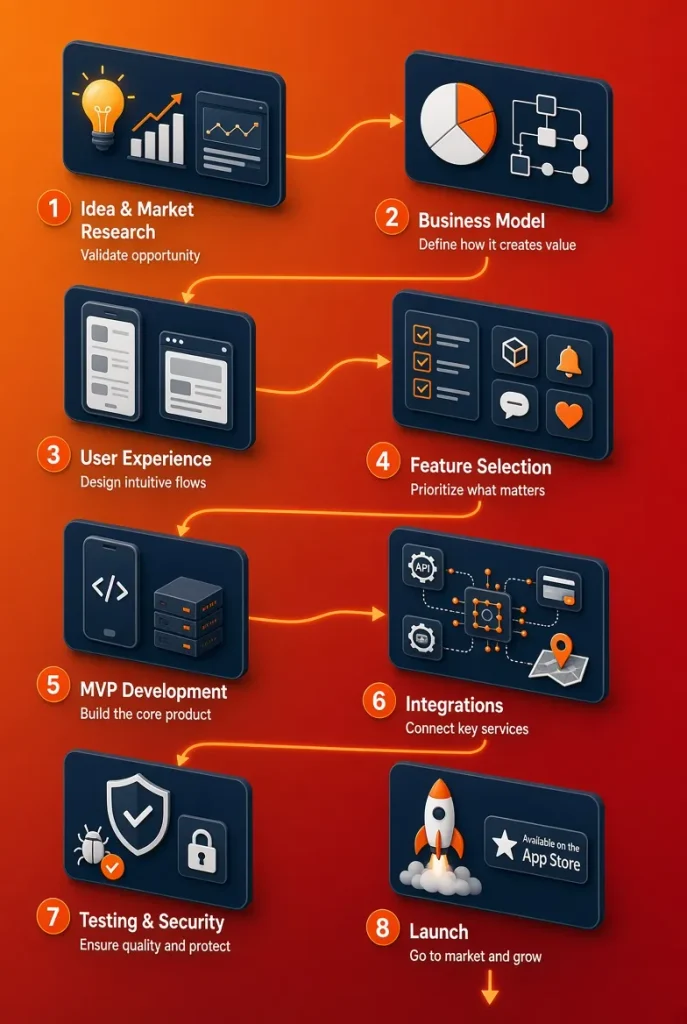
The process of food delivery app are following below:
- Define your target market and the problem you are solving
- Choose your business model, such as marketplace, single-restaurant, subscription, or niche
- Map the customer, restaurant, rider, and admin experience
- Select only the app features users need at launch
- Design a simple and fast checkout flow
- Build and launch an MVP first
- Add payments, maps, and notifications
- Test payments, tracking, and security before going live
Starting with an MVP and improving it through real user feedback can be more practical than trying to build a perfect food delivery application from the beginning.
Real Challenges to Expect for Food Delivery App
- Convincing restaurants to join a new platform
- Keeping delivery costs sustainable
- Retaining customers after launch discounts end
- Handling peak-hour order spikes
- Scaling the backend as order volume grows
These challenges cannot be solved through app development alone. Strong delivery operations and a clear business plan are also important for long-term growth.
Choosing a Development Partner
Do not choose a development partner only because of the lowest price. Look at their experience with marketplace apps, payment integrations, scalable backends, and food delivery projects. You should also ask about post-launch support, security, and maintenance.
Daigency helps businesses build fast, secure, and scalable food delivery apps in the UAE. From customer and restaurant apps to rider panels, payments, GPS tracking, and admin dashboards, our team handles the complete app development process. We focus on simple user experiences, reliable technology, and solutions that can grow with your food delivery business. A team that understands your food delivery business model and development requirements can be more valuable than a company that only focuses on your feature list.
Your food delivery business needs more than an app. It needs a platform built for growth
Grow your visibility, performance, and digital marketing strategies.
Final Thought
A successful food delivery app is not only about writing good code. Clear positioning, reliable delivery services, smooth delivery management, and a business model that can generate revenue are equally important.
For many businesses entering the UAE food delivery industry in 2026, starting with a focused MVP and then improving it based on real customer feedback is a practical way to manage app investment and support future business expansion.
FAQs- Food Delivery App
- How much does a food delivery app cost in the UAE in 2026?A basic MVP can cost around AED 35,000, while an advanced multi-vendor platform can reach AED 480,000 or more. The final cost depends on features, integrations, platform choice, and development requirements.
- How long does development take?A basic MVP may take around 3–4 months. A complete multi-vendor platform with live tracking and separate apps can take around 6–10 months.
- Can I build an app like Talabat?Yes, it is technically possible. However, copying an established platform exactly may not be the best strategy. A specific niche, location, or customer need can give your app a stronger position.
- Do I need separate apps for customers and riders?For a full marketplace, separate customer and rider apps are usually better because their workflows are different. This helps provide a clearer experience for both users.
- How do food delivery apps make money?Food delivery businesses can earn through restaurant commissions, delivery fees, subscriptions, featured restaurant listings, and in-app advertising. Many platforms use a combination of these revenue sources.
- Is a white-label app a good starting point?Yes, if your main goal is to test the market quickly and with a lower initial investment. For a long-term and highly customized food delivery platform, custom development can provide more flexibility.