
Quick answer: The junk removal app cost usually falls between $15,000 and $260,000+, depending on what you need the software to do. A lean booking and online quote app can start around $15K–$35K. A complete MVP with dispatch management, a crew app, online payments and customer notifications typically costs $45K–$100K. A full platform with route optimization, truck capacity management, disposal tracking and multi-location reporting can reach $120K–$260K+. Budget around 15–25% of the original build cost each year for maintenance, updates and support.
Market Size:
The global junk removal franchise market Size Expected to Grow from USD 1220.6 million in 2026 to USD 3489.37 million by 2035, at a CAGR of 12.5% during the forecast period 2026-2035.
These are industry estimates rather than fixed quotes. Your final cost depends on the features you need, the platforms you choose, your development team’s location and how clearly the scope is defined. This guide breaks down those factors so you can plan a realistic budget whether your business operates in the US, Canada, UK or UAE.
If you’re also considering a website, check out our guide on How Much Does a Junk Removal Website Development Cost to understand your potential investment.
Junk Removal App Cost at a Glance in 2026
| App type | What’s included | Estimated cost | Timeline |
|---|---|---|---|
| Lean MVP | Online quote form, booking, notifications, simple admin panel | $15,000 – $35,000 | 2–3 months |
| Standard MVP | Quote calculator, photo upload, booking with time windows, dispatcher dashboard, crew app, payments | $45,000 – $100,000 | 3–5 months |
| Full platform | Adds route optimization, truck capacity, disposal tracking, multi-location reporting | $120,000 – $260,000+ | 6–12 months |
| AI layer (add-on) | Photo-based volume estimation, demand forecasting, analytics | +$35,000 – $90,000+ | 2–3 months |
Some operators also consider an “Uber for junk” marketplace, where customers request a pickup and independent haulers claim jobs. That is a much larger two-sided platform: it needs a customer app, hauler app, admin panel, payouts, ratings and job management, so the budget normally reaches the upper end of the range or beyond.
Why a Junk Removal App Costs Different From a Regular Booking App
A generic booking app does not match the way junk removal companies price and manage jobs. Pricing is based on volume, not time. Companies usually charge by how much space the load takes in the truck: a quarter, half, three-quarter or full truck, plus charges for specific items or disposal requirements. Volume-based pricing needs to be part of the system rather than handled manually.
Customers cannot accurately estimate volume. Someone may say “about half a truck,” and the crew arrives to find a full load that needs a second trip. Photo-based estimating gives the dispatcher a better starting point before confirming the price. Every route can include a disposal stop. Once a truck is full, the crew may need to visit a landfill, transfer station, recycler or donation facility before the next job. Scheduling must consider disposal stops, facility hours and truck capacity rather than treating each appointment as isolated.
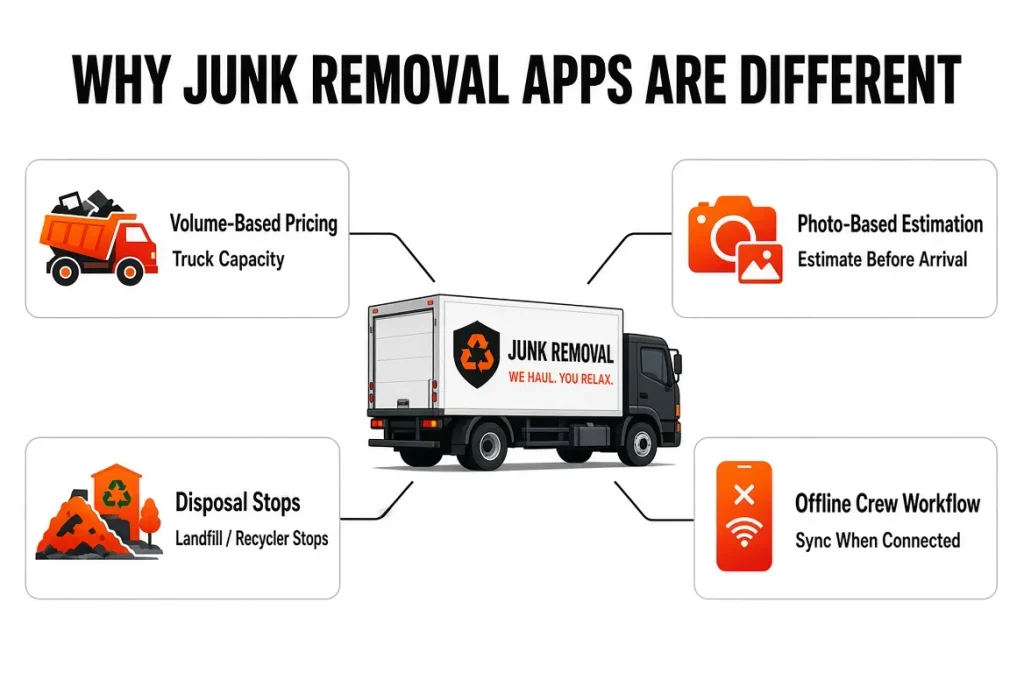
Crews do not always have internet. Basements, storage facilities, alleys and rural areas create connectivity problems. Offline functionality lets the crew app save job details, photos and notes on the device and sync them later. These details make junk removal software more specialized than a standard appointment app. They also explain why a proper junk removal app development project can cost more than a simple booking system.
Junk Removal App Features: MVP, Scale and Optimization
Phase 1: Must-have features (MVP)
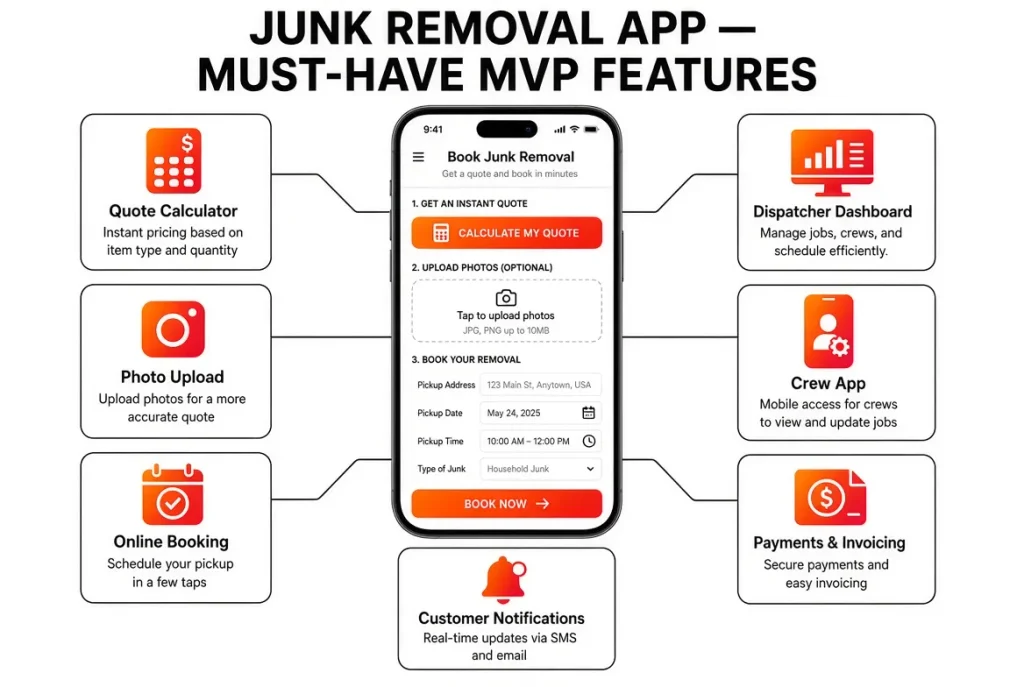
Online quote calculator: Customers select items or a truck-load size and receive a price range. Pricing logic should support configurable rates by market, item type, truck fraction and surcharge instead of one fixed price.
Photo upload for estimates: Customers submit photos of the junk so the dispatcher can review expected volume. This is a practical form of digital quoting and improves pricing accuracy before a crew arrives.
Online booking with time windows: Customers choose available 2–4 hour arrival windows and get confirmation without waiting for a callback.
Dispatcher dashboard: A central view of jobs, trucks, crews, locations and status. It becomes especially useful as the business moves from one or two vehicles to a larger truck fleet, and it replaces the whiteboards and spreadsheets many dispatchers rely on today.
Crew mobile app: Job details, navigation, gate codes, customer notes, arrival confirmation, before-and-after photos and completion details from the field.
Payments and invoicing: Online payment and card-on-site collection, with completed jobs triggering automated invoices and payment records.
Customer notifications: SMS and email for booking confirmation, reminders, “on the way” updates and receipts.
Phase 2: Scale features
Route optimization: Sequences stops using job locations, time windows and truck capacity. For a growing operation, this can be one of the largest development items because several variables move at once, including disposal stops and same-day additions.
Truck capacity management: Dispatchers see how much space remains in each truck before adding a same-day booking, preventing overbooking and overloaded jobs. Disposal and recycling tracking: Crews record where each load went. Tip fees and disposal costs are then tied directly to the relevant job.
Regulated item handling: Flags items such as e-waste, tires, paint, batteries and refrigerant appliances so crews know when special rules apply.
Multi-location and franchise reporting: Compare revenue, jobs and crew performance across locations.
Recurring jobs: Property managers, real estate agents, contractors and storage facilities generate repeat work. Recurring job management makes it easier to schedule those services without recreating every booking manually.
Phase 3: Optimization
AI photo estimation: Once you have enough reviewed photos and confirmed volumes, an AI estimator can be trained to help predict load size. Real operational data matters more than building AI early. Demand forecasting: Historical bookings help forecast busy periods and plan crews.
Retention tools: Follow-ups, referral tracking and repeat-booking campaigns help turn one-time customers into repeat customers, which is far cheaper than buying new leads.
Analytics: Reporting on margin by job type, disposal cost by material, average ticket size and crew productivity shows where the operation is making or losing money, so you can fix the right problem first.
Good to Know: Don’t build everything at once. A large feature list can delay the launch and make it difficult to see which parts of the software are actually improving the business. Ship the essentials, measure results, and let real usage decide what comes next.
Cost by Development Stage – Real Example
Every app goes through roughly the same five stages. Example using a $100,000 project:
| Stage | Share of budget | Example on $100K |
|---|---|---|
| Discovery (research, scoping, requirements) | 10–15% | ~$12,000 |
| Design (wireframes, UI/UX, prototype) | 20–25% | ~$22,000 |
| Development (front end, backend, integrations) | 40–55% | ~$42,000 |
| Testing and QA | 15–20% | ~$16,000 |
| Launch and deployment | 5–10% | ~$8,000 |
Skipping discovery to “save money” is one of the easiest ways to create a bigger bill later. A proper requirements document defines the pricing model, user roles, integrations, offline workflow and operational rules before development starts. This matters even more here, because you may need different rates by service area, truck fraction, item type, minimum charge and same-day demand.
Junk Removal App Cost by Country
Team location changes the budget considerably. These hourly rates are broad market ranges and vary with agency experience, complexity and seniority.
| Region | Typical agency hourly rate | Notes |
|---|---|---|
| USA | ~$80 – $200/hr | Roughly $100/hr is common; top-tier agencies can charge more |
| UK | ~£70 – £200/hr | Often among the higher-cost markets; London agencies sit at the top |
| Canada | ~CAD 80 – 180/hr | Generally somewhat below US rates |
| UAE | ~AED 150 – 450/hr | Dubai agencies vary widely; hybrid and offshore teams are common |
| India / Vietnam / Eastern Europe (offshore) | ~$20 – $60/hr | Lower rates, but communication and time zones need planning |
The same standard MVP could cost around $50K–$120K with a US or UK company and noticeably less with an offshore or hybrid team. Many businesses keep product management local while development is handled offshore.
Taxes and currency
USA: Sales tax rules for software services vary by state. UK: 20% VAT may apply. Canada: GST/HST, and in some provinces PST, may apply. UAE: 5% VAT generally applies.
Always ask whether tax is included in the proposal. And don’t compare hourly rate alone: communication, time zone overlap, technical experience, references, software quality and delivery history often affect the final result far more than a lower rate.
Best Tech Stack for a Junk Removal App
There is no single perfect stack. The better choice is usually the one your team already knows well and can maintain confidently.
| Layer | Common options |
|---|---|
| Crew mobile app | React Native or Flutter (one codebase for iOS and Android) |
| Dispatcher/admin web app | React, Vue or Next.js |
| Backend API | Node.js, Python (Django/FastAPI) or Laravel |
| Database | PostgreSQL |
| Routing | Google OR-Tools, Google Routes, Mapbox or HERE |
| Payments | Stripe, including Stripe Terminal for in-person payments |
| Photo storage | AWS S3 or Google Cloud Storage |
| Notifications | Twilio (SMS), SendGrid/Postmark (email), Firebase (push) |
| Maps | Google Maps Platform or Mapbox |
For example, a crew app built in Flutter or React Native lets one core codebase support both iOS and Android, while PostgreSQL handles customer, job, pricing and operational data. For route planning, Google OR-Tools can solve the vehicle routing problem of job locations, truck capacity and time windows. A Python microservice can run the optimization while the main application manages jobs and users.
Cross-platform development reduces cost because you avoid maintaining two separate mobile codebases. The savings come from code reuse, not from one platform being cheaper.
Hidden and Ongoing Costs of Building a Junk Removal App
Maintenance
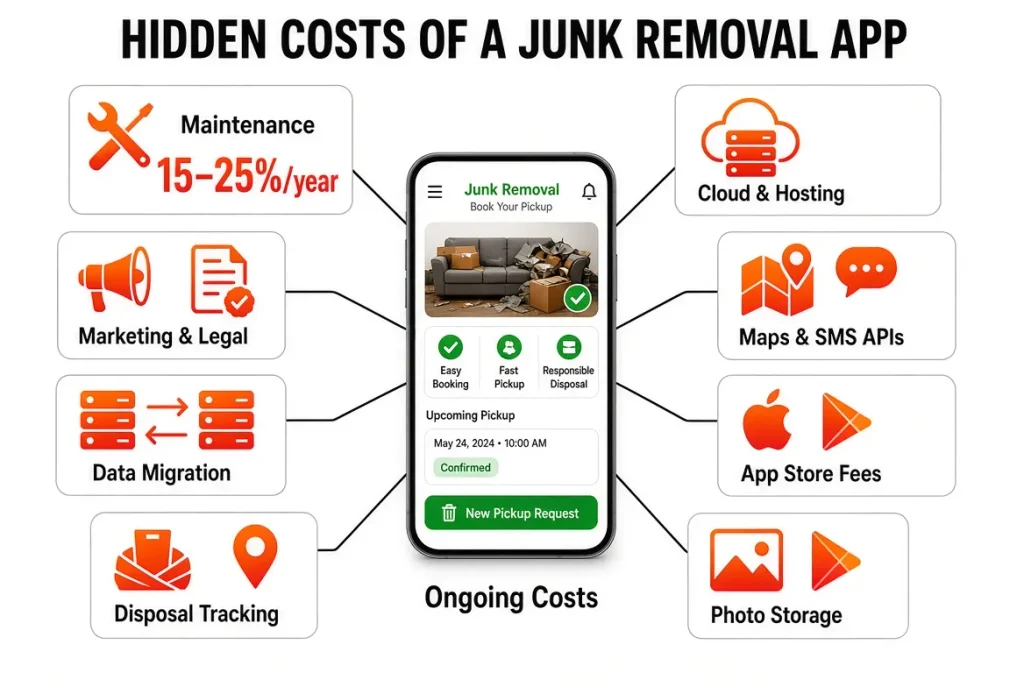
Plan for around 15–25% of the build cost per year. On a $100,000 app, that is roughly $15,000–$25,000 annually for bug fixes, security updates, OS changes, server maintenance and support.
Monthly running costs
Hosting, cloud storage, mapping, photo storage and SMS APIs can range from a few hundred to a couple of thousand dollars per month depending on usage.
App store fees
The Apple Developer Program is about $99/year, and Google Play has a one-time $25 registration fee. Verify current pricing before publishing.
Junk-specific hidden costs
Photo storage
A busy truck fleet can generate tens of thousands of before-and-after job photos each year. These images help resolve damage disputes and can eventually become training data for an AI photo estimator, so establish a sensible retention policy early.
Disposal tickets
If a disposal ticket isn’t connected to a specific job, you may know your total annual dump spend but have no idea which jobs produced those costs. Disposal tracking solves this by tying the expense to the actual service.
Material surcharges
Mattresses, tires and refrigerant appliances can carry separate facility charges. Tracking them as line items shows true job profitability.
Data migration
If several years of jobs are spread across field service software, accounting systems, spreadsheets and paper tickets, moving that information into a new platform can become a project of its own.
Marketing
Many founders underestimate customer acquisition costs. Launching an app does not automatically create demand, so marketing should be part of the overall business budget, not an afterthought.
Legal
Privacy policies, terms of service and regional compliance matter, particularly when handling addresses, photos and payment data.
Need a Custom Junk Removal App?
Daigency helps junk removal businesses plan, build, and scale custom software without overspending
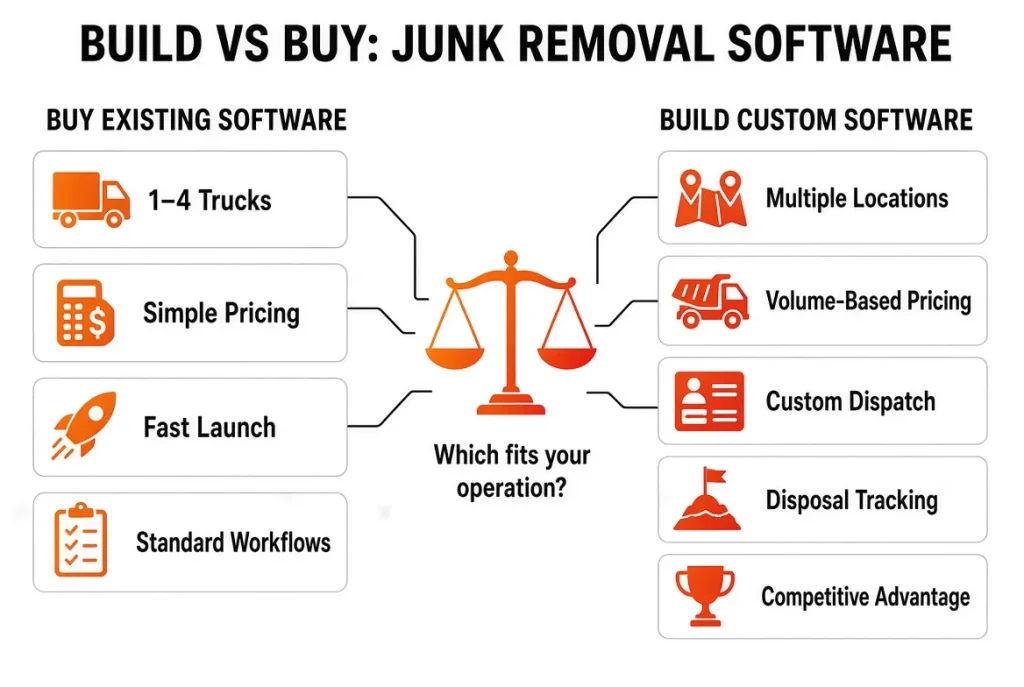
Build vs Buy: Should You Build a Custom App?
Buy existing software if:
- You run 1 to 4 trucks in one location.
- Your pricing is simple, such as flat rates or hourly pricing.
- You need to go live in days rather than months.
- Most work is booked during normal office hours.
A software subscription is often far more practical for a small junk removal business, because general field service platforms already cover most day-to-day needs. Tools such as Jobber, Workiz or Housecall Pro handle job management, scheduling, estimates, invoices and payments without custom development cost. The key question is whether the software fits your workflow without too many manual workarounds.
Build custom if:
- You operate multiple locations or a franchise network and need consolidated reporting.
- Your pricing is volume-based with item, market or same-day surcharges.
- You need detailed disposal and recycling tracking for compliance or marketing.
- Dispatchers spend hours moving information between two or three tools.
- You want software to be a competitive advantage through instant quotes, photo estimates or smarter routing.
For a larger multi-truck operator, custom software makes sense when manual processes start hurting margins: underpriced jobs, wasted driving, missed calls and poor truck utilization become recurring costs.
The middle path is often smartest: keep a configurable field service platform as your system of record for jobs, invoices and payments, then build a custom layer through APIs. Start with quoting, then add booking, then routing. A failed experiment then affects one layer rather than the whole operation.
A simple 90-day test
Pull your last 90 days of jobs and check:
Truck fraction: For how many jobs do you know the actual truck fraction filled, not just the amount quoted?
After-hours calls: How many calls went to voicemail outside office hours, and how many became missed jobs?
Real margin: Pick four random jobs. Subtract crew hours, fuel and disposal tickets from revenue. Can you find each disposal cost?
Route crossings: How many days did a truck backtrack because a same-day booking was added after the route was planned?
Annual leak cost = (missed jobs × average ticket) + (underpriced cleanouts × average shortfall) + (dead driving hours × crew cost per hour), multiplied by yearly frequency.
If the total is below roughly $40,000 per year, a subscription tool may still be the better choice. If the loss is substantially higher and growing, custom software can potentially pay for itself within a few operating seasons.
How to Reduce Junk Removal App Development Cost
Launch an MVP first
Start with the features that directly affect booking, quoting, dispatch and payment. Add advanced features after you have real customer and crew feedback.
Use cross-platform frameworks
React Native and Flutter reduce work compared with separate native apps.
Invest in discovery and design early
Changing a wireframe is cheap; changing a feature mid-development is not.
Use managed services
Services such as Stripe, Twilio and Firebase save significant time compared with building payment, messaging and notification infrastructure from scratch.
Keep the interface practical
Not every screen needs custom visual effects. For field service software, speed and clarity are often more valuable than elaborate UI, especially for crews using the app with gloves on in a driveway.
Add AI later
Machine learning for photo-based volume estimation needs good training data. Collect customer photos and confirmed estimates from day one, then build the AI layer when the dataset is useful.
Go hybrid
A local product lead with offshore developers cuts budget while keeping communication close.
Sequence features by the biggest leak
If pricing errors hurt most, fix photo quoting first. If after-hours calls are missed, improve online booking next. Add advanced routing once daily volume justifies it.
Stop Paying for Inefficient Manual Processes
Build custom junk removal software that streamlines quoting, booking, dispatch, payments, and operations.
How to Build a Junk Removal App: 8 ways Step-by-Step Complete Guide
1: Map your workflow
Write down the full process from first customer contact to final payment. Mark where you lose time, miss leads or make pricing mistakes.
2: Define pricing logic first
Set a base rate for each truck fraction (1/8, 1/4, 1/2, 3/4 and full), plus item surcharges, ZIP-code rates, same-day premiums, minimum charges and residential versus commercial pricing. A simple model:
Price = (volume × market rate) + item surcharges + premiums, with a minimum charge.
Keep this as an editable pricing table rather than hard-coded logic, so rates can change without a developer.
3: Design the estimate-to-booking flow
Customer submits photos → system shows a price range → dispatcher confirms volume → customer approves → booking locks. This small human review protects accuracy while being much faster than phone-only.
4: Choose your tech stack
There is no single perfect stack. The better choice is usually the one your team already knows well and can maintain confidently. (for full detail see section “Recommended Tech Stack”)
5: Build offline-first for crews
Arrival, photos, notes, payment and completion should be saved on the device and synced later. Adding offline access afterward is expensive, so decide during initial architecture.
6: Add routing and capacity logic
Start with nearest-job logic and basic capacity checks, then introduce advanced optimization as daily jobs grow.
7: Build disposal and compliance tracking
On completion, the crew records where the load went (landfill, recycler, donation center or specialty handler), including facility, material type and approximate weight.
8: Pilot, then roll out
Test with one or two trucks for a few weeks. Collect feedback from crews and dispatchers, fix friction points, and only then expand the system across the rest of the fleet.
Legal and Compliance Requirements for a Junk Removal App
Rules can change, so always confirm the current requirements with the relevant local authorities before launching.
USA
Waste hauling permits and disposal reporting vary by state and city. Privacy laws such as CCPA/CPRA can apply in California.
Canada
Waste regulations vary by province and municipality. Customer data can fall under PIPEDA and provincial laws such as Quebec’s Law 25.
UK
Waste carriers generally need to register. GDPR and UK data protection rules apply to customer information.
UAE
Waste licensing varies between emirates, including Dubai and Abu Dhabi, and the UAE has its own personal data protection framework.
Since the app stores customer addresses, job photos, payment information and disposal records, privacy and data export should be included in the requirements from the beginning rather than added after development.
How to Choose a Development Partner
- Ask for examples in field service, logistics, waste management or fleet software, not just generic mobile apps.
- Ask how they handle offline sync, truck capacity and route optimization.
- Request a phased roadmap with a clearly defined MVP.
- Insist on a written requirements document covering pricing logic, user roles, integrations, payments and workflows.
- Confirm you will own the source code, repository, cloud accounts and API keys from the first commit.
- Check the legal entity and review contract terms carefully.
- Ask for client references and, if possible, speak with a previous client.
- Compare 3–5 quotes using the same written brief, and ask what is included and excluded, especially QA, maintenance, app store submission, cloud setup and support.
At Daigency, we help service businesses turn operational headaches into simple, scalable software. Whether you need a lean MVP for online quoting and booking or a full platform with dispatch, crew apps and route optimization, our team will help you define the right scope, choose the right tech stack and launch without overspending.
Turn Your Junk Removal Operations Into Smart Software
From online quotes and booking to dispatch, routing, and crew management, Daigency can build the right solution for your business.
Final Thoughts
The junk removal app cost comes down to two factors: how much you build and who builds it. Start with accurate volume-based quoting, a photo review process, clean dispatch and an offline-capable crew app. As you grow, add route optimization, disposal tracking, recycling reporting, analytics and AI.
If your pricing model, locations or compliance needs have outgrown off-the-shelf software, a phased custom build can be worthwhile. If not, a configurable subscription plus a few API integrations may be all you need.
The best approach is not to build the biggest platform. It is to solve the operational problem costing you the most money first.
FAQs - Junk Removal App Cost
- How much does a junk removal app cost?Roughly $15,000–$35,000 for a lean booking app, $45,000–$100,000 for a standard MVP with dispatch and a crew app, and $120,000–$260,000+ for a full platform with advanced operations, routing and reporting.
- How long does it take to build a junk removal app?A lean MVP takes around 2–3 months, a standard MVP 3–5 months, and a full platform 6–12 months, depending on scope and integrations.
- What is the annual maintenance cost?Around 15–25% of the original build cost each year, covering bug fixes, security updates, OS compatibility, server maintenance and support.
- Is it cheaper to build iOS or Android?Roughly the same when built separately. The bigger saving comes from cross-platform development with Flutter or React Native, where one codebase supports both.
- Can I build a junk removal app without coding?Partly. No-code tools can handle simple booking forms, estimates and basic customer management. Volume-based pricing, offline crew functionality, truck capacity, routing and deeper integrations generally need custom development.
- Is it cheaper to buy or build?Buying is normally cheaper for small junk removal businesses. Custom development becomes more attractive when manual workarounds, pricing disputes, missed calls, inefficient routes and reporting problems cost more than the software itself.
- What features should I build first?Volume-based quoting, photo upload, online booking, a dispatcher dashboard, a crew mobile app and payments. Once stable, add routing, truck capacity management, disposal tracking and analytics.
- Does the app need to work offline?Yes, especially for field crews working in basements, storage units and rural properties. Offline mode lets them keep working and sync later.
- Should custom software replace my current tool?Usually not immediately. Keep the existing platform as the system of record and build a custom layer for quoting, booking or routing through its API. This reduces risk while improving the areas where generic software falls short.
- Why do quotes vary so much?Quotes differ because of scope, UI/UX complexity, backend architecture, integrations, team location, offline requirements, routing logic, payment processing and ongoing support. Give every company the same written requirements to compare fairly.