
Quick answer: A junk removal website costs between $0 and $20,000+ in 2026 (USD). A DIY website builder costs about $0-$900, a basic freelancer site $1,500-$3,000, and a professional lead-generation website with service pages, location pages, and photo quote forms $3,500-$7,000. Agency-built sites for multi-location companies range from $6,000-$14,000+, and custom systems with online booking, instant quotes, or CRM integration start at $12,000+. Most small local junk removal companies should budget $1,500-$7,000, plus hosting, maintenance, and tools after launch. Final pricing varies by country, number of pages, features, and who builds the site.
Market size:
Junk removal is a growing global industry. According to Global Growth Insights, the global junk removal franchise market reached USD 1.07 billion in 2025 and is projected to grow from USD 1.20 billion in 2026 to USD 3.46 billion by 2035, at a CAGR of 12.5%. As demand rises, more customers search online before they call, which makes a clear, fast junk removal website more valuable.
If you run a junk removal business, your website is more than a digital business card. It is often the first place a homeowner, property manager, or business owner goes after finding you on Google Search or Google Maps. So, how much does a junk removal website cost in 2026?
The cost can range from $0 for a DIY website builder to $20,000+ for a custom agency build. For many small local companies, a realistic budget is around $1,500 to $7,000.
Thinking about building both a junk removal app and website? Our guide on How Much Does a Junk Removal App Development Cost breaks down pricing, features, development options, and the factors that can affect your overall budget.
This guide explains the typical cost to build a junk removal website, what affects the price, which features are actually useful, and where your budget is better spent.
Junk Removal Website Cost in 2026: The Complete Pricing Guide
| Option | Typical Upfront Cost | Best For |
|---|---|---|
| DIY website builder | $0–$900 | Startups and business owners willing to do the work themselves |
| Basic freelancer site | $1,500–$3,000 | Small, single-location junk removal businesses |
| Professional website | $3,500–$7,000 | Established companies focused on lead generation |
| Agency website | $6,000–$14,000+ | Larger or multi-location companies |
| Advanced custom system | $12,000- $20,000 | Businesses needing booking, quoting, CRM, or other integrations |
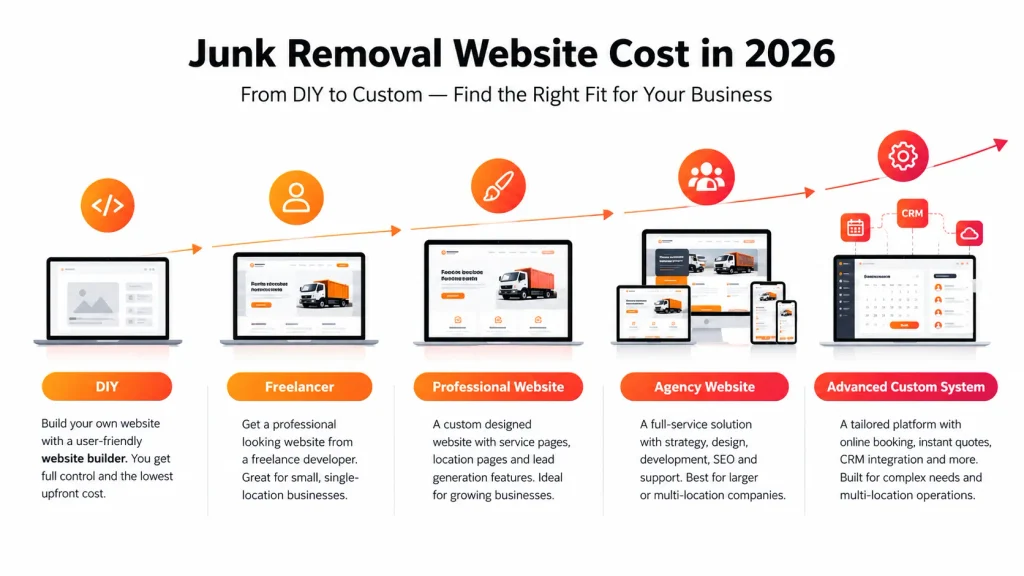
These are planning ranges rather than fixed prices. Your final junk removal website pricing depends on the number of pages, website design, content, functionality, quote or booking features, integrations, and who develops the site.
For a company serving one local market, you usually do not need a $20,000 website. At the same time, a cheap template with your logo added to it is unlikely to deliver the same customer experience as a professional website built around your services and customers.
The goal is to pay for functionality that helps your junk removal business win more customers, not features that simply make the website look complicated.
What Makes a Junk Removal Website More Expensive
The number of pages is only one part of the website development cost. What those pages need to do usually has a much bigger impact.
1. Online booking
A simple contact form is inexpensive. A proper junk removal booking system is different.
If customers need to choose a service, select a date and time, enter an address, upload photos, and receive confirmation, the website needs scheduling functionality, notifications, and possibly payment processing. A junk removal website with online booking can be useful for a company with predictable availability, but it also comes with additional development and monthly software costs.
2. Instant quote calculators
A basic price estimator can give customers a rough idea of what a job might cost.
A more advanced price calculator connected to your actual pricing rules, truck capacity, materials, access requirements, and availability requires considerably more development. Most smaller companies do not need a complicated calculator at launch. A well-designed online quote form with photos can often do the job.
3. Photo-upload quotes
Junk is difficult to describe accurately. A homeowner may not know whether the furniture, boxes, appliances, or other unwanted items in their garage will fill a quarter of a truck or half of one.
Allowing customers to upload photos can make the quote process easier for both sides. It gives your team useful information before making contact and makes the lead capture process more convenient.
4. Service and city pages
If you offer furniture removal, appliance removal, garage cleanouts, house cleanouts, renovation debris removal, or commercial junk removal, those services may deserve their own pages.
The same applies to locations. A company serving several communities may need useful service area pages explaining where it works and what services are available there. More useful pages mean more website content, design, development, and SEO work.
5. Custom design vs. templates
A customized WordPress theme can give a small junk removal company a professional appearance without the cost of building everything from scratch.
A fully custom website takes more design and development time. It can make sense when your business has specific requirements, but it is not automatically better for every local business.
6. Content creation
Someone has to explain your junk removal services, service areas, pricing approach, accepted items, booking process, and policies. If the developer or agency also creates your website content, the website design cost may increase.
Good content is worth paying for when it answers customer questions clearly instead of filling pages with generic marketing language.
7. Integrations
A website may need to connect with a CRM, payment processor, review platform, analytics system, scheduling software, or dispatch system. Each integration adds development work and may introduce another monthly subscription.
Before paying for an integration, ask whether it will actually improve your customer acquisition, operations, or website conversion.
Planning Your Junk Removal Website Budget?
Tell Daigency your goals, features, and budget, and we’ll help you choose the right website solution without paying for unnecessary features.
DIY vs. Freelancer vs. Agency: Which Is Best for a Junk Removal Website
DIY or website builder ($0–$900)
Platforms like Wix, Squarespace, Webflow, or a WordPress template can get a basic site online quickly. It’s the cheapest option in money, but you invest your own time: structure, writing, images, mobile layout, forms, and updates. Modern AI website builders can create a solid first draft from a description of your business, but you must check every detail before publishing, including services, service areas, pricing, contact details, and claims. Replace generic stock images with real photos of your work whenever possible.
Freelancer ($1,500–$3,000)
A good choice for a small local business that needs a professional site without an agency budget. It works especially well for a straightforward WordPress site with service pages, contact forms, local SEO basics, and a quote request system. Quality varies, so review past projects and get the scope in writing.
Small web studio ($3,500–$7,000)
A good fit for a growing business that needs more strategy, design, content, or functionality. A studio that regularly works with home-service businesses often understands local search and lead generation better than a general developer.
Agency ($6,000–$14,000+)
An agency brings together strategists, designers, developers, SEO specialists, and support staff. It makes sense for larger or multi-location companies, or for those needing custom booking, CRM integration, or a broader digital marketing strategy.
Good to know: The cheapest quote isn’t necessarily the cheapest project. A $500 five-page template and a $4,000 lead-generation website are completely different products. Compare scope, pages, content, features, ownership, support, and ongoing costs before comparing prices.
Should a Junk Removal Website Use WordPress or Custom Development
For most small junk removal companies, WordPress is a practical choice. It handles service pages, location pages, forms, reviews, blogs, booking plugins, analytics, and most common SEO needs without a custom platform.
Custom development becomes worthwhile when you need something standard tools can’t do easily, such as your own pricing engine, dispatch integration, customer dashboard, or real-time booking. For a typical local business, it’s usually unnecessary at the start.
What a Junk Removal Website Should Include
Think about the customer standing in a garage with a pile of unwanted items. They are not looking for a long company history. They want answers:
- Do you remove what I have?
- Do you serve my area?
- How much might it cost?
- How soon can you come?
- Can I trust you?
- How do I get a quote?
Your website structure should make those answers easy to find.
Core pages (a solid starting point)
- Homepage: What you do, where you work, and what customers should do next
- Main junk removal page
- Furniture removal: Couches, mattresses, tables, dressers, and other accepted items
- Appliance removal: Only the appliances you actually accept
- Cleanout services: Garage, basement, estate, house, and property cleanouts
- Service areas: Locations you genuinely serve
- About: Your team, experience, and company information
- Contact / Get a Quote: A simple way to request service
As the business grows, you can add pages for commercial junk removal, construction debris, renovation cleanup, hot tub removal, yard waste, pricing, and FAQs where there is genuine customer demand.
How Should a Junk Removal Website Homepage Start
A common mistake is opening with “Welcome to ABC Junk Removal. We’ve proudly served the community since 2012…” Your story matters, but the customer is thinking, “Can you take this couch, and how much will it cost?”
A stronger opening focuses on their problem:
Want More Junk Removal Leads From Google?
Daigency combines professional website development, service-area pages, conversion-focused design, and local SEO to help your business get found and contacted.
How Should a Junk Removal Website Explain Pricing
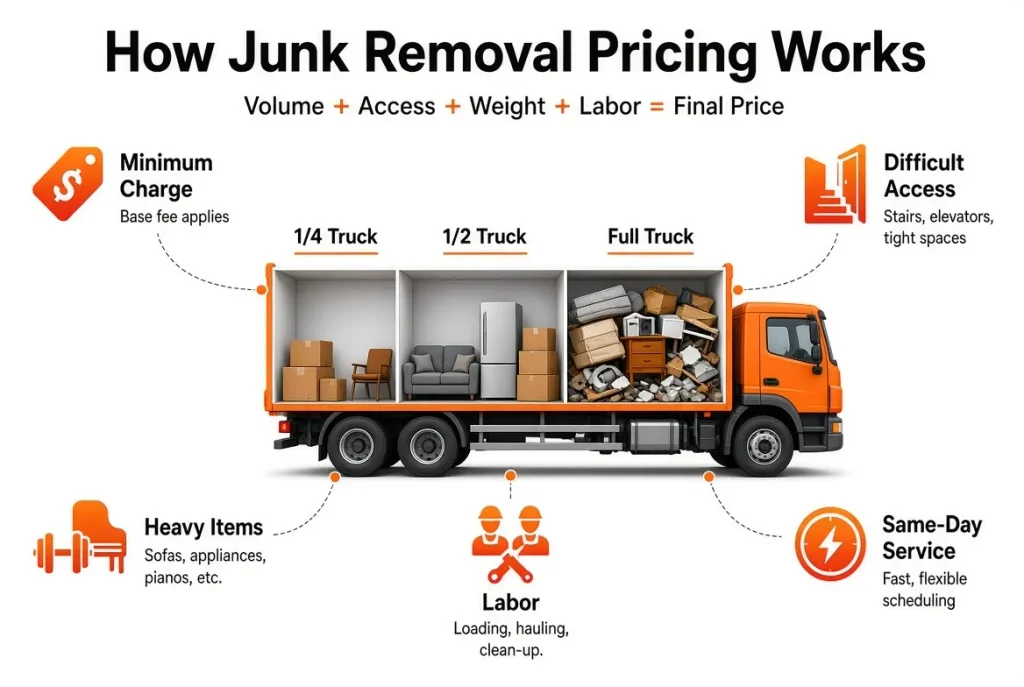
Many junk removal jobs cannot be priced accurately until the crew sees the items.
That does not mean you should hide pricing completely.
You can explain:
- Minimum pickup charge
- Single-item pricing
- Quarter-, half-, and full-truck pricing
- What can increase the price
- Stairs or difficult access
- Heavy or unusually large items
- Same-day service
- Whether labor is included
- Whether photo estimates are free
As a rough US example, some companies may advertise starting prices around $100–$175 for a small pickup, $150–$300 for a quarter truck, and $250–$550 for a half truck. These figures vary significantly by city, company, materials, access, and volume, so they should not be treated as universal junk removal pricing.
Even when you cannot provide an exact price, explaining how your pricing works gives customers more confidence.
What Should a Junk Removal Quote Form Include
A quote form should make it easier to contact you, not feel like an application form.
A useful quote request may ask for:
- Name
- Phone number
- ZIP code or address
- Type of junk
- Photos, if supported
- Preferred date, if necessary
What Trust Signals Should a Junk Removal Website Have
Customers are letting a stranger onto their property, so trust matters. Use genuine evidence:
- Customer reviews that explain what the company actually did
- Verified reviews where available
- Before-and-after photos from real jobs
- Real photos of your crew and trucks
- Years in business
- Insurance or licensing information where relevant
- Clear information about what happens to collected materials
- A straightforward list of items you do not accept
If you say you recycle, donate, or responsibly dispose of materials, make sure those claims are accurate.
Never create fake reviews or use photographs that make customers think they are looking at your actual team or work when they aren’t.
Online Booking or Quote Requests for a Junk Removal Website
There is no single answer for every junk removal company.
You generally have three options:
- Phone only: Best if you prefer speaking with every customer. Make your phone number highly visible.
- Quote request form with photos: Often the best starting point for small companies because it is simple and inexpensive.
- Online booking: Useful when your availability and service process are predictable.
Don’t add online booking just because a competitor has it. Add it when it makes the customer’s experience easier and fits the way your crew actually works.
Local SEO for Junk Removal Websites: How to Get Found on Google
A professional website does not automatically appear at the top of Google.
For a local service such as junk removal, your website needs to support the broader local SEO strategy that helps search engines understand what you offer and where you work.
Service pages
Give important services their own pages when they attract different searches or customers.
For example, furniture removal, garage cleanouts, estate cleanouts, and renovation debris removal can have different customer needs.
A dedicated page gives you space to explain each service properly.
Location pages
If you serve several cities, create useful pages for the places you genuinely cover. A good one includes available services, neighborhoods served, local job photos, relevant reviews, and a clear quote button. Don’t create dozens of pages where only the city name changes. Ten genuinely useful pages beat 100 thin ones.
Google Business Profile
Keep your Google Maps listing consistent with your website: name, phone number, hours, services, service areas, and photos. Encourage satisfied customers to leave honest reviews. Your website and profile work together, but neither guarantees rankings.
Technical basics
Your website should have:
- HTTPS
- Descriptive title tags and meta descriptions
- Clear heading structure
- Internal links between related pages
- XML sitemap
- Google Search Console
- Optimized images
- Relevant structured data, such as LocalBusiness or Service
Helpful content
You don’t need hundreds of blog posts. Answer the questions customers actually ask: How much does junk removal cost? What can a company take? How do I prepare? Junk removal vs. dumpster rental? How does an estate cleanout work? What happens to junk afterward? The goal is to help people decide, not repeat a keyword on every page.

Why Does Mobile Speed Matter for a Junk Removal Website
A large share of local searches happen on smartphones, often while someone is standing outside a rental property or in the middle of a garage cleanout. Visitors should be able to tap your number, understand your services, check your service area, read reviews, request a quote, and upload photos without zooming or digging through menus.
To keep the site fast:
- Compress images
- Avoid unnecessary scripts and heavy animations
- Use reliable hosting
- Keep pages focused
- Test on real phones and slower connections
A clean, mobile-friendly site beats a visually impressive one that loads slowly.
What Are the Ongoing Costs of a Junk Removal Website
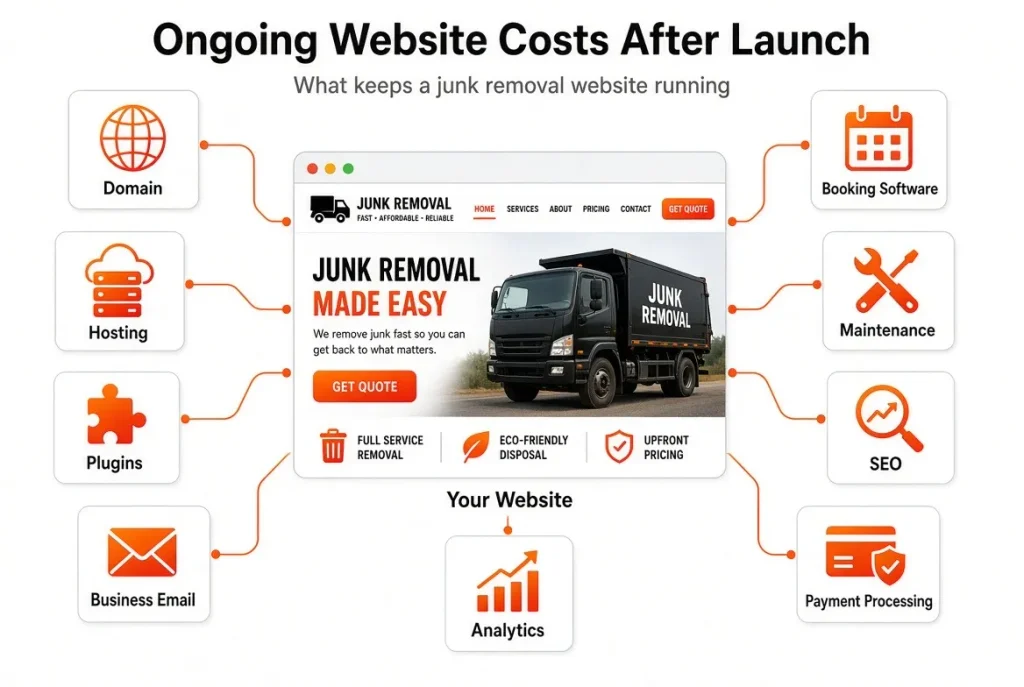
The initial website development cost is only part of the budget.
You may also have recurring expenses such as:
| Expense | Typical Cost |
|---|---|
| Domain | $10–$30/year |
| Hosting | $10–$50/month |
| Premium plugins/tools | $5–$100+/month |
| Booking software | $20–$150+/month |
| Maintenance | $50–$300+/month |
| SEO | $300–$2,000+/month |
You may not need everything listed above.
A small local junk removal company might only need hosting, a few tools, and occasional maintenance. A larger company may need booking software, CRM tools, SEO, analytics tool, and other services.
SEO is separate from the website itself. If you pay for it monthly, ask exactly what work is included.
Also consider business email, professional photography, payment processing fees, and any third-party software required for online booking.
Monthly Website Plan vs. One-Time Fee: Which Costs Less for Junk Removal
A “$99/month website” sounds inexpensive when you look only at the monthly number.
Here is what the total becomes:
| Monthly Price | 1 Year | 3 Years | 5 Years |
|---|---|---|---|
| $99 | $1,188 | $3,564 | $5,940 |
| $199 | $2,388 | $7,164 | $11,940 |
| $299 | $3,588 | $10,764 | $17,940 |
A subscription isn’t automatically a bad deal, since it may include hosting, updates, maintenance, and support. The key question is: “What will I have paid after three years, and do I own the website if I cancel?”
What You Should Own Before You Sign: Who Owns Your Junk Removal Website
Before signing a website agreement, make sure you understand who owns:
- Your domain name
- Website files and content
- Your images
- Analytics and tracking accounts
- Hosting account
- Google Business Profile
- Customer data
Your domain should normally be registered in your business’s name.
If a provider says, “We own it for you,” ask what happens if you decide to leave.
A website can be an important part of your digital foundation, so losing access to your domain, content, or customer data can create a serious problem.
10 Questions to Ask Before Hiring a Junk Removal Website Developer
- How many pages are included?
- Who writes the content?
- Are service-area pages included?
- Can customers upload photos?
- Is online booking included, and does it have a monthly fee?
- Is technical SEO included?
- Who owns the domain and website?
- What are the ongoing costs?
- What happens if I cancel?
- What support do I get after launch?
These questions make it easier to compare a freelancer, web agency, or website subscription fairly.
How Long Does It Take to Build a Junk Removal Website
Typical timelines look like this:
- DIY builder: A day or weekend if your content and images are ready
- Basic freelancer website: Around 2–4 weeks
- Larger website with booking, quotes, and multiple pages: Around 4–8 weeks or longer
The biggest delays usually have nothing to do with coding. Missing logos, photos, service details, approvals, and pricing can hold a project up for weeks. Having your business information ready makes everything smoother.
Build a Better Junk Removal Website
Turn searches into calls and quote requests with a website designed around your customers.
How Much Should You Spend on a Junk Removal Website
- Under $900: DIY website builder. Good for testing a market or getting your first online presence.
- $15,00–$3,000: Professional but straightforward website with limited customization.
- $3,500–$7,000: More complete lead-generation website with multiple service pages, location pages, photo quotes, tracking, and stronger design.
- $7,000–$20,000+: Multi-location businesses, advanced booking or quoting, CRM integrations, and more customized functionality.
- $20,000+: There should be a specific business reason for this level of investment.
Before agreeing to a high price, ask what requirement makes the project more expensive.
Features worth paying for first:
Click-to-call, a short quote form with photo upload, clear pricing explanation, service and service-area pages, reviews and real job photos, mobile-first design, fast loading, and conversion tracking.
Features you can skip at the start:
Complicated calculators, a mobile app, heavy animations, a huge blog, customer portals or chatbots, dozens of near-identical city pages, and a custom CRM.
Build around what your customers need today, and add more when the business has a real reason to use it.
Common Junk Removal Website Mistakes to Avoid
- Choosing the cheapest quote without checking what’s included
- Paying for unnecessary pages (more pages don’t automatically mean better SEO)
- Hiding all pricing information
- Using long quote forms
- Using stock photos instead of showing real work
- Ignoring mobile users
- Hiding the phone number on the Contact page
- Creating thin or duplicate city pages
- Promising services you don’t provide
- Spending too much before testing the market
You don’t need a $15,000 website to find out whether customers respond to your business.
How Do You Know If Your Junk Removal Website Is Working
Do not judge your website only by how attractive it looks. Track the actions that matter to the business:
- Phone calls
- Quote requests
- Form submissions
- Online bookings
- Organic traffic
- Search impressions
- Search clicks
- Conversion rate
- Leads by service
- Leads by location
Real example, if your website gets plenty of organic traffic but almost nobody requests a quote, the issue may not be SEO.
It could be the conversion process. Your call-to-action may be unclear. Pricing may be difficult to understand. The form may be too long. The site may be slow on mobile. Or customers may not see enough trust signals. The goal is not simply more traffic. It is more qualified junk removal leads.
Is a Cheap Junk Removal Website Worth It
Yes, a cheap website can work. The problem isn’t the price itself but what you get for it. A simple site with clear navigation, real photos, accurate information, fast loading, and strong calls to action can outperform a far more expensive one.
Real Example: Imagine Website A costs $700 and produces almost no inquiries, while Website B costs $3,500 and consistently brings several extra jobs each month. The extra $2,800 quickly becomes insignificant.
That’s why the better question isn’t “How much does a website cost?” but “What is this website designed to do for my business?”
Final Junk Removal Website Checklist
Before launching your website for a junk removal company, make sure it has:
- A clear headline explaining what you do and where
- Service area information that is easy to find
- Click-to-call phone number
- Prominent quote button
- Short quote form
- Photo upload if useful
- Main services clearly explained
- Pricing information or a clear pricing method
- Accepted and restricted items listed
- Real customer reviews
- Before-and-after photos
- Team and truck photos
- Mobile-friendly design
- Fast page loading
- Consistent Google Business Profile information
- Analytics and conversion tracking
- Domain owned by your business
- Clear hosting and maintenance costs
- Clear SEO costs if SEO is included
- Easy-to-understand contact information
Build a Junk Removal Website Around Your Business Goals
The right junk removal website is rarely the one with the most features. It’s the one that helps the right customers find you, trust you, and request a quote.
At Daigency, we help junk removal businesses plan and build websites around their actual requirements, from simple lead-generation sites to advanced booking platforms, including UI/UX design, WordPress development, service and location pages, photo quote forms, integrations, and local SEO.
Talk to our team today.
Ready to Build Your Junk Removal Website?
From WordPress websites to custom booking and quote systems, Daigency can build a solution around your business needs.
Final Thoughts:
An effective junk removal website doesn’t need to be complicated. It needs to answer customers’ questions quickly: What do you remove? Where do you work? How does junk removal pricing work? How soon can you come? Can I trust you? How do I request a quote?
Get those basics right with real photos, honest reviews, clear service information, a visible phone number, and a short quote form. That gives your business a strong foundation without paying for features you don’t need.
Start with the essentials, then track your calls, quote requests, bookings, and conversion rate. As your customer base and service area grow, upgrade your junk removal website step by step.
FAQs - Junk Removal website Cost
- How much does a junk removal website cost in 2026?A junk removal website cost can range from $0 for a DIY setup to $20,000+ for a custom agency build. A freelancer-built website commonly falls around $1,500-$3,000, while agency projects may range from $6,000 to $14,000+ depending on the scope.
- What's the cheapest way to build one?A DIY website builder. You save money but take responsibility for design, content, mobile experience, forms, and basic SEO.
- Is $5,000 too much?Not necessarily. It's reasonable if it includes professional design, content, service and location pages, quote functionality, analytics, and SEO setup. It's expensive if you're only getting a basic template with a few pages.
- Is WordPress good for junk removal companies?Yes. WordPress works well for many local service businesses because it can support service pages, local SEO content, forms, reviews, booking plugins, blogs, and other common website needs.
- Should I add online booking?Only if it fits how you operate. If availability is predictable and customers benefit from choosing a time, it can help. If every job needs a custom quote first, a photo-based quote request is a better starting point.
- Should I show prices?Show whatever you can provide accurately: starting prices, truck-load examples, minimum charges, or how pricing is calculated. Make clear that the final price depends on volume, access, materials, and labor.
- How many pages do I need?Start with around 5–8 well-planned pages. Add service and location pages as they become genuinely useful.
- Do I need a website if I have a Google Business Profile?Yes. Your profile helps customers find you, while your website gives them more detail on services, areas, pricing, reviews, and contact options. The two should support each other.
- Does a new website rank on Google automatically?No. Rankings depend on relevance, content quality, technical health, local signals, competition, and authority. No legitimate company can guarantee a specific position.
- How long does it take to build?A simple site takes around 2–4 weeks. Larger projects with booking, pricing tools, integrations, and many pages can take 4–8 weeks or longer, depending on scope and how quickly content and approvals arrive.