
The final price depends on functionality, design (template vs. custom), third-party integrations, and developer rates. Ongoing costs like hosting, domain, maintenance, and security add roughly 15-20% of the build cost per year
Ask three web development agencies how much a website will cost, and you might receive quotes of $2,000, $12,000, and $60,000 for what sounds like the same project. At first, those numbers can seem confusing. But there is usually a good reason for the difference: each agency may be proposing a different solution, level of customization, or set of features.
A basic website for a local plumber, for example, has very different requirements from a clinic’s patient portal or an online store that handles hundreds of orders. All three are websites, but the work involved in building and maintaining them is not the same.
That is why the cost of a website depends less on the number of pages and more on what the website needs to do. Design, functionality, integrations, content, security, and ongoing support all affect the final price.
This guide breaks down website development costs in 2026, including typical prices by industry, the factors that influence your budget, expenses you might overlook, and practical ways to keep costs under control without compromising quality.
Quick Overview Website Cost Breakdown in 2026
A website can cost a few hundred dollars if you build it yourself, or more than $500,000 for a complex custom platform. For many small and midsize businesses, a realistic starting budget is $3,000–$50,000.
| Type of website | Typical cost | Typical timeline |
|---|---|---|
| DIY / AI website builder | $0–$500 per year | 1 day–2 weeks |
| Landing page | $500–$5,000 | 1–4 weeks |
| Small business website (5–10 pages) | $2,000–$10,000 | 3–8 weeks |
| Professional business website with CMS | $8,000–$50,000 | 6–16 weeks |
| E-commerce store | $5,000–$80,000+ | 6–20 weeks |
| Custom web portal | $30,000–$120,000 | 3–6 months |
| Web app / SaaS product | $25,000–$300,000+ | 3–10 months |
| Enterprise digital platform | $100,000–$500,000+ | 6–12 months or more |
Note: All prices are in USD and are intended as planning estimates, not guaranteed quotes. Actual costs vary depending on project scope, location, developer experience, integrations, and compliance requirements.
These ranges are useful for setting an initial budget. Your actual quote may be lower or higher depending on the features you need, how much customization is involved, and whether the project includes content, SEO, testing, and post-launch support.
Why Do Website Development Prices Vary So Much
Two websites with the same number of pages can have very different development costs. The following seven factors explain why.
Functionality, not page count
A 50-page informational site can be easier to build than a five-page site with customer accounts, payments, booking, and dashboards. Interactive features need more development, testing, and maintenance.
Number of unique page layouts
The number of pages matters, but the number of different layouts matters more. A 30-page site built on four reusable templates can cost less than a 12-page site where every page needs its own design. When requesting quotes, list your page types (homepage, service page, blog post, product page, contact page).
Template, semi-custom or fully custom design
Your design approach has a direct impact on the budget.
- Template-based ($500–$5,000): Fast and practical, but the design may resemble other sites.
- Semi-custom ($5,000–$15,000): Uses an established platform such as WordPress or Webflow while allowing more control over branding, page layouts, and user experience.
- Fully custom ($15,000–$50,000+): Designed around your brand, business processes, and customers’ needs. It is useful when standard templates cannot deliver the required experience.
A custom design is not automatically the better choice. If a well-configured template does everything your business needs, paying for a completely original design may not offer enough additional value to justify the expense.
Third-party integrations
Many websites need to connect with other software, such as a CRM, payment gateway, booking system, accounting tool, or property listing service. API configuration, testing, and troubleshooting. Allow roughly $1,500–$10,000 per integration, and confirm whether subscription fees and maintenance are included.
Technology choice
The technology behind your website affects its development cost, flexibility, and long-term maintenance requirements.
WordPress is a common choice for business websites and content-heavy projects. Shopify works well for many standard online stores. React and Next.js can support more customized, interactive experiences, while a custom back end may be necessary for specialized applications.
The best option depends on your requirements, not which technology is currently popular. A familiar platform that your team can manage easily may be a better investment than a more complicated system that requires specialist support for every small change.
Who builds it
Developer rates vary by location, experience, and the type of work involved. The following figures provide a general starting point for comparing providers.
| Region | Typical hourly rate |
|---|---|
| US and Canada | $80–$250 |
| UK and Western Europe | $60–$150 |
| Eastern Europe and Latin America | $35–$80 |
| South Asia | $20–$60 |
These are broad estimates rather than fixed regional averages. Senior specialists and agencies may charge more, particularly for complex applications.
A lower hourly rate does not necessarily mean a cheaper project. If communication problems, rework, or missed deadlines increase the total hours, the final cost can exceed the price of hiring a more experienced developer from the start.
Content, SEO, security and compliance
Copywriting, photography, keyword research, technical SEO, accessibility, and security testing can add about $2,500–$20,000 for a substantial site. Compliance (encryption, audit logs, consent management, access controls) can add $2,000–$25,000 or more when you handle payments or sensitive data. Identifying these needs early is cheaper than redesigning later.
Not Sure Which Website Solution You Need?
From choosing the right platform to prioritizing essential features, planning your project early can help you manage costs and avoid unnecessary expenses.
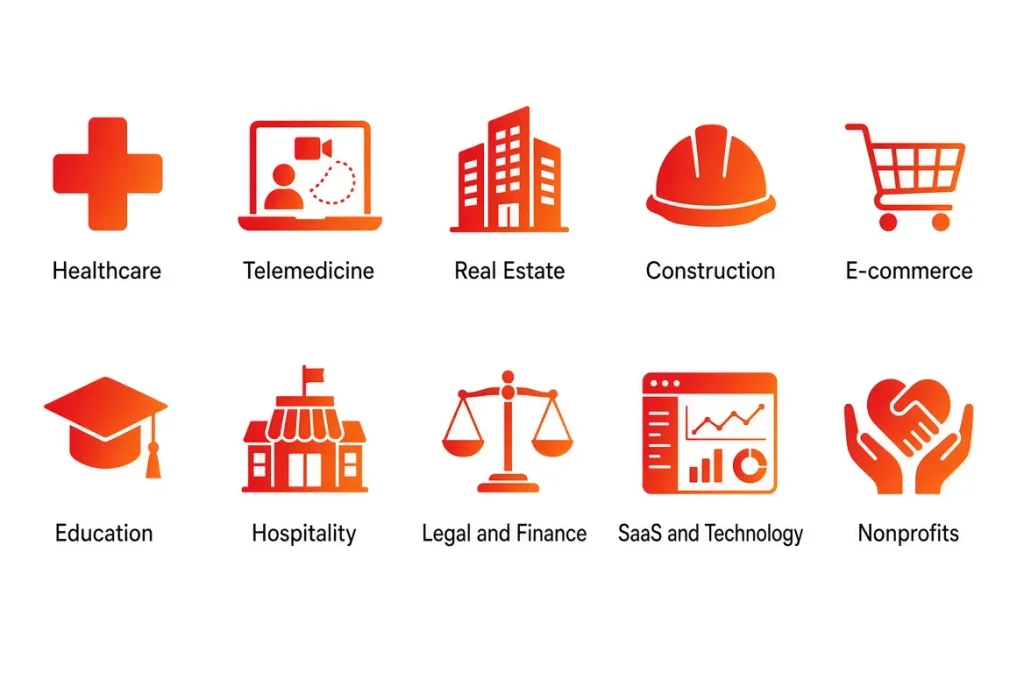
Website Development Cost by Industry
The features a business needs depend heavily on its industry. A restaurant may need reservations, while a property portal needs searchable listings and a healthcare platform may require secure access to sensitive records.
Here is what businesses in different industries can expect to spend in 2026.
Healthcare (clinics, hospitals, dental, labs)
Typical cost: $5,000–$60,000+
A small clinic generally needs a professional website that helps patients understand its services, find doctors, check locations, read reviews, and request appointments. A project with these features might cost $5,000–$15,000.
The budget increases when the website needs more advanced capabilities, such as:
- Online appointment booking connected to a scheduling system
- A patient portal for accessing reports, prescriptions, or invoices
- Integration with electronic health records (EHR/EMR) or laboratory software
- Support for multiple hospitals, clinics, or branches
- Accessibility improvements so people with disabilities can use the website
Healthcare websites may also need to meet privacy and security requirements, such as HIPAA in the United States, GDPR where applicable in the European Union, or relevant local data-protection laws.
Building compliance into the original project is generally more straightforward than adding it later, when existing systems may need to be redesigned. The additional cost depends on the data involved and the applicable requirements.
Good to Know: Start with an informational website and appointment requests if that is enough to serve your patients. You can introduce a patient portal later, once there is a clear need for one.
Telemedicine and digital health platforms
Typical cost: $25,000–$250,000+
A telemedicine platform involves much more than displaying information online. It needs to support interactions between healthcare professionals and patients while protecting sensitive data.
Depending on the service, features may include:
- Secure video consultations using a service such as Twilio, Agora, or a Zoom SDK
- Separate patient and doctor accounts with role-based access
- Appointment scheduling, reminders, and calendar synchronization
- Secure messaging, electronic prescriptions, and medical records
- Online payments and insurance billing
- An administrative dashboard for managing doctors, payments, and reports
A basic minimum viable product (MVP) that includes booking, video consultations, payments, and simple records may cost around $40,000–$80,000. A more advanced platform with insurance workflows, EHR integration, mobile apps, and extensive compliance requirements can exceed $200,000.
Running the platform also costs money. Video usage, text messages, cloud hosting, monitoring, and security audits may add $1,500–$10,000 per month as usage grows.
Healthcare privacy rules, professional licensing, and security obligations vary between markets. These requirements should be reviewed before development begins, especially if the platform will serve patients in multiple countries.
Real estate (agents, agencies, property portals)
Typical cost: $3,000–$100,000+
A real estate website needs to help people find suitable properties quickly. Visitors often want to filter listings by location, price, property type, and number of bedrooms before contacting an agent.
Typical project costs include:
- Individual agent or small agency website: $3,000–$12,000. Usually includes property pages, contact forms, and a listing plugin on a platform such as WordPress.
- Agency website with live MLS/IDX listings: $10,000–$30,000. May include property search, map views, saved searches, and connections to listing databases.
- Property portal or marketplace: $50,000–$150,000+. More suitable for platforms with multiple agents, user accounts, promoted listings, and advanced search features.
Other cost factors include map services and their usage fees, MLS/IDX licensing, virtual property tours, mortgage calculators, and CRM integrations.
Good to Know: Prioritize fast loading times, accurate property information, and high-quality photographs before investing in advanced features. A slow website with poor images can make it harder to generate enquiries, even when the design looks impressive.
Construction and contractors
Typical cost: $3,000–$50,000
Construction companies usually need a website that demonstrates their experience and gives potential customers a reason to get in touch. Project galleries, service descriptions, certifications, testimonials, and quote request forms cover many of the essentials.
A straightforward website for a builder or renovation company typically costs $3,000–$10,000.
Larger projects may include:
- Detailed project case studies and before-and-after galleries
- Tender submission or vendor registration forms
- Careers pages and subcontractor information
- Client portals for project updates, documents, and invoices, potentially costing $30,000–$100,000
- Connections to project management or business software
The price depends on whether the website simply presents the company or also supports its day-to-day operations.
Good to Know: Set aside part of your budget for local SEO, including your Google Business Profile, service-area pages, and customer reviews. A straightforward website that attracts relevant local enquiries can be more valuable than an expensive website that receives little traffic.
E-commerce and retail
Typical cost: $5,000–$80,000+
An online store can be relatively affordable when it uses an established platform and follows standard shopping and checkout processes. Costs rise when the business needs special pricing rules, complex inventory management, or integrations with other systems.
Typical budgets include:
- Standard Shopify store with up to around 100 products: $5,000–$20,000
- WooCommerce store with custom features: $10,000–$35,000
- Store with subscriptions, B2B pricing, or ERP integration: $35,000–$80,000
- Multi-vendor marketplace: $60,000–$200,000+
Product imports, shipping rules, tax configuration, payment gateways, and inventory synchronization can all affect the final quote.
Remember to account for recurring costs, including platform subscriptions, paid apps, and payment processing. A fee structure of around 2.9% plus $0.30 per transaction is one common example in some payment markets, but actual rates vary by provider, country, card type, and plan.
Education and e-learning
Typical cost: $3,000–$150,000+
Educational websites range from simple school websites to full learning platforms where students attend classes, complete assessments, and track their progress.
Typical project budgets are:
- School or coaching website: $4,000–$15,000
- Course website with student accounts and payments: $15,000–$50,000
- Full learning management system (LMS): $50,000–$150,000+
A complete LMS may include live classes, quizzes, certificates, progress tracking, reporting, and instructor dashboards.
Video hosting, live-class integration, student management, and reporting are common cost drivers. If an existing learning platform already supports your requirements, configuring it may be more economical than developing everything from scratch.
Restaurants, hotels and travel
Typical cost: $3,000–$40,000
A restaurant website usually needs a menu, photographs, opening hours, location details, and a way for customers to make reservations or place orders. A website with these basics typically costs $3,000–$8,000.
Adding online ordering and delivery integrations can bring the cost to around $10,000–$25,000.
Hotels have different requirements. Their websites may need room listings, availability calendars, booking engines, payment gateways, and channel managers that synchronize availability across booking platforms. These projects typically cost $15,000–$40,000.
Travel businesses may also need itinerary tools, customer accounts, or connections to external booking systems.
For smaller businesses, connecting an established booking service is often more affordable and easier to maintain than building a complete reservation system from the beginning.
Law firms, finance and professional services
Typical cost: $6,000–$50,000
For law firms, financial advisers, and other professional service providers, a website needs to communicate credibility and make it easy for potential clients to understand the services available.
A typical project may include custom branding, professional profiles, practice or service pages, case studies where appropriate, secure contact forms, and useful articles.
A standard professional website might cost $6,000–$15,000. More complex financial technology or wealth management platforms can cost $40,000–$200,000 or more because they may need client dashboards, identity verification, detailed access controls, and extensive security testing.
Requirements such as Know Your Customer (KYC) checks, PCI DSS compliance for relevant payment environments, and external security audits can add to the cost.
Many firms keep their public-facing website separate from the secure application that handles confidential client information. This can make it easier to manage marketing content without exposing sensitive systems to unnecessary risks.
Manufacturing and logistics
Typical cost: $5,000–$50,000
Manufacturers often need websites that help buyers understand their products before requesting a quote. This may involve technical specifications, downloadable product documents, distributor directories, product catalogs, and enquiry forms.
Logistics companies may need additional functionality, including shipment tracking, customer accounts, booking workflows, and connections to transport management systems.
A straightforward informational website is generally less expensive than a platform that handles live operational data. The key question is whether visitors simply need information or whether the website must also connect to the systems employees use every day.
SaaS and technology startups
Typical cost: $25,000–$300,000+
For a software startup, the marketing website and the software product are two separate projects, even when they share the same brand.
A marketing website typically costs $5,000–$20,000. It explains the product, highlights its benefits, and encourages visitors to sign up or request a demonstration.
The application itself costs more. A first version with user login, one core workflow, and a dashboard may cost $30,000–$80,000. Products that also require subscriptions, team accounts, billing, permissions, and third-party integrations can reach $80,000–$200,000 or more.
The total depends on the product’s complexity, not just the number of screens. Data processing, security, testing, and ongoing maintenance can all require substantial work.
Good to Know: Focus on the smallest version of the product that solves a real customer problem. Launching with a few useful features gives you a chance to learn what customers actually need before spending money on more advanced functionality.
Nonprofits and NGOs
Typical cost: $2,000–$25,000
Nonprofits often need a website that explains their mission, shares their work, attracts volunteers, and makes donations straightforward.
A basic website may include impact stories, donation processing, volunteer registration, event pages, and contact information. A donation-ready WordPress website typically costs around $4,000–$12,000, although simpler projects can cost less.
More advanced websites may include donor accounts, recurring donations, campaign tracking, multilingual content, and connections to donor management software.
Some agencies offer discounted rates for nonprofit organizations. It is worth asking about these options, particularly if your project has a clearly defined scope and a limited budget.
Which Industries Spend the Most on Websites
The table below brings together the typical costs for basic and more advanced websites across the industries covered in this guide.
| Industry | Basic site | Advanced / custom |
|---|---|---|
| Healthcare | $5,000–$15,000 | $30,000–$60,000 |
| Telemedicine | $40,000–$80,000 (MVP) | $150,000–$250,000+ |
| Real estate | $3,000–$12,000 | $50,000–$150,000 |
| Construction | $3,000–$10,000 | $30,000–$100,000 |
| E-commerce | $5,000–$20,000 | $35,000–$200,000 |
| Education | $4,000–$15,000 | $50,000–$150,000 |
| Hospitality | $3,000–$8,000 | $15,000–$40,000 |
| Legal / finance | $6,000–$15,000 | $40,000–$200,000 |
| SaaS / tech | $5,000–$20,000 (marketing site) | $80,000–$300,000+ |
| Nonprofit | $2,000–$8,000 | $12,000–$25,000 |
These are broad planning ranges, not like-for-like quotes. Compare proposals by features, deliverables, and support, not price alone.
Why a Website Is a Long-Term Investment
A website can generate revenue, attract customers, and cut time spent on routine enquiries. For example, if it wins five extra clients a month at $500 each, that’s $30,000 in additional annual revenue, and a $10,000 site could match its cost in roughly four months. But revenue isn’t profit: you must account for operating costs, marketing, and taxes, and be sure the website is genuinely the reason those clients came.
Spending more doesn’t guarantee better results. The real question is whether the site delivers measurable outcomes: more qualified enquiries, completed bookings, fewer abandoned purchases, or less time on repetitive questions.
Website or Web Application: Which Do You Need
One of the most common budgeting mistakes is treating a web application as if it were an ordinary website.
A standard website mainly presents information. A web application allows people to interact with data, complete tasks, or use personalized services. The difference affects both development time and ongoing costs.
| Feature | Standard website | Web application |
|---|---|---|
| Main purpose | Present information | Perform tasks and process data |
| Typical users | Public visitors | Logged-in customers or teams |
| Common features | Pages, forms, blog | Dashboards, accounts, workflows |
| Back-end needs | Limited or CMS-based | Often extensive |
| Typical cost | $3,000–$35,000 | $25,000–$250,000+ |
| Monthly upkeep | $50–$300 | $1,000–$5,000+ |
If visitors mostly read, a website is enough. If they need accounts, saved information, file uploads, payments, or dashboards, budget for an application.
Website Development Process, Step by Step Guide
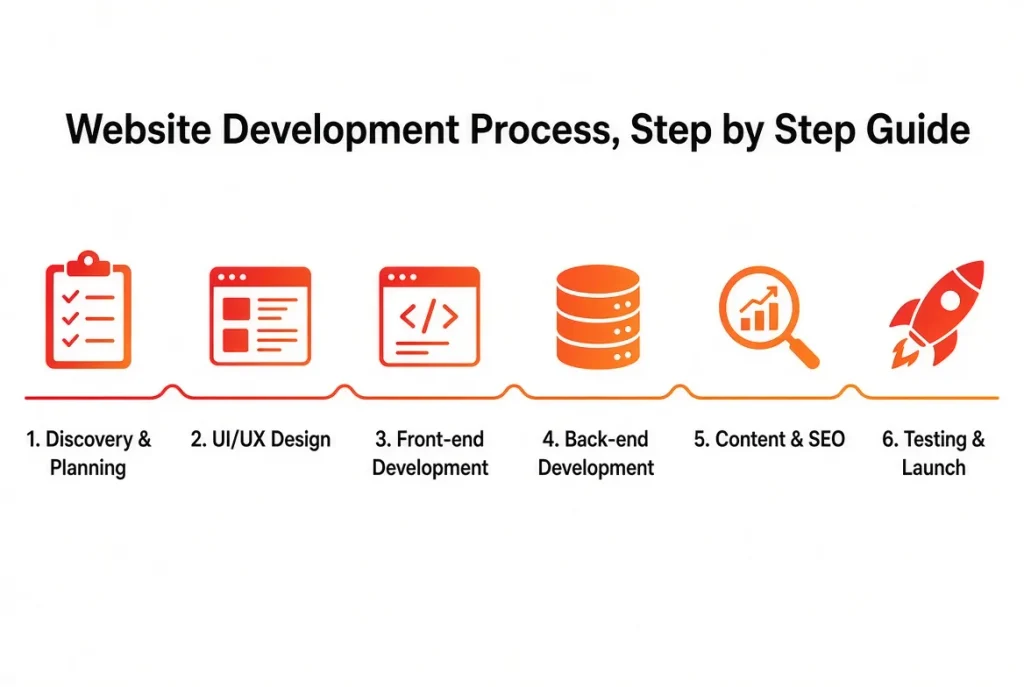
Knowing how a website is built makes it easier to understand what a development quote covers. Most projects move through six main stages, although the amount of work required at each stage varies.
Discovery and planning
The team defines the website’s goals, target audience, required features, technical approach, and integrations. This stage helps identify potential problems before they become expensive changes.
UI/UX design
Designers plan the page structure, navigation, layouts, and visual appearance. They may also prepare wireframes or interactive prototypes so you can review the experience before development begins.
Front-end development
Developers build the parts of the website that visitors see and interact with. This includes page layouts, navigation, forms, responsive design, and interactive elements.
Back-end development
This stage covers the systems behind the website, such as databases, user accounts, permissions, payment processing, and integrations. A basic content website may need relatively little back-end work, while a marketplace may require considerably more.
Content and SEO setup
Add content, metadata, redirects, sitemaps, and analytics. Confirm what is included.
Testing and launch
Check forms, mobile usability, browsers, performance, security, and backups, and agree how post-launch bugs are handled.
Not every project needs the same amount of work at each stage. Instead of relying on a standard percentage breakdown, ask providers to show how their estimate is divided between planning, design, development, testing, and launch.
DIY vs. Freelancer vs. Agency
The right development option depends on your budget, technical skills, project complexity, and how much responsibility you want to manage yourself.
- DIY builders (Wix, Squarespace, Webflow, Shopify): Roughly $15–$60 per month. Good for simple sites and early ideas, though customization is limited and paid apps add up.
- Freelancers: A straightforward project may cost around $1,500–$15,000, while hourly rates can range from $25–$150 depending on location and experience. Freelancers are often a good choice when the requirements are clear and the project is manageable. You may still need to coordinate design, content, hosting, and testing yourself.
- Agencies: Projects can cost $10,000–$250,000 or more. An agency may provide strategy, design, development, quality assurance, and project management under one arrangement. This can be useful for larger websites, complex integrations, or projects where security and reliability are particularly important.
There is no single option that works for every business. A DIY builder can be perfectly suitable for a new consultancy, while a business processing sensitive customer data may need a specialist team.
Also, consider the total effort required to complete the project. A developer who charges more but delivers reliable work in three weeks may offer better value than someone who takes twelve weeks and needs constant supervision.
The Hidden Costs that Nobody Mentions
The initial development quote does not cover every expense you will face after launch. Websites need hosting, software updates, renewals, security checks, and occasional improvements to keep working properly.
Here are some common ongoing expenses to include in your budget.
| Ongoing cost | Typical price |
|---|---|
| Domain name | $10–$50 per year |
| Hosting | $10–$30/month (shared), $29–$150/month (managed WordPress/Webflow), $100–$1,000+/month (cloud) |
| SSL certificate | Free for most sites; $100–$300/year for premium types |
| Plugins and licenses | $200–$3,000 per year |
| Maintenance and security | $50–$500/month for small sites; $1,500–$5,000+/month for web apps |
| Third-party tools (email, SMS, maps, video) | $15–$500/month each |
| Content and SEO | Ongoing, varies |
These figures are indicative. Actual hosting, software, and maintenance costs depend on traffic, storage, service providers, and the level of support you need.
As a starting point, consider setting aside 15–20% of the original development cost each year for maintenance and improvements. For a $10,000 website, that works out to roughly $1,500–$2,000 annually.
This is a budgeting guideline rather than a fixed industry rule. A simple website that rarely changes may cost less to maintain, while an application handling payments or sensitive information may require a larger budget.
Before signing a contract, ask what the maintenance plan covers, how quickly urgent issues will be addressed, and whether unused support hours can be carried forward. Make sure you understand which services are included and which will be billed separately.
Let’s Build a Website That Supports Your Business Growth
Create a website that meets your customers’ needs and supports your business goals. Connect with Daigency to discuss your requirements and plan the right development approach.
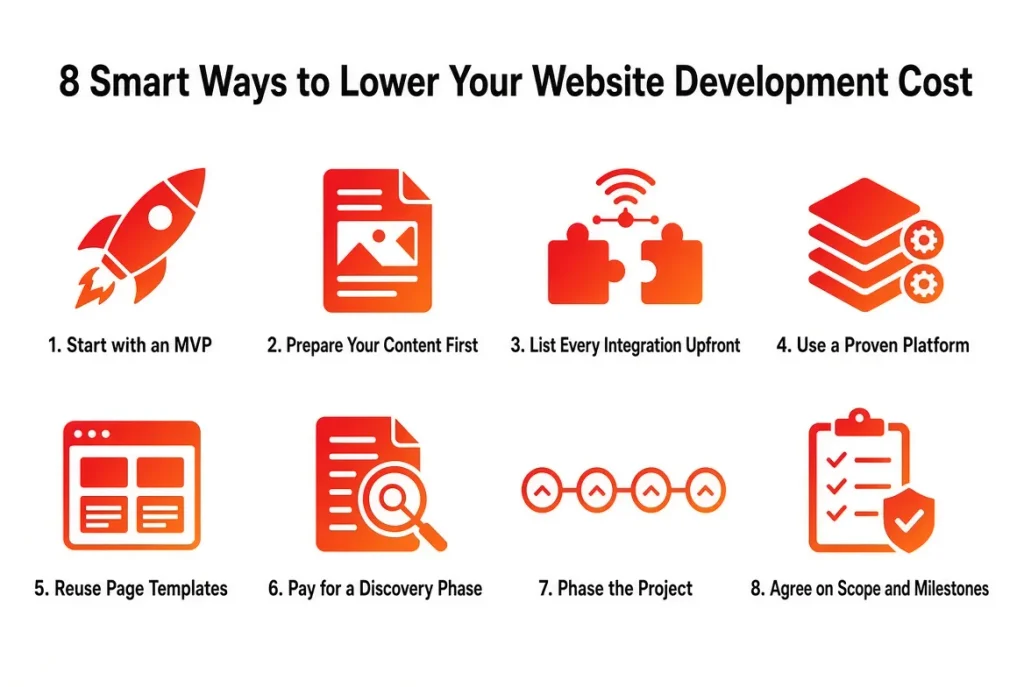
8 Smart Ways to Lower Your Website Development Cost
Reducing your website budget does not have to mean accepting poor design or unreliable development. In many cases, the biggest savings come from making better decisions before the work starts.
Start with an MVP
Launch with essentials and expand based on real usage.
Prepare your content first
Have your text, photographs, logos, and brand assets ready before design begins. This reduces delays and avoids paying developers to wait for materials or repeatedly adjust layouts.
List every integration upfront
Tell your developer which payment gateways, CRMs, booking systems, or other tools need to connect to the website. Adding integrations halfway through a project can require extra development and testing.
Use a proven platform
Choose technology that fits the project. A simple business website rarely needs a complicated custom framework, while a complex application may outgrow a basic template.
Reuse page templates
Shared layouts cut design and build time.
Pay for a discovery phase
Spending $2,000–$5,000 on planning may be worthwhile for a complex project. Clear requirements, technical decisions, and a realistic roadmap can help prevent costly misunderstandings later.
Phase the project
Launch the core website first and add more advanced features when there is a clear business reason to do so. For example, a clinic might start with service pages and appointment requests before introducing a patient portal.
Agree on scope and milestones
Make sure the contract explains what will be delivered, what is excluded, how many revisions are included, and how additional work will be priced. Linking payments to agreed milestones also makes the project easier to manage.
The aim is to spend money on features that improve the customer experience or help the business achieve its goals, rather than on functionality that may never be used.
How to Choose a Website Development Partner
A low quote may look attractive, but the cheapest proposal is not always the best fit. Before hiring a developer or agency, look at the quality of their work, how they communicate, and whether they understand the requirements of your project.
Ask every provider the following questions:
- Have you completed similar projects, and can you show examples?
- What is included in the price, and what is excluded?
- Who owns the domain, source code, hosting account, and design files?
- How will you test security, accessibility, mobile usability, and speed?
- What post-launch support is available, and at what cost?
- How are extra features and scope changes priced?
- For regulated industries, how will you handle compliance?
Pay attention to how the provider answers. A reliable company should explain its approach, discuss potential limitations, and ask questions about your business before recommending a solution.
The proposal should also identify the main deliverables, estimated timeline, payment schedule, responsibilities, and acceptance criteria. If you receive a single price without a clear explanation of what it covers, ask for more detail before making a decision.
How Does Daigency Keep Your Website Budget Working for You
Daigency defines scope, features, and integrations before development begins, so every part of your budget supports a clear business result. We recommend the right-sized solution for your goals, whether a template, semi-custom build, or full custom platform, never just the most expensive option. Our industry-aware planning covers the features and compliance needs of healthcare, real estate, e-commerce, education, hospitality, and professional services from day one. We launch with the essentials and add advanced features in phases, so your website grows with your business.
Ready to Build Your Website?
Get a website solution tailored to your business goals and budget. Talk to Daigency about your project requirements and the features you really need.
Final Thoughts
There is no single price for website development in 2026. The cost depends on your industry, your business goals, and the features your customers need..
Different industries have different priorities:
- Contractors: a professional portfolio and strong local visibility.
- Clinics: easy appointment booking and secure handling of patient information.
- Real estate agencies: fast property search and high-quality images.
- Telemedicine startups: a secure platform with video consultations, user accounts, and specialized integrations.
Before requesting quotes, define what the website needs to achieve, separate essential features from optional ones, and plan for maintenance costs as well as the initial build. Then compare providers on their proposed solution, experience, and ongoing support, not on price alone.
A well-planned website does not need every possible feature. It needs to solve the right problems, give visitors a good experience, and support your business as it grows.
FAQs - Website Development Cost
- How much does a website cost in 2026?From a few hundred dollars for DIY, to several thousand or tens of thousands for a professional business site, to hundreds of thousands for custom applications and enterprise platforms.
- How much does a 5-page website cost?Around $1,500–$6,000. Template-based sites with client-supplied content cost less than those with original design, copywriting, and SEO.
- What is a reasonable budget for a small business website?$3,000–$15,000. The lower end buys a professional template-based site; a larger budget allows custom layouts, richer content, and an easy-to-update CMS.
- How much does a website cost per month?DIY builders cost about $15–$60 per month. A professional site needs roughly $50–$500 per month for hosting, maintenance, and security. Web applications can cost $1,500+ per month.
- How long does it take to build a website?Simple sites take 3–6 weeks, CMS business sites 6–12 weeks, e-commerce and portals 3–6 months, and complex applications 6–12 months or more. Delays in content, approvals, and integrations extend this.
- Why is telemedicine so much more expensive than a normal website?It needs secure video, multiple account types, scheduling, payments, medical records, and privacy controls, plus compliance with healthcare regulations.
- How much does it cost to maintain a website?Budget 15–20% of the build cost per year. Complex or high-traffic applications can cost several thousand dollars per month.
- Does website development include SEO?Not always. Some developers include basic technical SEO; others charge separately for keyword research, content, audits, and ongoing optimization. Check your proposal.
- Can I build a website for free?Yes, but free plans usually carry platform branding, limited features, and a subdomain. For a business, a custom domain and paid plan is usually worth it.