Quick Answer: In 2026, an app like Uber usually costs $40,000 to $80,000 for a single-city MVP, $80,000 to $150,000 for a mid-level app, and $150,000 to $300,000+ for an enterprise platform. Platforms with many cities and many services can cost more than $600,000. A white-label taxi app can cost $5,000 to $40,000 upfront, but customization and license fees can raise the final amount.
The location of your team changes the budget a lot. The same project that costs $300,000 with a North American agency might cost about $70,000 with a Southeast Asian team. It depends on the scope, the team’s experience and how the work is delivered. Choosing the right partner is as important as choosing the right features.
Market Size
The ride-hailing market is big and still growing. According to Statista Market Insights, global ride-hailing revenue is expected to reach about $188.6 billion in 2026 and grow to nearly $230 billion by 2030. The number of users is also expected to reach about 2.34 billion by 2030. This shows there is real demand, but it also means you will compete with strong, well-funded players.
This guide covers costs, hours, features, team rates, technology, running expenses, revenue models, legal requirements and a launch plan.
A Quick Breakdown of What It Costs to Build an App Like Uber in 2026
| Tier | What’s included | Build cost (USD) | Timeline |
|---|---|---|---|
| White-label script | Ready-made rider, driver and admin apps, limited customization | $5,000–$40,000 plus possible license fees | 2–8 weeks |
| MVP | Rider app, driver app, booking, live tracking, one payment gateway, basic admin panel, one city | $40,000–$80,000 | 3–5 months |
| Mid-level | MVP plus ratings, promo codes, scheduled rides, wallet, multiple payment methods, analytics, surge pricing | $80,000–$150,000 | 5–8 months |
| Enterprise | Mid-level plus ML-based matching, fraud detection, multiple cities and currencies, ride pooling, in-app support | $150,000–$300,000+ | 9–14 months |
These are rough estimates based on typical agency prices. They are not fixed quotes. The final cost depends on your requirements, team location, technical difficulty and launch features.
What Is a Ride-Hailing App, and How Does It Work?
A ride-hailing app connects passengers with drivers nearby. Users enter a pickup place and a destination, check the fare and request a ride. The platform finds a driver, tracks the trip and takes the payment. It earns a commission on each ride. Uber, Lyft, Bolt, Grab, DiDi, FREENOW and Careem all work in this market. Depending on where you are, these businesses may need to follow transportation network company (TNC) or private hire license rules.
The hard part is not the screens. The hard part is bringing enough drivers and passengers together in the same area. Riders expect short waits, and drivers need steady bookings. This balance is called marketplace liquidity, and it shapes your launch plan and your development priorities.
Turn Your Ride-Hailing Idea Into Reality
Build a scalable taxi booking platform with rider and driver apps, real-time GPS tracking, secure payments and an admin dashboard.
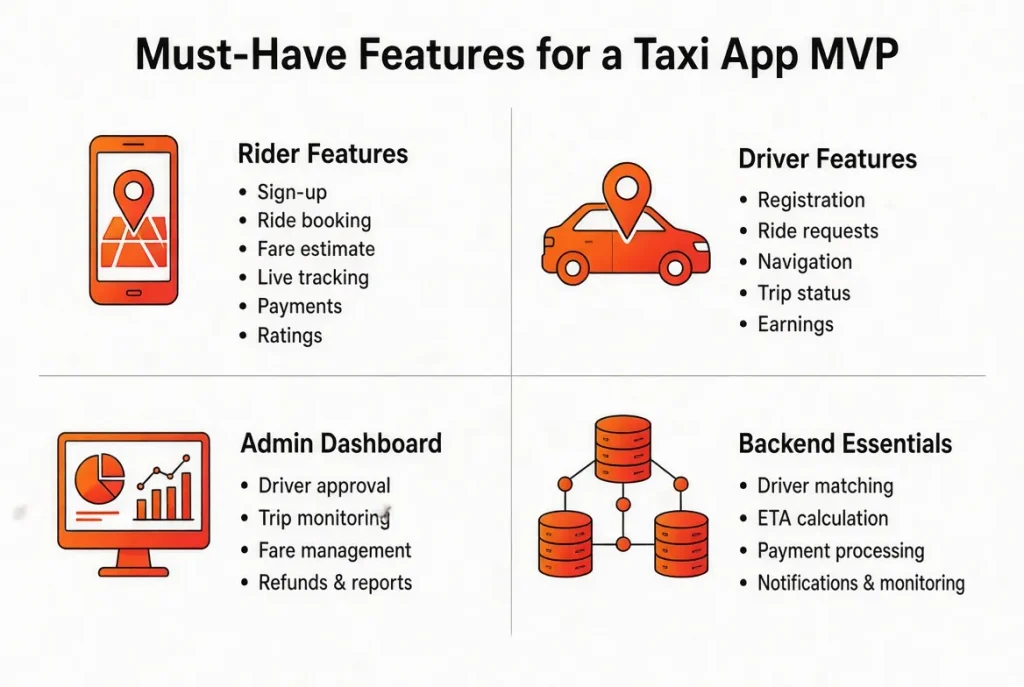
What Goes Into an App Like Uber: 4 Core Components
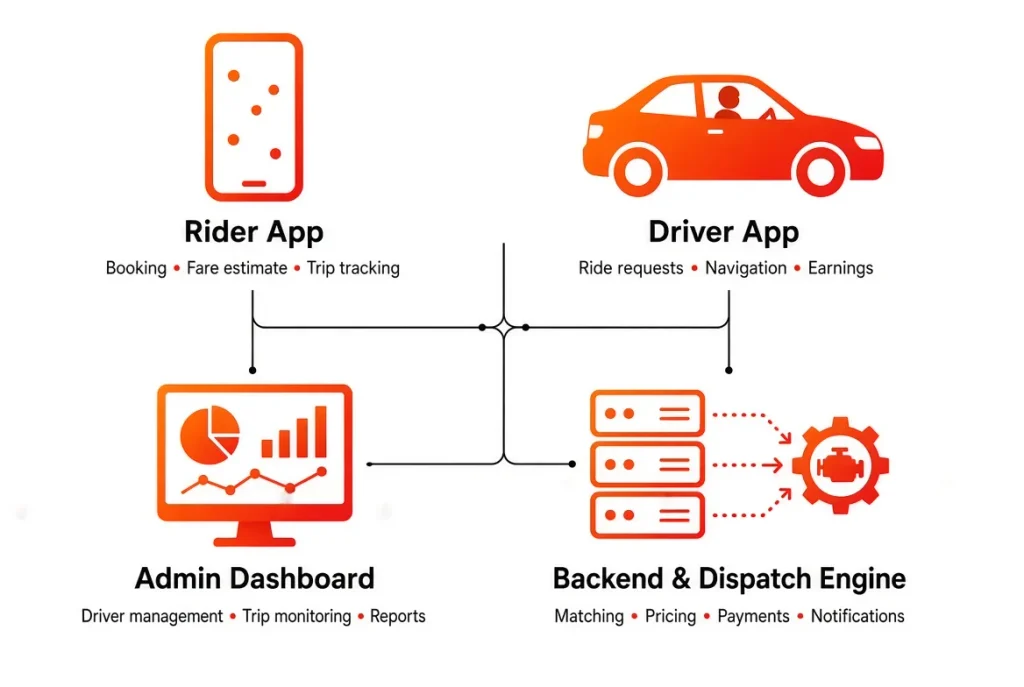
Most people think of the passenger app and assume it is most of the work. In reality, a ride-hailing platform has four connected parts.
Rider app (iOS and Android)
In rider app have sign-up, choosing pickup and drop-off places, fare estimates, booking, driver tracking, payments, trip history and ratings.
Driver app
Sign-up, document upload, ride requests, navigation, earnings and payouts. It is often harder to build than the rider app. Location tracking must keep working when the screen is locked, and the app must handle weak connections, background limits and battery-saving modes on different Android phones.
Admin dashboard
A web system for approving drivers, watching trips, changing prices, handling refunds and disputes, creating promotions and checking reports. Without it, daily operations become very hard to manage.
Backend and dispatch engine
The system that connects everything: driver matching, ETAs, fare calculation, trip status, payments, payouts and notifications. A backend error can cause wrong fares or double charges.
The biggest budgeting mistake is focusing on the rider app and forgetting the other three parts. Two apps that look the same can differ by $100,000 or more in what sits behind them. If a quote looks very low, check exactly what it includes.
Taxi App Cost Breakdown by Component
Approximate work for a first production release (some tasks run at the same time):
| Component | Typical hours | Share of budget |
|---|---|---|
| Discovery and requirements | 40–120 | 3–5% |
| UI/UX design (three interfaces) | 100–220 | 8–12% |
| Rider app | 350–500 | 15–20% |
| Driver app | 400–650 | 15–20% |
| Admin dashboard | 200–400 | 10–15% |
| Backend and real-time dispatch | 400–650 | 25–35% |
| Maps, payments, SMS, integrations | 100–200 | 5–8% |
| QA and load testing | 150–300 | 10–15% |
| Project management and DevOps | 100–180 | 5–10% |
A well-scoped MVP usually needs about 1,500 to 2,500 development hours. Most estimates are hours multiplied by team rates, so ask vendors for an hour-by-hour breakdown instead of one total number.
Taxi App Estimated Cost by Feature – 2026
Not every feature needs to be in the first release.
| Feature | Typical cost |
|---|---|
| Real-time booking and GPS tracking | $5,000–$20,000 |
| Driver-rider matching and dispatch | $5,000–$25,000 |
| Payments and driver payouts | $5,000–$18,000 |
| Driver onboarding and KYC | $3,000–$10,000 |
| Push notifications and SMS | $2,000–$7,000 |
| Ratings and reviews | $1,500–$5,000 |
| Scheduled rides | $3,000–$8,000 |
| In-app chat and masked calling | $3,000–$10,000 |
| SOS and safety tools | $2,000–$10,000 |
| Surge and dynamic pricing | $4,000–$25,000 |
| In-app wallet | $6,000–$15,000 |
| Analytics and reporting | $5,000–$18,000 |
| Ride pooling and carpooling | $15,000–$35,000 |
| AI-based dispatch and ETA prediction | $15,000–$40,000 |
Give dispatch, payments and the driver app attention from day one, because they are hard to add later. Ride pooling especially can mean a lot of rework if you add it late. Chat, scheduled rides, referral codes and advanced analytics are easier to add once you have users.
Cost by Team Location for Online Cab App
For a project that needs 2,000 hours:
| Region | Hourly rate | Approx. cost |
|---|---|---|
| USA and Canada | $100–$200 | $200,000–$400,000 |
| UK and Western Europe | $70–$150 | $140,000–$300,000 |
| UAE and the Gulf | $50–$120 | $100,000–$240,000 |
| Eastern Europe | $40–$80 | $80,000–$160,000 |
| Latin America | $40–$70 | $80,000–$140,000 |
| Southeast Asia | $20–$50 | $40,000–$100,000 |
Low rates do not always mean a better deal. A $40,000 app that struggles with 500 users at the same time can cost more to fix than a reliable $70,000 one. Look for live apps with real users (not just design screenshots), check App Store or Google Play pages, and read reviews on Clutch or GoodFirms. Also confirm the time-zone overlap, the team’s real-time and payments experience, and who owns the source code and data at the end.
Many startups pair a local product owner with a nearshore or offshore engineering team. This keeps costs down without hurting coordination.
Freelancer vs Agency vs In-House Team: Which Is Better?
| Model | Cost | Control | Main risk |
|---|---|---|---|
| Freelancers | Lowest upfront | Low | Hard to coordinate on complex projects |
| Agency | Medium | Medium | Needs careful checking and a clear contract |
| White-label script | Low | Limited | Code quality and scaling problems |
Native vs Cross-Platform
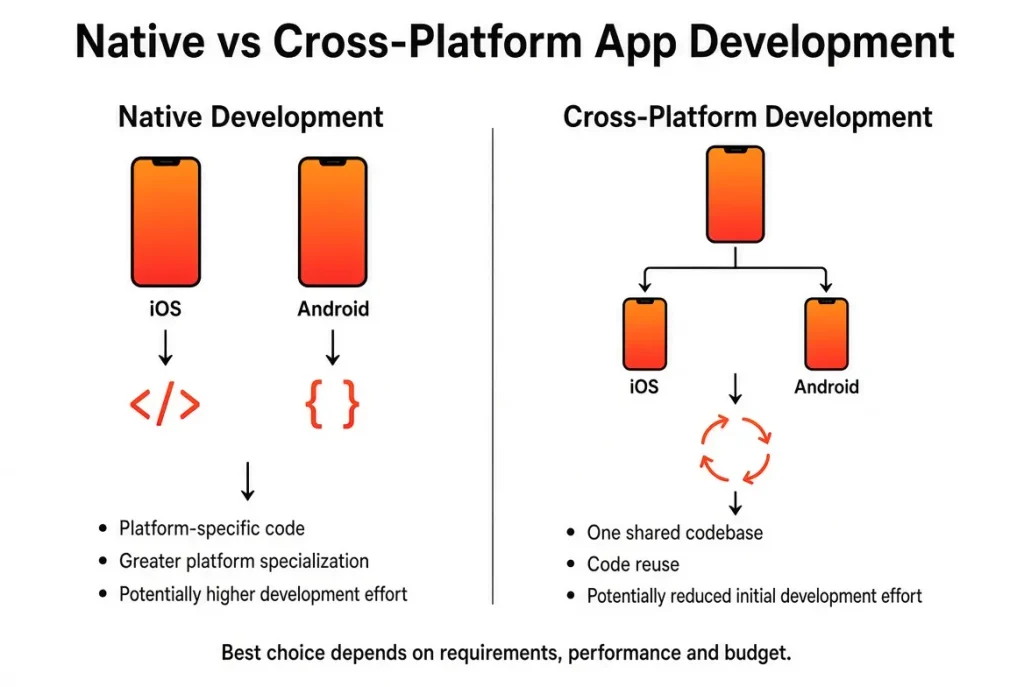
For most startups, cross-platform is a good start. Flutter and React Native build iOS and Android apps from one codebase. This can cut client-side work by 25–40% compared with two native apps. Both support real-time location tracking. Flutter is often chosen for steady UI and animation, while React Native has a large JavaScript ecosystem.
Native development (Swift and Kotlin) costs more, but it makes sense if you need heavy background-location processing or special performance. You do not have to decide for the whole product on day one. Many teams start cross-platform and move certain modules to native if performance data shows a need. You can also launch on Android first if most of your market uses Android.
Cost Breakdown by Technology Stack for App Like Uber
| Layer | Common choices |
|---|---|
| Mobile apps | Flutter, React Native, or native Swift and Kotlin |
| Backend | Node.js (NestJS), Go, Python (Django or FastAPI), Java |
| Real-time layer | WebSockets (Socket.IO), Firebase, MQTT |
| Geospatial lookup | Redis geo index, PostGIS, H3 hex grid |
| Databases | PostgreSQL for payments and reports; Redis or MongoDB for live trip state |
| Maps and routing | Google Maps Platform, Mapbox, HERE, OpenStreetMap-based services |
| Payments and payouts | Stripe (including Connect), Adyen, PayPal, Braintree, or a local gateway |
| Notifications and OTP | Firebase Cloud Messaging, APNs, Twilio |
| Cloud and DevOps | AWS, Google Cloud or Azure with Docker; Kubernetes at scale |
| Monitoring | Datadog, New Relic, Sentry |
Pay special attention to geospatial processing and real-time communication. The system must find nearby drivers quickly and keep trip data updated without delay. A slow dispatch engine ruins the experience, no matter how good the app looks. Use trusted providers for payments, SMS, push notifications and identity checks, and focus your custom engineering on matching, pricing, reliability and trip handling. A modular backend makes it easier to scale single parts later.
The Features Must-Have for Version 1
Your first release should deliver one complete journey: request a ride, match with a driver, complete the trip, pay and rate.
Rider app
Phone or email sign-up with OTP, pickup and destination search, fare estimates, vehicle choice, live driver tracking and ETAs, card or wallet payment (cash where suitable), trip history, receipts, ratings, notifications and SOS or trip sharing.
Driver app
Sign-up with license, vehicle and ID uploads, online and offline controls, ride requests with an accept-or-decline timeout, navigation handoff to Google Maps or Waze, clear trip statuses, and earnings and payout views.
Admin dashboard
Approve drivers and vehicles, see live drivers and trips on a map, manage fares and commissions, process refunds and disputes, block users, and track rides per day, waiting time, cancellation rate and revenue.
Backend essentials
Matching engine, ETA calculation, a reliable trip state machine, payment processing, payouts, notifications, logging and monitoring. These must work in a steady way when a ride is canceled, a payment fails or a driver loses connection.
The Features That Can Wait for Version 2
- Surge pricing: Easier to set well once you understand local demand.
- Ride pooling: Complex, so plan for it early even if you build it later.
- Corporate accounts and invoicing: Useful if you target business travel.
- Wallet, tips and split fare: Add them when customers clearly need them.
- Referral and loyalty systems: Add early only if your launch plan depends on them.
- Multi-language and multi-currency: Make these a priority when your market or growth needs them.
- AI dispatch and demand prediction: Wait until you have enough real ride data.
Ongoing Costs of an Uber-Like App Nobody Mentions
Every booking triggers map requests, location updates, notifications and payments, so running costs grow with activity.
| Cost | Typical range |
|---|---|
| Cloud hosting | $300–$3,000/month at launch; more at scale |
| Maps and routing APIs | $200–$3,000+/month |
| SMS, OTP and masked calls | Per message or minute; rises with usage |
| Payment processing | Commonly 2.5–3% plus a fixed fee per transaction |
| Maintenance and updates | 15–20% of build cost per year |
| Driver background checks | Per driver, sometimes repeated |
| App store fees | Apple about $99/year; Google Play $25 one time |
| Security audits and compliance | A few hundred to a few thousand dollars/year |
| Customer and driver support | Depends on team size |
Maps need extra attention. One trip can involve address searches, geocoding, route calculations, fare estimates and repeated ETA updates. Check the current Google Maps Platform or Mapbox prices before launch.
Another cost that estimates often miss is getting drivers and passengers. Driver incentives, rider discounts and local marketing can be more than the software cost in the first year. Get enough drivers in the right places before you promote heavily. If you don’t, new riders will face long waits and never come back.
Do the Unit Economics Before You Build
Take an average fare of $10 and a 20% commission:
| Line | Amount |
|---|---|
| Platform commission | $2.00 |
| Card processing (about 2.9% + $0.30) | -$0.59 |
| Maps, SMS and notifications | -$0.08 |
| Left over before support, hosting, incentives, insurance and marketing | About $1.33 |
That $1.33 is not profit. It still has to pay for support, infrastructure, insurance and getting new customers. Before launch, estimate your take rate, customer acquisition cost (CAC), driver retention and the number of daily rides you need to break even.
A Realistic First-Year Budget – Worked Example
One mid-sized city, a nearshore or Eastern European team, and a cross-platform MVP:
| Item | Cost |
|---|---|
| Discovery and design | $12,000 |
| Rider and driver apps (Flutter) | $22,000 |
| Backend and admin panel | $24,000 |
| Integrations (maps, payments, SMS) | $6,000 |
| QA and launch | $8,000 |
| Build total | $72,000 |
| 10% contingency | $7,200 |
| First 6 months of cloud and APIs | $6,000 |
| First 6 months of maintenance | $5,000 |
| Legal, licensing and insurance setup | $3,000–$8,000 |
| Marketing and driver onboarding | $15,000+ |
| Realistic first-year budget | About $110,000–$120,000 |
Budgeting only for development is risky. Once you add contingency, infrastructure, maintenance, legal costs and marketing, your first-year spend can be about 50% more than the build quote.
Planning to Build an App Like Uber?
Get a tailored development cost estimate based on your business model, target market and must-have features.
How Uber-Style Apps Make Money
Decide your revenue model before development starts. It affects fare calculation, driver pay and the features in your first version.
- Commission per ride: Often 15–30%. On a $20 ride with 25% commission, the platform keeps $5 and the driver gets $15. A lower rate can attract drivers, but it must still cover your costs.
- Driver subscription or flat fee: Drivers know what they will pay, but it is harder to sell before you have enough bookings.
- Rider subscriptions: Riders get discounts or priority booking, and you get steady revenue.
- Rider-set pricing: Fare negotiation suits price-sensitive markets, but it needs clear rules.
- Surge pricing: Raises revenue at busy times, but sudden price jumps upset customers. Set limits and test.
- Cancellation and waiting fees: Fair to drivers if the rules are clear and legal in your area.
- Corporate accounts: Hotels, hospitals and businesses may want monthly invoices and central booking.
- Advertising and premium services: Luxury vehicles, women-only rides or airport transfers, depending on local demand and rules.
White-Label Clone vs Custom Build
| Factor | White-label or clone | Custom build |
|---|---|---|
| Upfront cost | $5,000–$40,000 | $40,000–$300,000+ |
| Time to launch | 2–8 weeks | 3–14 months |
| Ongoing cost | License fees or paid customization | Infrastructure plus maintenance |
| Source code and data | Often limited | Yours, based on the contract |
| Flexibility | Limited by the vendor’s plans | Made for your needs |
| Best for | Testing demand or digitizing an existing fleet | Funded businesses, multi-city plans or unique models |
White-label software is a practical way to test demand. The main worry is what happens when you outgrow it. Moving driver accounts, passenger records and ride history can be costly if the vendor limits your access. Before you sign, check the license terms, source-code rights, data-export options and recurring fees.
Where AI Adds Value (and Where It Doesn’t)
Adding AI too early raises cost without much return. Most new businesses should launch with rule-based systems and add machine learning after they collect real trip data. The best first choices are:
- ETA and demand prediction: Better matching and better driver positioning.
- Fraud detection: Finds suspicious accounts, payment abuse and GPS spoofing.
- Dynamic pricing: Improves availability but needs monitoring.
- Support chatbots: Answer routine questions.
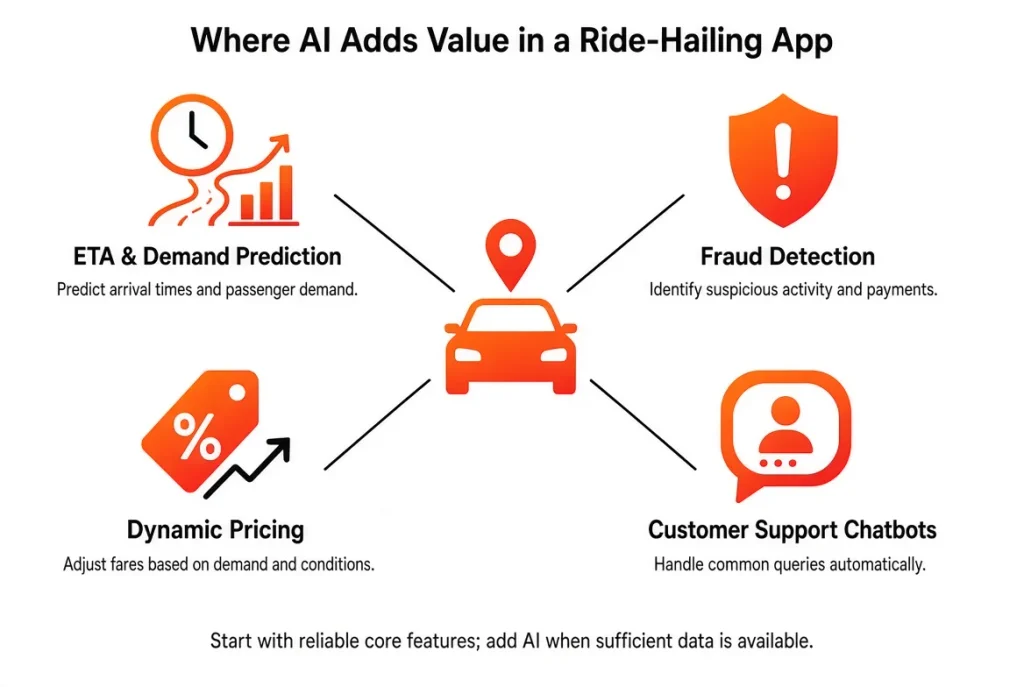
For a new platform, reliable bookings and correct payments are worth more than an expensive AI feature with little data behind it.
Legal and Compliance Checklist for App like Uber
Legal costs are normally not included in development quotes, and the rules differ by country and city. Talk to a local transport lawyer before you choose a launch date or spend money on marketing.
- Business registration and tax requirements.
- Ride-hailing or operator licenses (for example, TNC permits in parts of the US, or private hire licensing through Transport for London).
- Driver and vehicle document checks, including background screening where it applies.
- Passenger liability and commercial insurance.
- Data protection for location and payment data (GDPR, CCPA, local laws).
- PCI DSS if your payment setup brings you into scope; a hosted payment provider reduces card-data risk.
- Accessibility requirements, including ADA duties in the US.
- Terms of service, privacy policy and driver agreements.
- Correct classification of drivers as contractors or employees.
Following the rules in one city does not mean you follow the rules in another.
How Long Does It Take to Build an App?
| Phase | Typical duration |
|---|---|
| Discovery and planning | 2–4 weeks |
| UI/UX design | 3–6 weeks |
| Backend and admin panel | 6–14 weeks |
| Rider and driver apps | 8–16 weeks |
| Testing, QA and load testing | 3–6 weeks |
| Launch and store approval | 1–3 weeks |
Allow about 3–5 months for an MVP, 5–8 months for a mid-level app and 9–14 months for an enterprise app. The phases overlap. Spend time on discovery. Changing a requirement during planning is a short talk, but changing it in the middle of development affects design, backend, testing and the schedule.
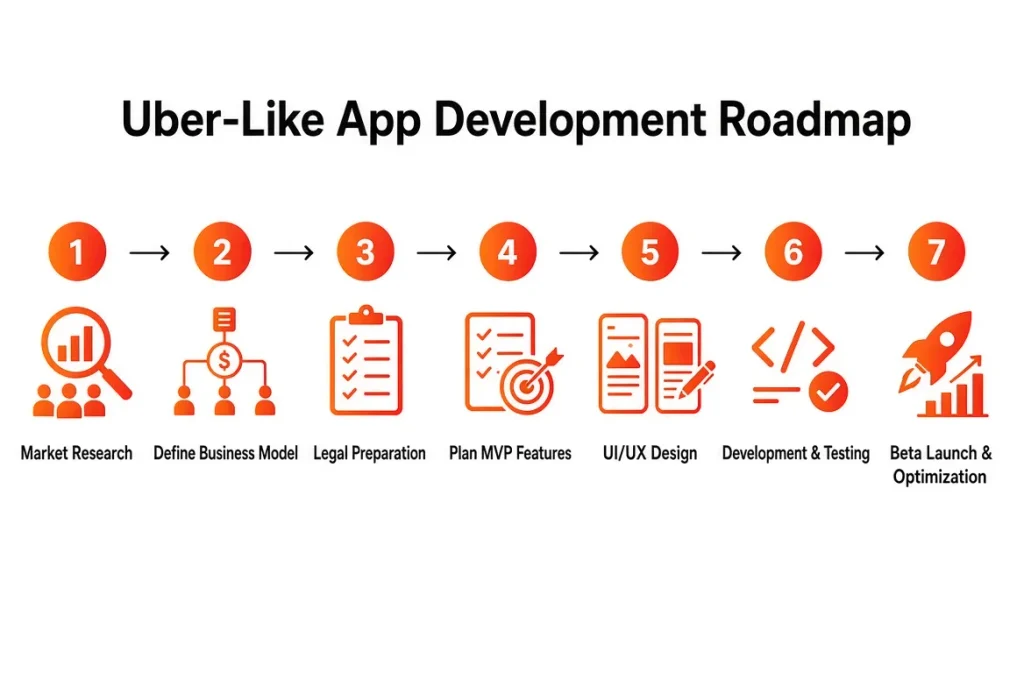
How to Build a Taxi App like Uber: A Step-by-Step Plan
- Validate the market. Talk to at least 20 possible drivers and riders and study the existing services in your city. Ask riders about prices, waits, safety and payment options, and ask drivers about commissions and payout delays.
- Choose your niche. Lower commissions, airport transfers, women-only rides, school or medical transport, corporate shuttles or vans. Focus is better than trying to serve everyone.
- Address legal requirements early.
- Define pricing rules and trip statuses. Write down the base fare, per-km and per-minute rates, minimum fare, night charges, airport fees and cancellation policy, and map every status from request to completion or failed payment.
- Set the MVP scope. Booking, tracking, payments, ratings and a basic admin dashboard.
- Choose your development team. Compare experience, process and estimates. Milestone-based contracts help control spending if scope and change requests are written down.
- Design and prototype. Test a clickable prototype with five to ten real drivers and riders.
- Build in two-week sprints with CI/CD and automated tests for fares and trip states.
- Test on real roads. Use different phones, weak networks, tunnels and battery-saving modes.
- Run a closed beta with 30–50 friendly drivers in one neighborhood.
- Soft-launch and build driver supply first. Track pickup times, acceptance, completed rides, payment success, cancellations and repeat use.
- Improve before you expand. Let real data decide what to build next, and expand only when your first market runs well.
Common Mistakes That Affect on Budgets
- Estimating only the rider app and ignoring the driver app, backend and admin panel.
- Building every Uber feature in the first release.
- Treating the admin dashboard as minor. An 80-hour estimate can grow to several hundred hours.
- Launching in several cities at once, which spreads driver supply too thin.
- Skipping load testing.
- Leaving payments until late, even though refunds, failed charges, tips and payouts need early planning.
- Testing background location on only a couple of phones.
- Choosing the lowest bid without checking experience with scaling.
- Checking local rules in launch week.
- Spending everything on development and leaving nothing for driver acquisition.
- Not budgeting for contingency and maintenance.
How to Reduce Cost – 10 Smart Ways
- Start with one city and one platform, but design the app so more cities can be added without a rebuild.
- Use cross-platform development (Flutter or React Native).
- Use trusted third-party services for maps, payments, SMS, notifications, identity checks and background checks. This can cut first-release effort by 20–30%.
- Start with the supply you already have, such as your own fleet or a taxi association.
- Onboard drivers by hand at first. An admin-assisted process can save an estimated 80–120 hours compared with a full in-app KYC workflow, as long as the checks still meet legal and safety rules.
- Keep the admin panel simple, not optional.
- Leave AI for later.
- Write down the scope with features, deliverables and acceptance criteria before development starts.
- Invest in two to four weeks of discovery.
- Protect your ownership rights over source code, customer data and reusable components, including how to move the project if you change vendors.
How to Choose a Development Partner
Ride-hailing needs experience with real-time systems, payments and background location, not just mobile apps. Ask possible agencies:
- Have you built a real-time dispatch service, or only the apps around one? Can I review live products and speak to past clients?
- Can you provide an hour-by-hour estimate?
- Who owns the source code, driver data and passenger data at the end?
- How will you test live tracking, payments and payouts?
- What launch and post-launch support is included, and what does it cost?
- How will the system cope if ride volume grows ten times?
- What happens if requirements change in the middle of the project?
A reliable partner explains technical choices in plain language, backs up the estimate and warns you about risks early. Compare proposals on scope, quality and long-term support, not on price alone.
At Daigency, we help businesses plan and build digital products around their real needs. If you are exploring a taxi booking platform or another on-demand service, you can talk to our team about scope, key features and budget before you commit to development.
Ready to Launch Your Own Uber-Like App?
Partner with Daigency to plan your features, estimate your budget and map out a practical development roadmap for your ride-hailing business.
Uber for X: The Same Model in Other Industry Comparison
The model of booking, matching, tracking and payment fits well in other sectors:
- Healthcare: Non-emergency patient transport and scheduled medical rides.
- Logistics and courier: Parcel pickup, delivery dispatch and last-mile transport.
- School and corporate transport: Fixed routes, employee shuttles and parent tracking.
- Home services: Cleaning, repair and beauty professionals.
- Fleet and car rental: Availability, reservations and tracking.
- Moving trucks and airport transfers.
A focused service can beat a general platform. A medical transport app can win on scheduling, compliance and accessibility instead of copying every Uber feature. Grab, Gojek and Careem have also grown into food delivery, parcels and payments, and smaller towns may offer chances with different booking, pricing and verification methods.
Should You Start With a No-Code Booking App?
If you run a small taxi business with fewer than 20 vehicles and most bookings come by phone or messaging apps, a no-code booking tool (about $0–$1,500 per year) may be enough to start. It helps you organize reservations cheaply, but it usually has no real-time GPS tracking and no automatic dispatch. Once your volume grows and you need control over matching, tracking and payments, move to a custom MVP.
Final Thoughts
The cost of building an app like Uber depends on your goals, your launch market and how much functionality you need on day one. A focused single-city MVP is a very different project from a multi-city platform with advanced dispatch and several service types.
The practical path is to start in a market you can manage, get the booking-to-payment journey right, and invest in reliable dispatch, secure payments and a driver experience that works in real conditions. Keep money aside for maintenance, legal requirements and driver acquisition. Once you have real trip data, you will know what to improve and where to expand.
FAQs - App Cost like Uber
- How much does it cost to build an app like Uber in 2026?A single-city MVP usually costs $40,000–$80,000, a mid-level app $80,000–$150,000 and an enterprise platform $150,000–$300,000+. Costs change with location, scope and technical needs.
- How much does it cost to build a taxi app?A full marketplace taxi app costs about the same as a ride-hailing platform. A simpler booking app for a company that already owns its vehicles and manages its drivers may start at around $10,000–$30,000.
- How long does it take to develop a taxi app?About three to five months for an MVP, five to eight for a mid-level product and nine to fourteen for an enterprise platform.
- What is the minimum budget for an Uber-like app?A lean single-city MVP may be possible at around $35,000–$50,000 with a tight scope and a cost-efficient team. Below about $20,000, you will usually get a white-label solution or a limited prototype.
- What are the most expensive features?Dispatch and matching, real-time GPS tracking, payments and payouts, and ride pooling.
- What are the monthly running costs?A small app may spend $100–$500 per month on hosting, maps and notifications, while a growing platform may spend several thousand. Support, marketing and driver incentives cost extra.
- Is cross-platform good enough for a taxi app?Yes, for many businesses. Flutter and React Native support real-time tracking. Think about native later if you need heavy background-location processing or platform-specific performance.
- Do taxi apps pay the 30% App Store commission?Usually no. Apple and Google treat physical services like rides differently from digital content, so fares can usually go through an outside payment provider. Developer account fees still apply, and you should check the current store policies before launch.
- Is a white-label taxi app cheaper than a custom build?Usually it is cheaper upfront and faster to launch. The long-term cost depends on license fees, customization needs, scaling limits and whether you can export your code and data.
- Does a ride-hailing app need a license?In many markets, yes. The rules depend on the country, city, business model and type of service, so talk to a local transport lawyer before you launch.
- Which AI features should I add first?ETA prediction and fraud detection, once you have reliable data. Dynamic pricing and ML-based dispatch can come later when you understand demand patterns.
- Is a taxi app profitable?It can be, depending on ride volume, commission, driver retention and acquisition cost. Launching in one city or niche makes the numbers easier to manage.
- What is the biggest reason ride-hailing startups fail?Usually it is not the technology. Weak driver supply, long waits, poor unit economics, weak legal preparation and weak daily operations sink platforms whose apps work fine.
- What is the difference between a taxi booking app and a ride-hailing app?A taxi booking app digitizes reservations for a company that owns its vehicles and manages its drivers. A ride-hailing app is a marketplace that connects passengers with partner drivers. This adds onboarding, automatic matching, commissions and payouts, and so it costs more.
- Which APIs and third-party services does a taxi app need?Maps, geocoding and directions (Google Maps Platform, Mapbox); a payment gateway with marketplace payouts (such as Stripe Connect where available); SMS and OTP (Twilio); push notifications (Firebase Cloud Messaging, APNs); and identity verification or background-check providers where required.