

If you’ve been researching food delivery app development, you’ve probably noticed something annoying: every website gives you a different number. One says $20,000, while another says $300,000. So, which one is right? Market share breakdown (DoorDash 66%, Uber Eats 23%, Grubhub 8%) – useful if you want to add a supporting why competition drives feature expectations.
Honestly, both can be. The food delivery app development cost depends on what you’re actually building. A simple food ordering app for your own restaurant is very different from a full food delivery platform like DoorDash, with customers, restaurants, delivery partners, online ordering, payments, and an admin system working together.
With the US online food delivery market continuing to grow year over year, more restaurants and startups are entering the space- which is exactly why getting your budget right from the start matters.
Your app development cost can also change based on the features, technology stack, platform, development requirements, and level of customization. That’s why looking at average app prices alone isn’t enough. You need a realistic development budget based on your business model and the type of mobile application you want to build.
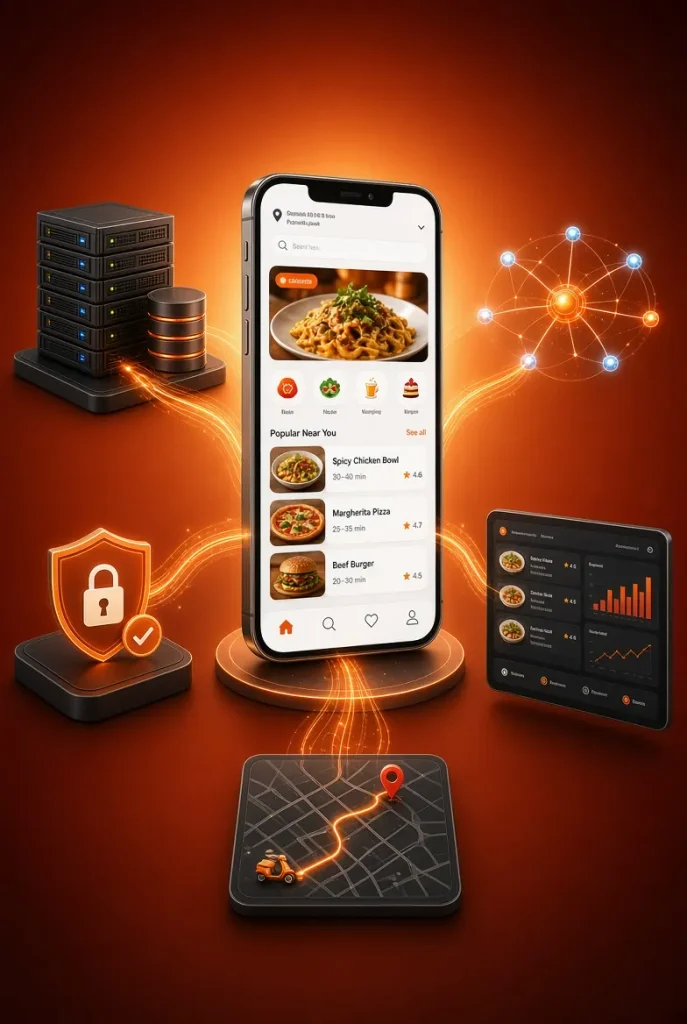
Here’s a straight answer, without the fluff.
Quick Overview Food Delivery App Cost Breakdown
In 2026, a food delivery app in the USA typically costs between $25,000 and $300,000+. Here’s how that breaks down by app type:
| App Type | Estimated Cost | Timeline |
| Basic MVP (single restaurant) | $17,000 – $35,000 | 2–4 months |
| Multi-restaurant app | $45,000 – $90,000 | 4–6 months |
| Full delivery platform | $100,000 – $150,000 | 6–9 months |
| Enterprise / multi-city app | $180,000 – $220,000+ | 9–12+ months |
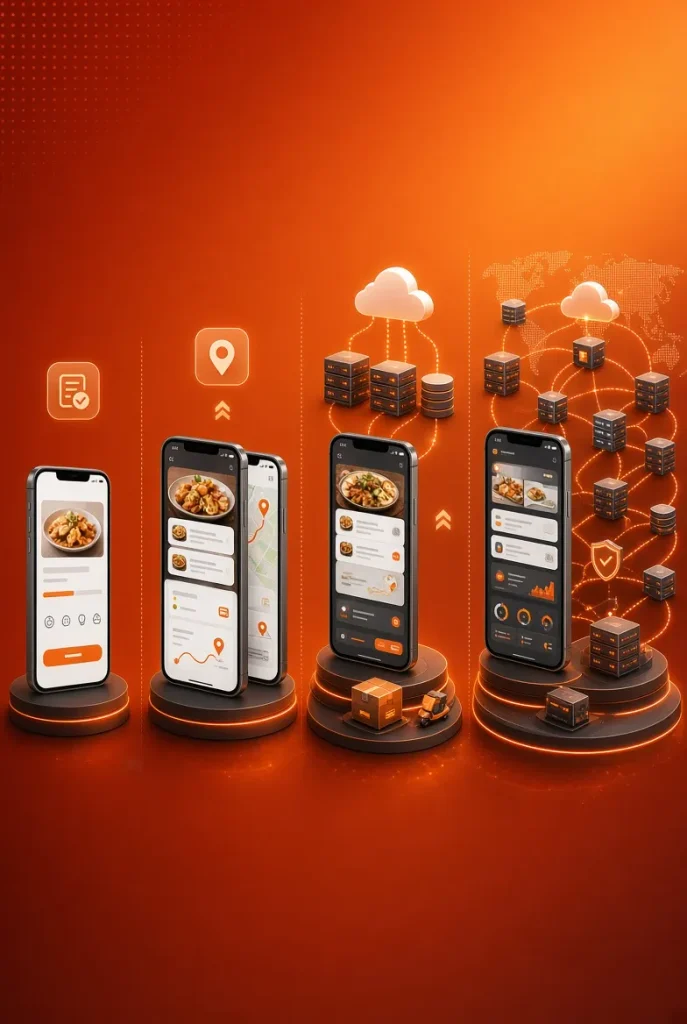
These numbers can move up or down based on features, design, technology stack, and the team you hire.
Build a food delivery app in the USA?
Think of them as a starting point for budget planning, not a fixed quote.
Why Isn’t There One Fixed Price?
Because “food delivery app” isn’t really one product. It’s an umbrella term for several very different things.
A single pizza shop that wants online ordering needs a fraction of what a platform like Uber Eats needs. In fact, platform-to-consumer delivery now makes up the majority of the market by order volume, which is why most new entrants are building toward a marketplace model rather than a single-restaurant app from day one. A full food delivery platform is really four connected systems working as one:
- Customer app – browsing, ordering, paying, and tracking
- Restaurant panel – managing menus, prices, and incoming orders
- Driver app – accepting deliveries, navigation, and earnings
- Admin dashboard – overseeing the entire operation, payments, and reports
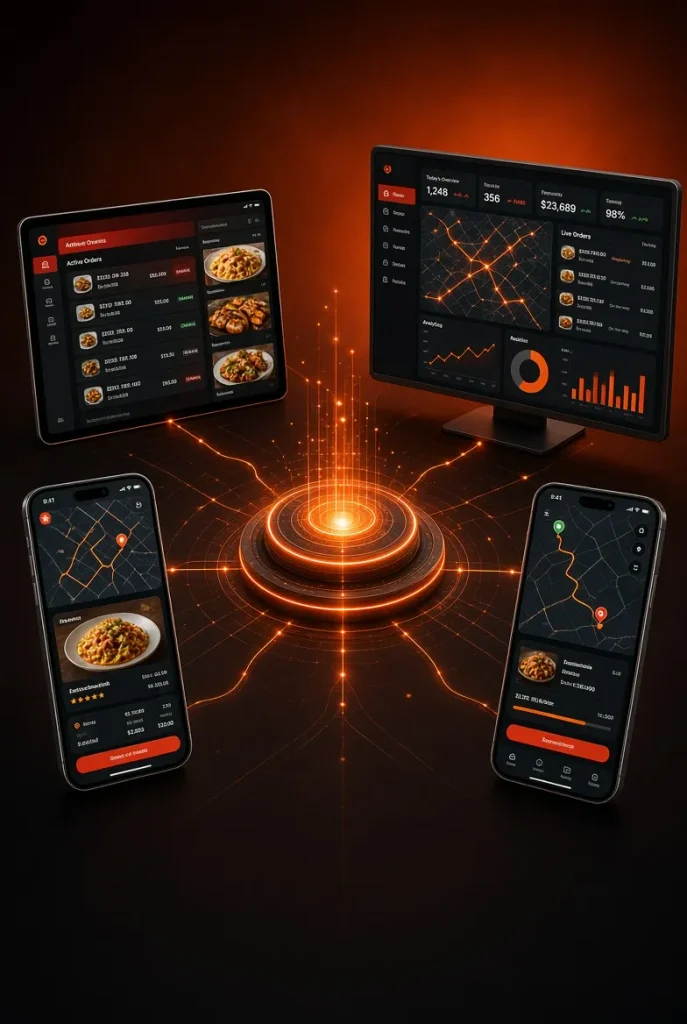
These pieces have to work together in real time. The moment someone places an order, the restaurant needs to see it instantly, a driver needs to get assigned, and the customer needs live status updates.
That real-time coordination and delivery operations, rather than the ordering screen itself, is what actually drives up development cost.
What Actually Moves the Price Up or Down of Food Delivery App?
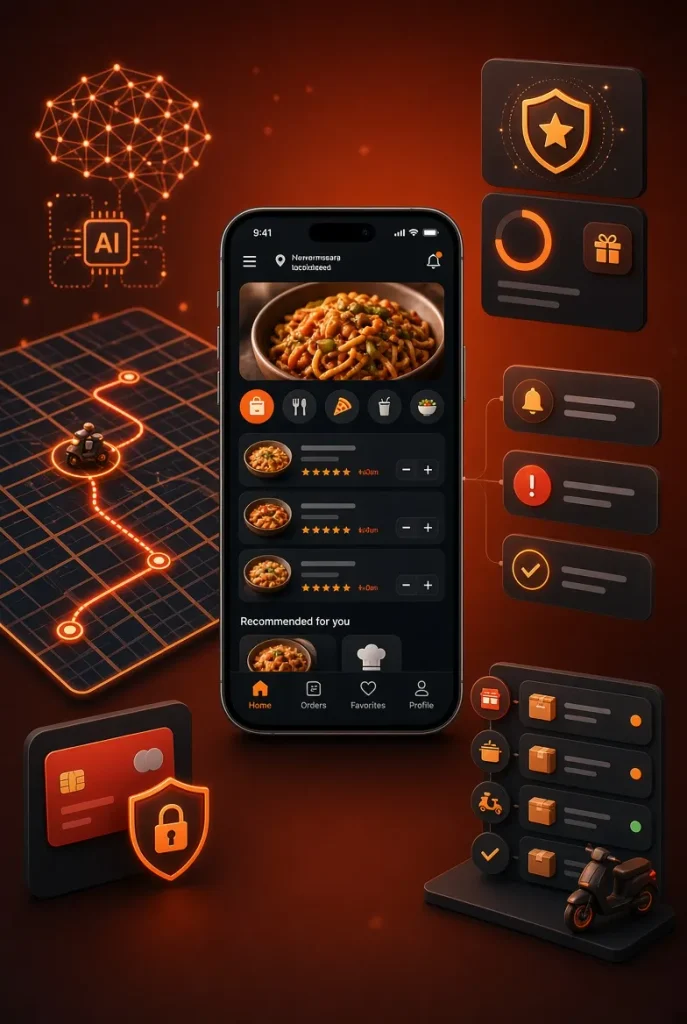
Features. A basic cart-and-checkout flow is relatively simple. Live GPS tracking, automated driver dispatch, AI-based recommendations, and loyalty programs are not. They require more backend development, additional logic, integrations, and much more testing.
Number of apps. Building just a customer mobile application is very different from building a customer app, restaurant panel, driver app, and admin dashboard. Each additional app means more screens, permissions, integrations, and QA work.
Design. A clean and simple UI costs less than a fully custom design with animations and personalized layouts. For food ordering, simple usually works well anyway. People want to order quickly, not spend time admiring the interface.
Platform choice. Native iOS and Android development means maintaining two separate codebases. Building once with technologies such as Flutter or React Native and launching on both platforms can reduce mobile app development time and cost.
Integrations. Payment gateways, Google Maps, SMS/OTP verification, push notifications, and POS systems all add development time. These third-party integrations can also come with ongoing usage fees.
Where your developers are based. US-based development teams typically charge $100–$200+/hour. Offshore teams can be significantly cheaper, but a lower development rate does not always mean a lower final bill if the code needs rework later.
What Should Actually Be in Version One?
You don’t need everything on day one. Most successful apps can start with a lean MVP (minimum viable product) and expand later based on real usage data.
Start with:
- Sign-up and login
- Restaurant listings and search
- Menu browsing and cart
- Secure checkout and payments
- Basic order tracking and notifications
- Simple restaurant order management
- A lightweight admin panel
Add later, once you have real users:
- Live GPS tracking
- AI-driven recommendations
- Loyalty and referral programs
- Multiple payment options
- POS integrations
- Multi-city expansion
Trying to launch everything at once usually means a longer development timeline, a bigger bill, and features nobody ends up using.
Starting with a focused food delivery solution also gives a business the chance to test its idea before making a larger development investment.
The Hidden Costs Nobody Mentions of Food Delivery App
The development invoice is not your final cost. It’s just the beginning.
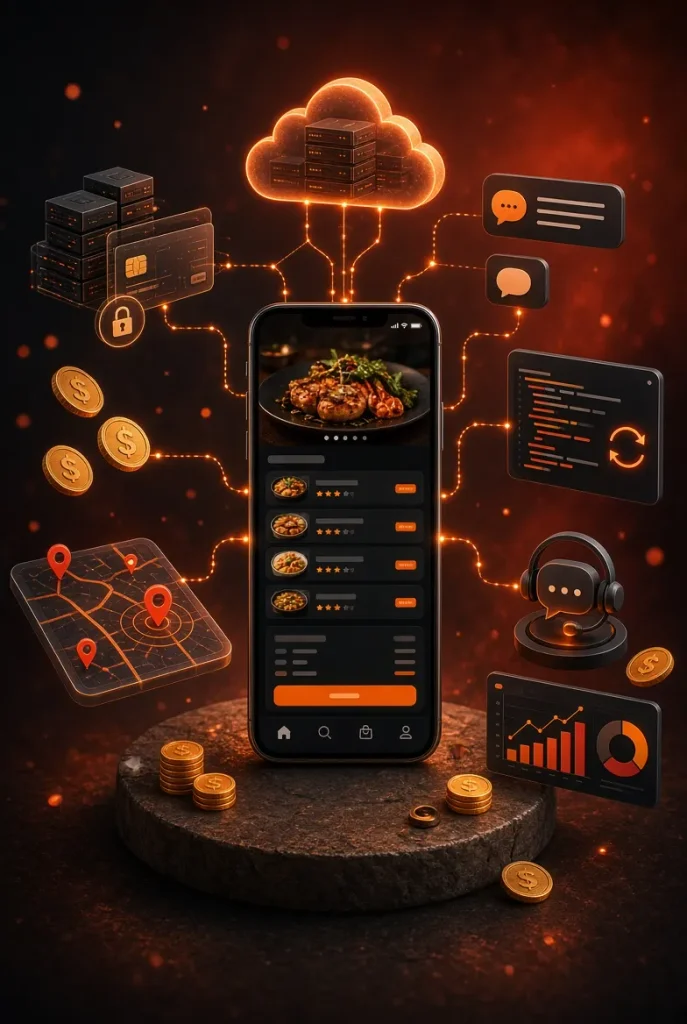
After launch, expect ongoing expenses for:
- Cloud hosting, which scales with your order volume
- Payment processing fees on every transaction
- Maps and location API usage
- SMS/OTP and notification services
- App maintenance, a common rule of thumb is setting aside 15–20% of your original build cost per year for updates and bug fixes
- Customer support
- Marketing, because launching an app doesn’t automatically bring customers
If your development budget is $60,000, your real first-year cost, once you add hosting, APIs, support, and marketing, will land noticeably higher.
This is why businesses should consider hidden costs, post-launch costs, maintenance costs, and technology integrations before starting app development. Planning for these expenses early makes the overall app investment easier to manage.
How Do These Apps Actually Make Money?
Before writing a single line of code, it’s worth deciding how the app will earn revenue, since this shapes what you build.
Common models include:
- Commission on every restaurant order
- Delivery fees charged to customers
- Subscriptions for free or discounted delivery
- Featured listings restaurants pay for
- In-app advertising
Most successful food delivery businesses don’t rely on just one model. They stack two or three together.
Your business model can affect the features, payment systems, delivery services, and overall structure of the digital platform you build.
Custom Build or White-Label?
You’ve got two real paths here.
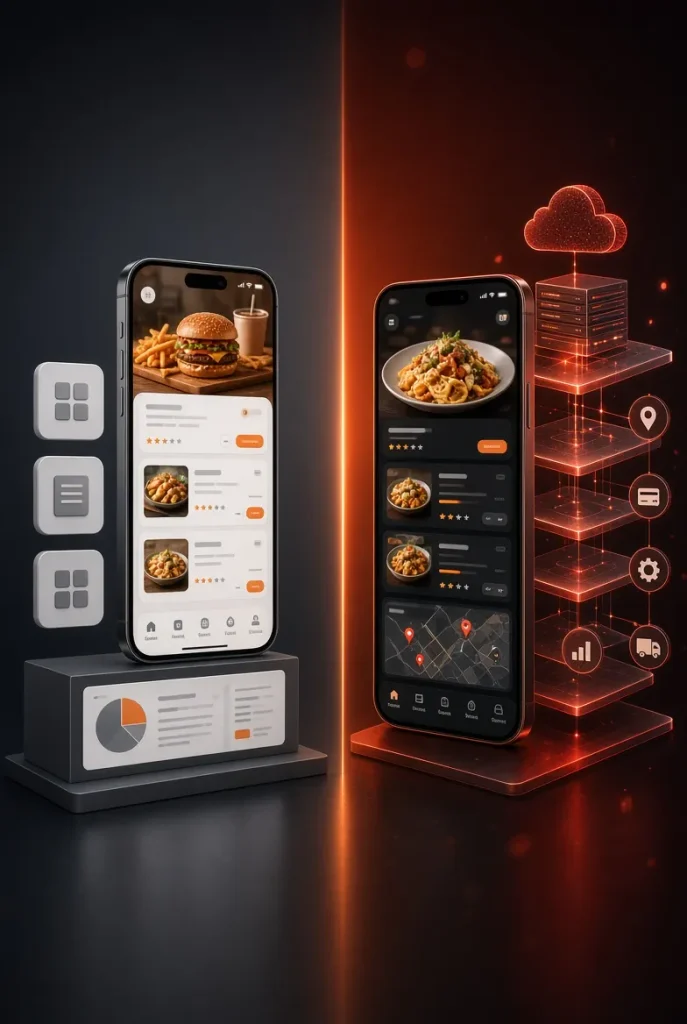
A white-label solution is a ready-made platform that you customize with your branding. It’s faster to launch and cheaper upfront, but you’re limited in what you can change. It can also feel restrictive once your business grows.
A custom app is built around your exact business model from scratch. It costs more and takes longer, but you get full control and more room to grow without hitting a ceiling.
If you’re testing an idea, white-label can make sense. If you’re building something you plan to scale for years, custom development is usually worth the extra investment.
This choice also affects scalability, development requirements, technology integrations, and future business expansion.
A Realistic Way to Budget
Before requesting quotes for food delivery app development services, get clear answers to these:
- Are you serving one restaurant, several, or an open marketplace?
- One city, or multiple?
- Do you need a dedicated driver app, or will you use third-party delivery?
- iOS, Android, or both?
- Which payment methods matter to your customers?
- Do you actually need live GPS tracking on day one?
- Which features can realistically wait six months?
Answering these honestly will get you a far more accurate estimate than any online calculator.
Your answers help define the project cost, development expenses, feature costs, platform costs, development timeline, and overall development budget before the project begins.
Final Thoughts
There’s no single “correct” price for a food delivery app development project because there’s no single type of food delivery app.
A single-restaurant ordering tool and a DoorDash-style marketplace share a name but almost nothing else in terms of development effort.
For most new businesses, the smart move is the same one it’s always been: build a focused MVP, get it in front of real customers, and expand based on what they actually use, not on what looks impressive in a feature list.
A clear business model, realistic budget, suitable technology stack, and practical development plan can make the app development process much easier to manage.
Why Choose Daigency for Food Delivery App Development?
Building a successful food delivery application requires more than attractive screens. The platform needs a reliable backend, secure payments, smooth user flows, integrations, and an architecture that can support future growth.
Daigency can help businesses plan and develop custom mobile applications based on their business model, required features, target market, and budget. From UI/UX and mobile app development to backend systems, APIs, payment systems, and other integrations, the project can be structured around what your business actually needs.
Whether you need a simple restaurant delivery app, a multi-restaurant platform, or a scalable food delivery solution, the development process can be planned around your goals and budget.
Want to build a food delivery app in the USA?
Talk to Daigency about your idea, features, budget, and development plan.
FAQs- Food Delivery App Cost in USA
- How much does it cost to build a food delivery app in the USA?Costs generally range from $17,000 for a basic single-restaurant MVP to $220,000+ for a full multi-vendor platform with driver management and live tracking.
- How long does it take to build one?A basic MVP takes about 2–4 months. A complete platform with customer, restaurant, driver, and admin apps can take 6–12 months.
- Do I need separate iOS and Android apps?Not necessarily. Frameworks like Flutter or React Native let you build once and launch on both platforms, which usually saves time and money.
- Can I build a food delivery app on a small budget?Yes. A focused MVP with only essential online ordering features can be built within a modest budget, with advanced features added after launch.
- What increases the cost the most?Live GPS tracking, automated driver dispatch, AI features, POS integrations, and building four separate apps — customer, restaurant, driver, and admin — instead of one.
- What ongoing costs should I plan for after launch?Hosting, payment processing, maps and SMS APIs, maintenance, customer support, and marketing. For upkeep alone, businesses commonly plan around 15–20% of their original build cost per year.