
How AI Is Changing Search
Search is changing quickly. A few years ago, people mostly typed keywords into Google and opened websites from the search results. Today, they may ask a complete question, use voice search, or ask an AI tool for a direct answer.
This change has created new ways for businesses to improve online visibility. Search Engine Optimization (SEO) helps websites appear in traditional search results. Answer Engine Optimization (AEO) focuses on giving clear answers to user questions. Generative Engine Optimization (GEO) helps content become useful and visible in AI-generated answers.
These strategies are connected, but they are not exactly the same. Understanding SEO, AEO, and GEO in digital marketing can help businesses build a stronger content strategy for modern search.
The goal is simple: create useful, trustworthy, and easy-to-understand content that both people and search technologies can understand.
What Is SEO?
Search Engine Optimization (SEO) is the process of improving a website so it can appear higher in organic search results. It helps search engines understand a website and decide when its pages are relevant to a user’s search query.
In simple words, SEO helps people find your website without paying for every visit.
How Does SEO Work?
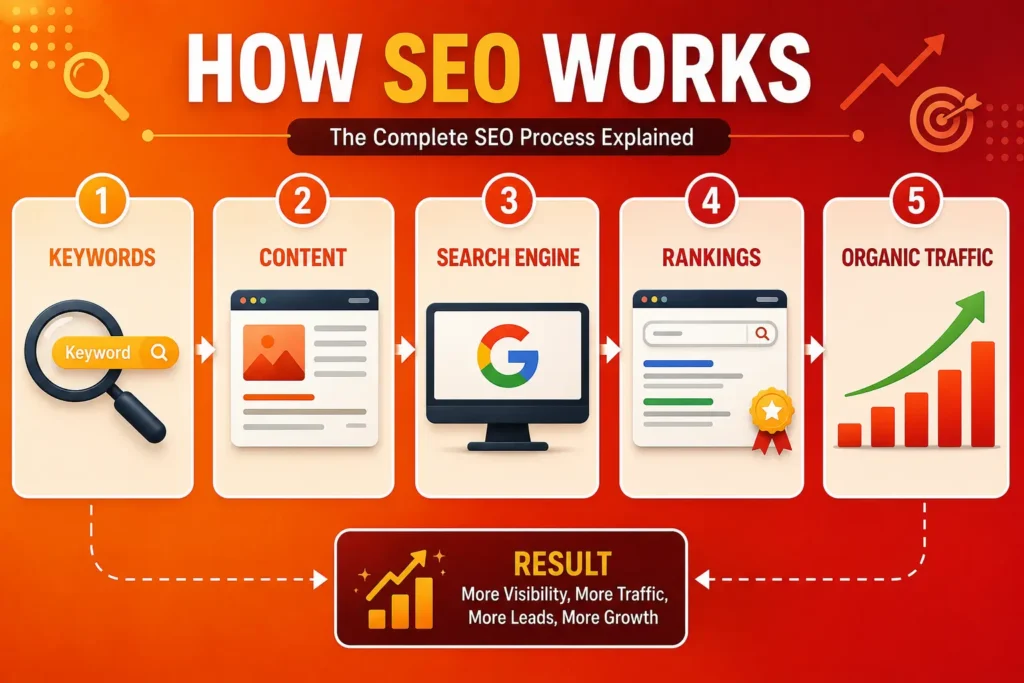
SEO works through several important areas, including:
- Keyword research: Finding the words and phrases your target audience searches for.
- On-page SEO: Improving headings, title tags, meta descriptions, content, images, and internal linking.
- Technical SEO: Improving website speed, mobile usability, crawlability, indexing, and technical structure.
- Off-page SEO: Building backlinks, mentions, and website authority.
- Content optimization: Creating useful and relevant content that matches search intent.
- User experience: Making a website easy to navigate and helpful for visitors.
Search engines consider many ranking factors when deciding which pages should appear in search engine results pages (SERPs).
If you want to learn more about improving your Google rankings, our guide on How to Rank Website on Google in 2026
10 Benefits of SEO Optimization
SEO can provide several benefits for businesses when it is planned and maintained properly:
- Increases organic traffic
- Improves website visibility
- Helps reach people with relevant search intent
- Builds brand awareness
- Supports long-term online growth
- Can improve credibility and trust
- Helps generate qualified leads
- Supports better user experience
- Can increase clicks and conversions
- Creates a stronger online presence
Why Is SEO Important for Business?
SEO is important for business because customers often use search engines before making a decision. A strong SEO strategy can help a company appear when people are looking for its products, services, or information.
For example, someone searching for “website development company in Houston” already has a clear need. A well-optimized website has a better chance of reaching that person through organic search.
Disadvantages of SEO
SEO also has some challenges. It can take time to produce strong results, search engine algorithms can change, and competition can make popular keywords difficult to rank for.
SEO is therefore not a one-time task. Businesses need fresh content, technical improvements, useful backlinks, and regular performance checks.
What Is AEO?
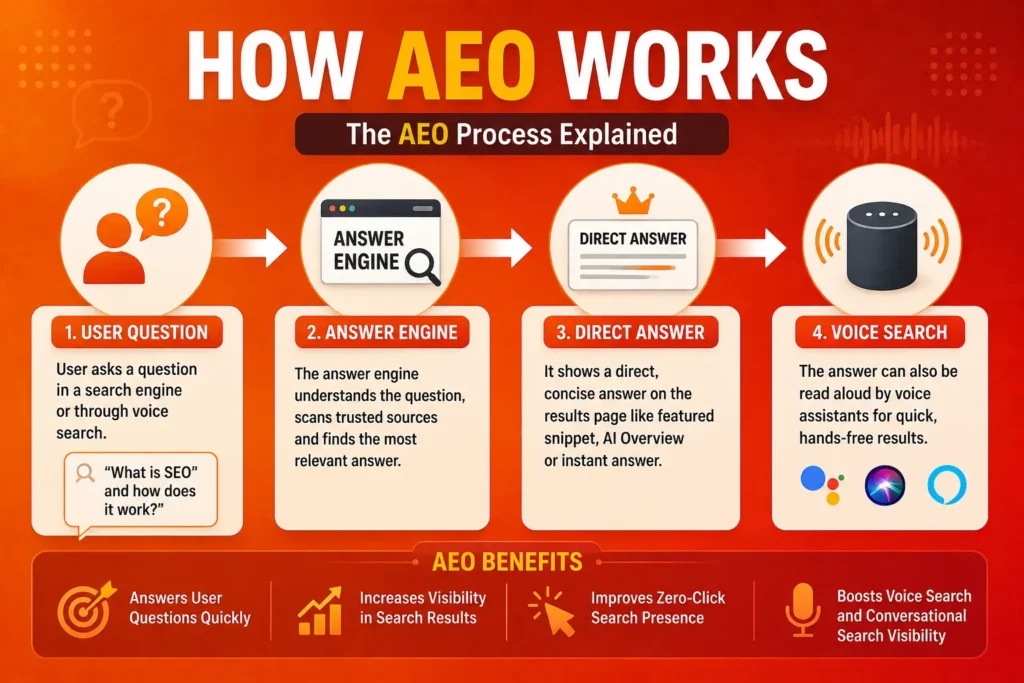
Answer Engine Optimization (AEO) is the practice of creating content that can provide direct and useful answers to people’s questions. Instead of focusing only on ranking a page, AEO focuses on helping search systems identify a clear answer.
For example, a person may search:
“What is SEO and how does it work?”
AEO-friendly content would answer the question quickly and then explain the topic in more detail.
How Does AEO Work?
AEO works well with question-based queries, conversational search, and direct-answer formats. Content should make important information easy to find and understand.
Useful AEO practices include:
- Answering common questions directly
- Using clear headings and subheadings
- Adding FAQ content
- Keeping important answers concise
- Using natural language
- Understanding user questions and search intent
- Organizing information into clear sections
- Supporting answers with reliable information
AEO can also be useful for voice search because people often ask voice assistants complete questions rather than short keywords.
AEO vs SEO
A common question is AEO vs SEO: which is better?
The answer is that they serve different purposes.
SEO focuses strongly on improving organic search visibility and rankings. AEO focuses more on making content suitable for direct answers and answer engines.
A page can use both. For example, SEO can help a page rank for a search query, while AEO can make its answer easier for a search system to understand and present.
What Is GEO?
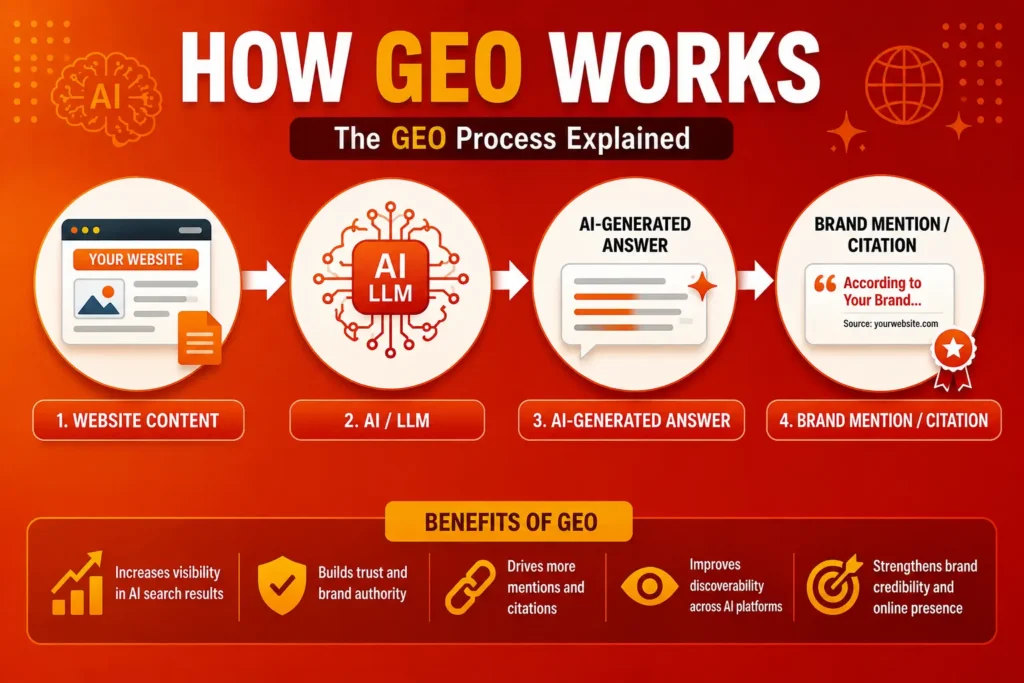
Generative Engine Optimization (GEO) is the process of creating and improving content so it has a better chance of being understood, referenced, or mentioned in AI-powered search and generative answers.
Generative AI systems can combine information from different sources to produce an answer. This makes content authority, factual accuracy, relevance, and clear information more important.
What Is GEO in Digital Marketing?
GEO in digital marketing means preparing a brand’s online content for the growing use of generative search.
Instead of only asking, “How can I rank on Google?” marketers may also ask:
“How can my brand become a trusted source in AI-generated answers?”
GEO can involve:
- Creating authoritative content
- Supporting claims with reliable sources
- Publishing original research and useful data
- Building brand authority
- Covering topics in depth
- Using clear and factual language
- Keeping important information updated
- Earning relevant brand mentions and citations
- Creating content that answers real user questions
What Is GEO in SEO?
GEO is closely related to SEO, but it has a different focus. Traditional SEO is mainly concerned with visibility in search engine results, while GEO considers visibility within generative search experiences.
This does not mean that GEO replaces SEO. A strong website can still need technical SEO, quality content, backlinks, and good search visibility.
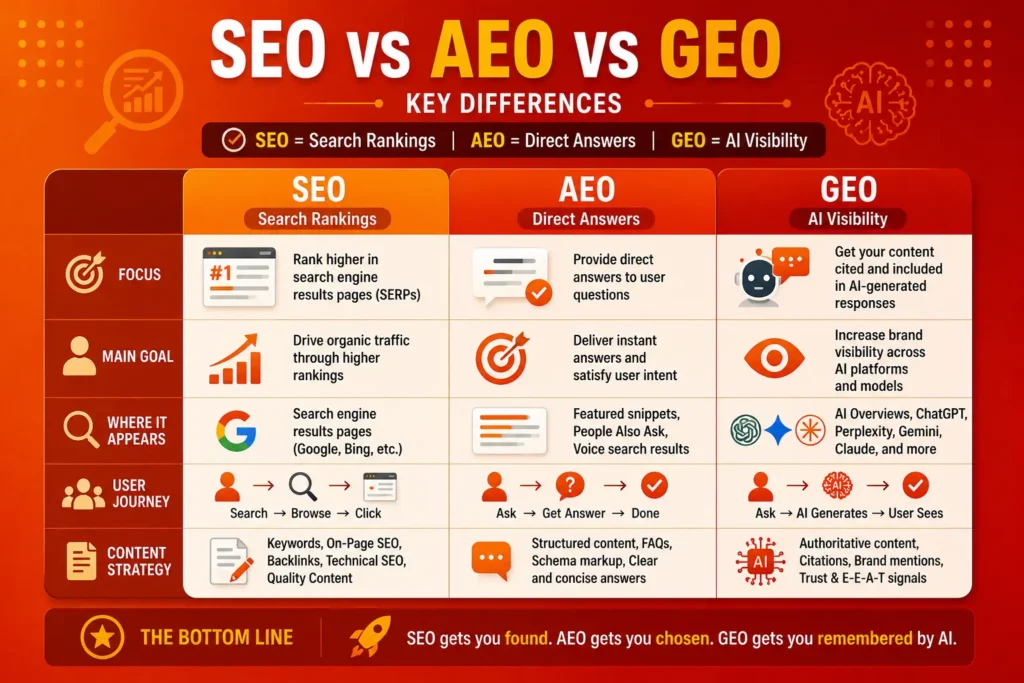
SEO vs AEO vs GEO: Key Differences
The easiest way to understand the difference is to look at what each strategy is trying to achieve.
SEO focuses on search rankings and organic traffic.
AEO focuses on direct answers to user questions.
GEO focuses on visibility and references in AI-generated answers.
SEO is strongly connected with traditional search engines. AEO is useful for answer engines and question-based searches. GEO is designed for the growing generative search environment.
SEO vs AEO
They work together rather than competing with each other. SEO improves a website’s organic search visibility, while AEO helps its content provide clear and direct answers to user questions.
A page that follows both approaches can target keywords while also answering related questions clearly.
AEO and GEO in Digital Marketing
Both important parts of modern search optimization. AEO concentrates on answering questions, while GEO looks more broadly at how generative AI understands and uses information.
Both approaches benefit from clear, reliable, user-focused content.
What Does GEO Mean in SEO?
GEO can be viewed as an additional layer of modern search optimization. It does not remove the need for SEO. Instead, it expands the goal from traditional search visibility toward visibility across AI-powered search platforms.
SEO vs AEO vs GEO Comparison Table
| Feature | SEO | AEO | GEO |
| Main goal | Improve search rankings | Provide direct answers | Improve AI search visibility |
| Main focus | Organic search | Questions and answers | Generative AI responses |
| Common platforms | Google, Bing | Search engines, voice assistants, answer engines | AI search and generative platforms |
| Content style | Helpful and optimized | Clear and concise | Factual, authoritative, and easy for AI to understand |
| Main signals | Keywords, links, technical health, relevance | Questions, answers, structure, intent | Authority, relevance, citations, mentions, factual quality |
| Main outcome | Organic traffic | Direct answers and visibility | AI mentions, references, and visibility |
How SEO, AEO and GEO Work Together
SEO, AEO, and GEO work best when they are treated as connected parts of one content strategy.
Imagine a company publishes an article about website development.
First, SEO helps the article target relevant keywords, improve technical performance, earn backlinks, and appear in organic search.
Next, AEO helps the article answer questions such as “How much does website development cost?” or “How long does website development take?”
Then, GEO helps make the information clear, factual, authoritative, and useful for AI systems that may use multiple sources to generate an answer.
This creates a wider search strategy. Instead of creating separate content for every platform, businesses can build helpful content that works across the search ecosystem.
From our experience, SEO is still the foundation of a strong online presence, but search behavior is changing. We have seen that content performs better when it does more than target keywords. Clear answers, useful information, strong topic coverage, and trustworthy sources can make content easier to understand for both users and modern search systems. This is why combining SEO, AEO, and GEO can create a more complete search strategy.
How to Optimize Your Content for SEO, AEO and GEO
You do not need three completely different content strategies. Many good practices can support all three.
Start With Search Intent
Before writing, understand why someone is searching. A person may have informational intent, commercial intent, or another type of need.
For example:
- “What is SEO?” shows informational intent.
- “SEO services for small business” may show commercial intent.
- “SEO agency near me” shows a stronger local buying intent.
Understanding search intent helps you create content that matches what users actually want.
Use Natural Keywords
Keyword research is still useful, but avoid filling a page with the same phrase again and again.
Use your main keyword naturally along with related terms, entities, questions, and semantic concepts.
This creates content that sounds natural while giving search systems more context.
Answer Questions Clearly
For AEO, answer important questions directly.
A useful format is:
Question: What does GEO mean in SEO?
Answer: GEO is an approach that helps content become more useful and visible in AI-powered and generative search experiences.
Then provide additional details below the short answer.
Build Topical Authority
One article is rarely enough to demonstrate strong expertise on a broad subject.
Businesses can build topical authority by covering related topics, answering common questions, connecting relevant pages with internal links, and publishing accurate information regularly.
Create Authoritative Content
GEO also benefits from content that demonstrates authority and credibility.
Use:
- Original research
- Reliable sources
- Real examples
- Useful statistics
- Expert information
- Clear explanations
- Updated facts
- Relevant data
Avoid making unsupported claims simply to sound authoritative.
Make Content Easy to Understand
Use short paragraphs, descriptive headings, lists, tables, examples, and concise answers.
Natural language is especially useful because modern search behavior is becoming more conversational.
Improve Technical SEO
Do not ignore the technical side of SEO.
A useful content strategy should also consider:
- Mobile experience
- Page speed
- Crawlability
- Indexing
- Internal links
- Website structure
- Metadata
- Secure website connections
- Structured content
Good content still needs a technically healthy website.
Build Brand Authority
For GEO, brand visibility can go beyond your own website.
Relevant mentions, trusted sources, reviews, industry publications, and other credible references can help create a stronger online presence.
The goal is not to chase mentions everywhere. The goal is to become a useful and trusted source in your field.
Track the Right Metrics
SEO performance can include organic traffic, search rankings, CTR, conversions, and engagement.
For newer AI search experiences, businesses may also pay attention to brand mentions, AI citations, referral traffic, and visibility across different search platforms. The exact metrics will depend on the business and its goals.
Check out our guide to Best Free SEO Tools in 2026 to explore useful tools for keyword research, website analysis, and SEO performance.
Which Strategy Should Your Business Focus On?
The best strategy depends on your business, audience, and goals.
- For websites that need more organic traffic and stronger search rankings, SEO should remain a major priority.
- Businesses that receive frequent questions about their products or services can use AEO to make their content more useful for direct-answer searches.
- As audiences increasingly use AI search engines and generative AI platforms, GEO can help businesses prepare their content for this changing search landscape.
For most businesses, the better approach is not choosing only one.
A combined SEO AEO GEO strategy can help build visibility across traditional search, answer-focused experiences, and AI-powered search.
The important thing is to start with helpful content. Do not write only for algorithms or AI systems. Write for real people first, then make the information clear and accessible to search technologies.
Our guide What Does Local SEO Actually Cost? explains common pricing, cost factors, and local SEO plans may include.
Conclusion
Search is no longer limited to a list of blue links. People now use traditional search, voice search, answer engines, and AI-powered platforms to find information.
That is why businesses should understand the difference between SEO, AEO, and GEO.
SEO helps improve organic search visibility. AEO helps provide direct answers to user questions. GEO focuses on making useful and trustworthy information more visible in generative search.
The strongest approach is to combine these strategies instead of treating them as separate systems. Start with helpful, original, and reliable content. Understand search intent, answer real questions, improve technical SEO, build authority, and make your information easy to understand.
When your content is useful to people, relevant to their questions, and clear enough for modern search systems to understand, your business can build stronger visibility across the changing search landscape.
Need Help With SEO, AEO, or GEO?
Building visibility across traditional and AI-powered search takes the right strategy. At Daigency, we help businesses improve their online presence through SEO, content optimization, and modern digital marketing strategies.
Frequently Asked Question.
- Is AEO part of GEO?
AEO and GEO are related, but they are not exactly the same. AEO focuses on direct answers, while GEO focuses more broadly on visibility within generative AI responses.
- What does GEO mean in SEO?
GEO refers to Generative Engine Optimization. It focuses on preparing content for AI-powered and generative search experiences.
- What is SEO and how does it work?
SEO improves a website’s visibility in organic search by using content optimization, technical SEO, keyword research, links, and other ranking factors.
- Is AEO better than SEO?
No. AEO and SEO have different purposes. SEO supports organic search visibility, while AEO helps content provide direct answers. Using both can create a stronger strategy.
- Does GEO replace SEO?
No. GEO does not replace SEO. Technical SEO, content quality, search visibility, and website authority remain important for a strong online presence.
- How does AEO work?
AEO works by organizing content around real questions and providing clear, concise, useful answers that answer engines can understand.
- How does GEO work?
GEO focuses on creating relevant, trustworthy, factual, and authoritative content that can be understood and potentially referenced by generative AI systems.
- How can I optimize content for AI search?
Create helpful and original content, answer common questions, use natural language, support important claims, build topical authority, and keep information accurate and updated.
- Is SEO still important in 2026?
Yes. SEO remains important because people still use traditional search engines to discover websites, products, services, and information. AI search adds another layer rather than making traditional search disappear.
- How do SEO and GEO work together?
SEO helps build traditional search visibility, while GEO prepares content for generative search experiences. Together, they can support wider visibility across the modern search ecosystem.
Explore More SEO & Digitally Insights
Continue exploring our expert guides for practical SEO and digital marketing strategies that can help your business improve online visibility, attract more customers, and grow online.
- Best Affordable SEO Packages for Small Businesses in 2026
- What Does Local SEO Actually Cost?
- Best Free SEO Tools in 2026
- How Much Does iOS App Development Cost in 2026?
- Why Digital Marketing Is Essential for USA Businesses in 2026
- Digital Marketing Strategies for Small Businesses in a Low Budget
- Wix vs WordPress vs Squarespace: 2026 Breakdown
- How much does healthcare website development cost in Canada
- The Ultimate Colour Guide for 10 Different Industries in 2026
- Wix vs WordPress vs Squarespace: 2026 Breakdown