
Real Estate App Development Cost in 2026
Market Size Overview: The global real estate software market is projected to grow from $10.29 billion in 2023 to $21.77 billion by 2030, representing an 11.3% CAGR. Listings that include virtual tours can receive up to 130% more inquiries. More than 60% of property search traffic now comes from mobile devices, while AI applications in real estate are forecast to approach $1.8 trillion by 2030.
Whether you’re a founder, broker, real estate agent, or PropTech investor planning a digital property platform for the US, UK, GCC, or another market, understanding the real cost drivers is important. The sections below break down what actually affects a real estate app development budget in 2026.
Real Estate App Development Cost by Complexity
| Catagory | What’s included | Timeline | Cost (USD) |
| MVP | Property listings, search filters, map view, saved favorites, contact forms, and basic authentication | 8–16 weeks | $20,000 – $60,000 |
| Mid-Tier / Full-Featured | MLS/IDX integration, agent dashboards, saved-search alerts, mortgage calculator, messaging, and native apps | 18–28 weeks | $70,000 – $150,000 |
| Enterprise / Marketplace | AI recommendations, automated valuation (AVM), multi-board MLS synchronization, CRM, analytics, and multiple user roles | 28–40+ weeks | $150,000 – $280,000+ |
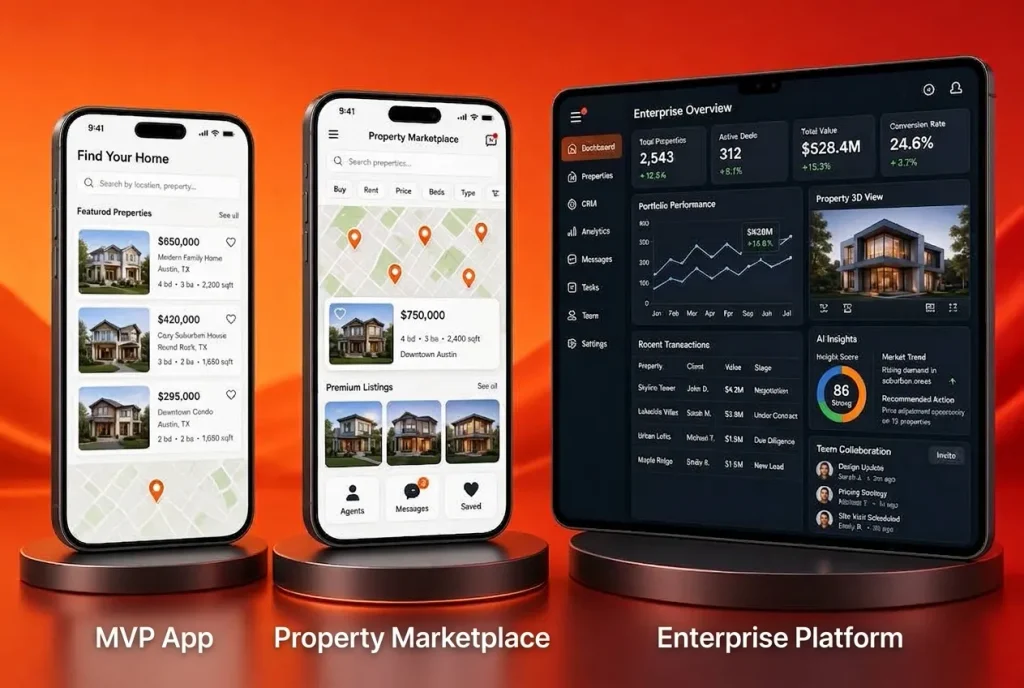
An MVP is designed to test the market with essential property search features and a simple admin panel. It normally does not include MLS integration, advanced AI technology, or native mobile apps.
A mid-tier platform adds features that established brokerages and growing startups often need, such as automated property feeds, CRM functionality, alerts, and mobile applications.
An enterprise real estate marketplace is much more complex. It may support buyers, sellers, agents, property managers, and investors while handling large amounts of property data. AI and machine learning alone can account for $40,000–$120,000 of the overall budget.
Real Estate App Cost based on App Type
| App type | Cost range (USD) |
| Brokerage listing app | $35,000 – $75,000 |
| Agent CRM / lead management tool | $50,000 – $110,000 |
| Rental marketplace | $30,000 – $120,000 |
| Property management platform | $30,000 – $160,000 |
| Investor analytics app | $80,000 – $200,000+ |
| Residential marketplace (Zillow-style) | $110,000 – $250,000+ |
| Commercial real estate platform | $100,000 – $240,000+ |
| Fractional ownership platform | $55,000 – $210,000+ |
Property management apps are usually priced according to the workflows they support rather than the number of screens. Tenant portals, rent collection, maintenance requests, owner reporting, and other property management features can each affect the overall development budget.
Fractional ownership platforms are different because regulatory requirements can become a major part of the project. Depending on the market, SEC, MiCA, VARA, or DFSA requirements may cost more than the engineering itself. Compliance can add approximately $30,000–$150,000 to the project.
Factors That Affect Real Estate App Development Cost
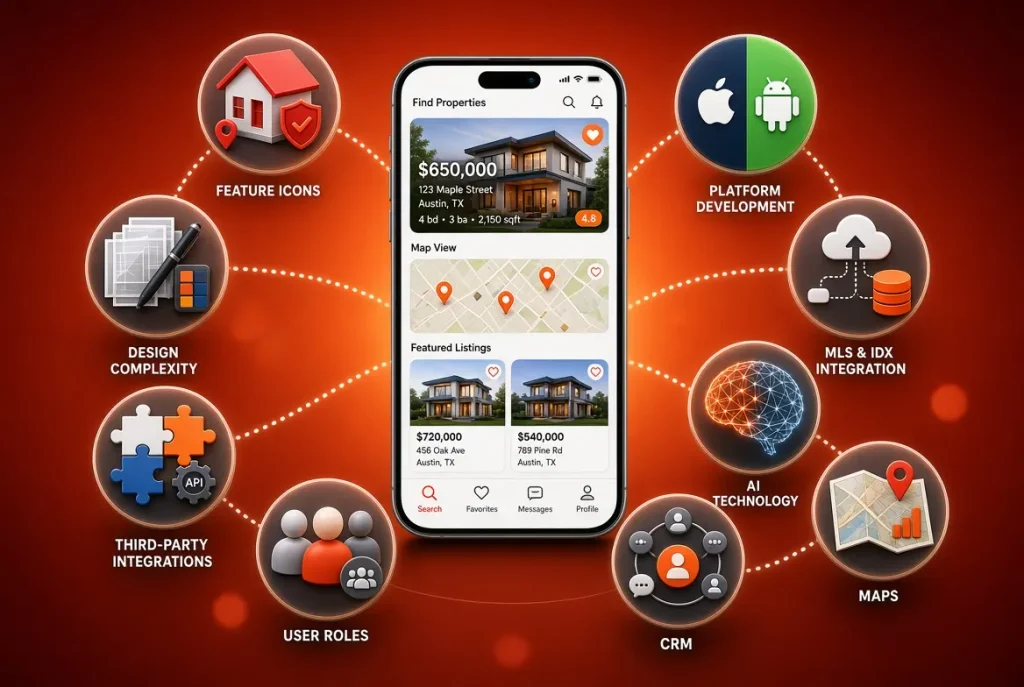
The factors are following which affect the real estate app development cost:
- Feature complexity is one of the biggest factors in real estate app development. Features such as virtual tours, AI-powered recommendations, biometric login, blockchain, advanced analytics, and multiple user roles all increase development time. Starting with the features users actually need can help control the initial budget.
- Platform choice: Building separate native iOS and Android applications can cost $70,000–$250,000+ per platform. Cross-platform development with Flutter or React Native can reduce the cost by 30–50% because much of the code can be shared.
- UI/UX design typically accounts for 15–25% of the budget. A real estate app needs to make property listings easy to browse, compare, save, and share. Poor navigation or confusing layouts can create problems later, especially when users are comparing multiple properties.
- Backend & integrations: MLS feeds, maps, payment gateways, CRMs, search services, and other third-party integrations add both development work and recurring licensing or usage fees.
- Security & compliance: Features such as MFA, encryption, GDPR, and CCPA compliance become especially important when an app handles financial, personal, or identity-related information. These requirements can add $10,000–$20,000 or more.
- Maintenance generally costs 15–20% of the original development budget each year. Real estate software often depends on external data sources and APIs, so updates and integration changes are part of ongoing maintenance.
- Team location can also create a major difference in the development budget:
| Region | Hourly rate (USD) |
| North America | $100 – $200/hr |
| Western Europe | $60 – $150/hr |
| Australia | $90 – $120/hr |
| Eastern Europe | $40 – $100/hr |
| Latin America | $28 – $90/hr |
| South Asia (India, Pakistan) | $20 – $60/hr |
A blended development model can also work for larger projects. For example, a company may handle product leadership in the US or UK while using an offshore engineering team for development. This approach can provide access to a broader development team while keeping the overall budget below a fully US-based setup.
MLS/IDX Integration – The Biggest Line Item for US Apps
For a US real estate app that displays live property listings, MLS/IDX integration can be one of the largest parts of the development budget. Depending on the number of boards, data requirements, and integration complexity, it can account for 20–40% of the total project cost. Most US MLS boards now require the RESO Web API the industry-standard data protocol maintained by the Real Estate Standards Organization rather than the older RETS format.
| Integration type | Cost |
| Single-board RESO Web API setup | $15,000 – $30,000 |
| Multi-board aggregation pipeline | $25,000 – $50,000+ |
| Legacy RETS feed migration | $10,000 – $20,000 |
| Monthly data/licensing fee (per board) | $300 – $1,500/month |
| Each additional board | $10,000 – $20,000 |
A licensed broker relationship is generally needed before this part of the project can be properly scoped. MLS board approval can take 4–12 weeks, so it makes sense to begin that process while other parts of the real estate application are being developed.
The integration cost covers work such as RETS/RESO connections, property-data normalization, synchronization between different board schemas, regular data updates, and required compliance or attribution rules.
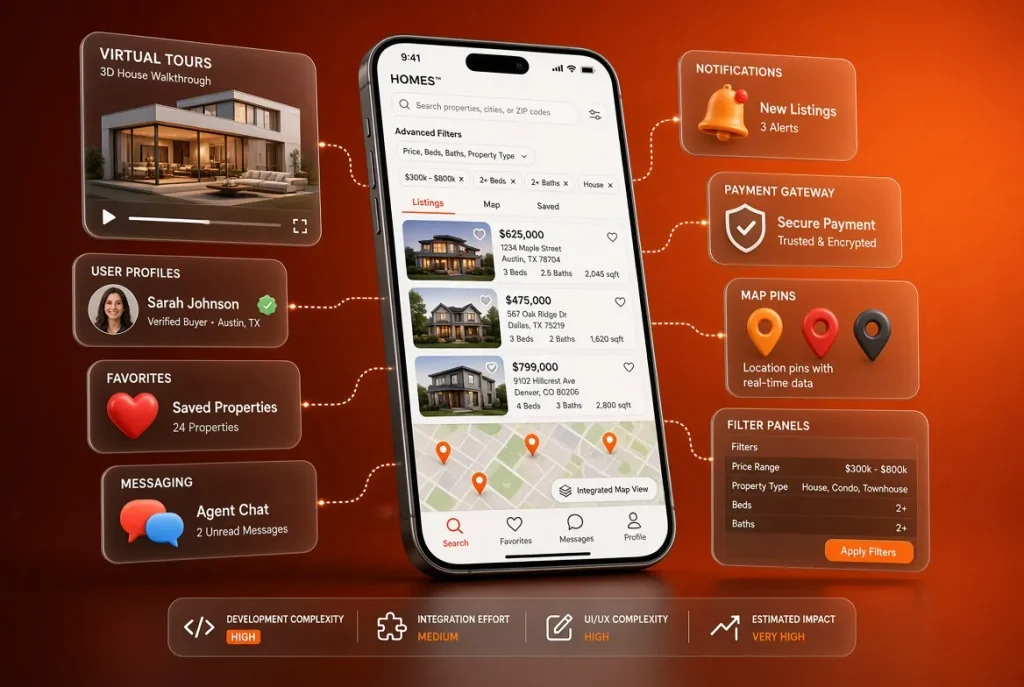
If the business model is based on rentals or direct property listings, MLS integration may not be necessary. In those cases, avoiding MLS can reduce the development budget by approximately $20,000–$45,000.
Real Estate App Development Cost by Features
| Feature | Cost (USD) |
| User registration & profiles | $2,000 – $3,500 |
| Property listings & search | $4,500 – $8,000 |
| Advanced search filters | $2,500 – $5,000 |
| Map & geolocation | $2,500 – $5,000 |
| In-app messaging | $2,500 – $5,000 |
| Media infrastructure/CDN | $5,000 – $10,000 |
| Saved searches & alerts | $2,000 – $4,500 |
| Mortgage calculator | $1,500 – $3,000 |
| Virtual tour integration (Matterport/Cupix) | $8,000 – $20,000 |
| Agent CRM dashboard | $5,000 – $10,000 |
| Custom AR/VR walkthroughs | $10,000 – $130,000+ |
A 360° property tour also has an ongoing marketing cost. Capturing each property with services such as Matterport, Cupix, or Kuula can cost approximately $150–$2,000 per listing. That recurring expense is separate from the one-time integration cost.
AI Costs in Real Estate Apps
AI technology is becoming a common part of modern real estate software. More than half of real estate firms already use AI in some form. Depending on the use case, expect $6,000–$60,000 per AI feature, or roughly $25,000–$120,000 for a broader AI layer.
| AI feature | Cost (USD) |
| Automated Valuation Model (AVM) | $20,000 – $50,000 |
| Natural language / conversational search | $10,000 – $25,000 |
| AI lead scoring for agents | $8,000 – $20,000 |
| AI chatbot for lead capture | $5,000 – $15,000 |
| Predictive analytics / market forecasting | $10,000 – $50,000 |
| AI property recommendations | $10,000 – $30,000 |
For a new real estate app, using an existing AI API is often more practical than developing a custom model from scratch. Services such as CoreLogic, HouseCanary, or an LLM provider can be integrated first and evaluated based on actual user demand.
Ongoing AI usage can add another $500–$3,000 per month, depending on traffic, model usage, and the features being offered.
Looking to Build an Enterprise Real Estate Marketplace?
Cost to Build an App Like Zillow, Redfin, or Rightmove
| Platform type | Cost (USD) |
| Zillow-style marketplace (national MLS + AVM) | $120,000 – $330,000 |
| Redfin-style brokerage app | $110,000 – $240,000 |
| Trulia-style neighborhood insights app | $120,000 – $180,000 |
| Rightmove/Property Finder-style portal | $90,000 – $180,000 |
The main expense behind platforms of this size is not simply the user interface. The underlying property-data pipeline, MLS connections, search infrastructure, analytics, CRM functionality, and other integrations make these platforms much more involved.
A focused version built for one market can be more manageable, with development costs around $80,000–$150,000 depending on the features and data requirements.
Hidden Costs in Real Estate App Development
| Cost area | Typical figure |
| Apple Developer Program | $99/year |
| Google Play registration | $25 one-time |
| Cloud infrastructure | $500 – $3,000/month |
| Map API usage | $200 – $1,000/month |
| Media storage & CDN | $300 – $1,500/month |
| MLS compliance review | $3,000 – $8,000 every 1–2 years |
| Marketing & ASO | $5,000 – $100,000+/month |
The initial development quote does not always cover every expense required after launch. Cloud hosting, map services, media storage, MLS compliance, app-store accounts, marketing, and app-store optimization can all become ongoing costs.
Real Estate App Development Budget by Phase
| Phase | Share of budget | Duration |
| Discovery & scoping | 8–15% | 2–4 weeks |
| UI/UX design & prototyping | 15–25% | 4–10 weeks |
| Development (frontend + backend) | 40–60% | 12–24 weeks |
| QA & testing | 10–15% | Runs in parallel |
| Deployment & launch | 5–10% | 1–3 weeks |
Discovery matters more here than in many other app categories because it is where the team can confirm MLS feasibility, broker access, data requirements, user roles, and the overall platform development plan.
Skipping discovery simply to begin development sooner can create major budget problems later. For example, a team may discover several months into development that the required property data source has not been secured.
A staged approach can reduce that risk: start with a discovery sprint costing around $5,000–$15,000 over 2–4 weeks, move into an MVP launch at $25,000–$75,000 over 8–16 weeks, and then continue with growth cycles of approximately $20,000–$50,000 per cycle based on real usage data.
Want to Know the Exact Cost for Your Real Estate App?
Recommended Technology Stack for Real Estate App in 2026
A modern and cost-conscious real estate app can use React Native or Flutter for mobile development, allowing iOS and Android applications to share much of the same codebase. This can provide 30–50% savings compared with developing two completely separate native applications.
For the web side, Next.js is useful when search visibility matters because server-side rendering can support SEO for property search pages. Node.js or Python can handle backend development, while PostgreSQL with PostGIS works well for property and location-based data.
For search, Elasticsearch or Algolia can provide faster filtering when users search across many property attributes. A basic database query can become inefficient as the number of listings and search conditions grows.
For media, services such as Cloudinary or CloudFront can handle property images and other listing assets. Real estate listings commonly contain 20–40 photos each, so media storage and delivery need to be considered from the beginning.
For AI functionality, an API-first approach using services such as CoreLogic, HouseCanary, or an LLM provider can be considered before investing in a custom-trained model.
How to Reduce Real Estate App Development Costs
The factors that reduce costs are given below:
- Build an MVP first – this can reduce the initial investment by 30–40% while giving you a chance to validate the real estate business model before committing to larger integrations.
- Use cross-platform frameworks such as Flutter or React Native instead of developing two separate native applications.
- Use pre-built APIs for services such as maps and payments rather than developing every supporting feature from scratch.
- Prioritize ruthlessly – focus the first release on the property search, listings, user accounts, and other features that are essential to the platform.
- Confirm MLS/broker access before scoping the integration so development does not begin around a data source that has not yet been approved.
- Choose a partner with proven real estate/PropTech experience — experience with MLS, RESO, property data, and real estate workflows can prevent costly problems during development.
Final Thoughts
Real estate app development cost in 2026 is not determined by one number. It depends on the business model, property data requirements, platform choice, user roles, integrations, design complexity, and the level of technology involved.
Confirm MLS access early, treat AI as separate features when estimating the budget, plan for the 15–20% annual maintenance cost, and make sure the scope matches the actual needs of the real estate business. A regional brokerage, for example, may need a very different digital property platform than a national marketplace.
This guide is for general planning. For an accurate quote specific to your feature set and MLS requirements, get a scoped estimate before committing to a budget
Your Vision into Reality – Meet Daigency
Building a real estate app is only half the job getting it in front of buyers, agents, and investors is the other half. Daigency is a full-service digital marketing agency that helps PropTech brands and real estate businesses grow online through branding, website development, SEO, social media, and paid ads.
Ready to Launch Your Real Estate App?
If you’re launching a real estate app in 2026, let Daigency help you market it right and turn downloads into real leads.
FAQs - Real Estate App
- How much does it cost to develop a real estate app in 2026?Between $20,000 and $280,000+, depending on the scope. An MVP generally falls between $20K–$60K, a mid-tier application with MLS functionality can cost $70K–$150K, and an enterprise real estate marketplace can reach $150K–$280K+.
- What's the biggest single cost driver?For US-focused applications, MLS/IDX integration is often one of the largest individual expenses. The first board can cost around $20,000–$45,000 depending on the integration requirements.
- How much does it cost to build an app like Zillow?A national-scale Zillow-style marketplace can cost approximately $120,000–$330,000. A more focused version designed for one market may fall around $80,000–$150,000 depending on its features and data requirements.
- Do I need MLS access to build a real estate app?Not necessarily. A rental marketplace or direct-listing platform can operate without MLS data. Depending on the business model, avoiding MLS can save approximately $20,000–$45,000 in development and integration costs.
- How long does it take to build a real estate app?An MVP generally takes 8–16 weeks. A mid-tier application with MLS integration can take 18–28 weeks, while a larger enterprise marketplace may require 28–40+ weeks.
- How much does AI add to the cost?AI features can add around $6,000–$60,000 per feature. A broader AI layer may cost $25,000–$120,000. Automated valuation models are usually among the more expensive AI features because of their data and modeling requirements.
- How can I reduce real estate app development costs?Start with an MVP, use cross-platform development, rely on established APIs where practical, prioritize essential app features, and confirm MLS access before development begins. Choosing a team with relevant real estate technology experience can also help avoid unnecessary rework.
- Should I outsource development?Outsourcing can be a cost-effective option for some businesses. Offshore and nearshore teams may offer rates that are 40–70% lower than US-based agencies for comparable scope. The development team's experience with real estate applications, property data, integrations, and the required technology stack should still be evaluated carefully.
- What's the ongoing/maintenance cost after launch?Maintenance generally runs around 15–20% of the original development cost per year. Additional monthly expenses may include hosting at $500–$3,000, MLS feeds at $100–$500 per board, and AI API usage at $500–$3,000 when AI features are part of the platform.
- How does cost vary by region?For typical project ranges, the USA can fall around $50,000–$300,000+, the UK around $40,000–$220,000+, and the GCC around $30,000–$180,000+. Outsourced teams in Eastern Europe or South Asia may charge 40–70% less than US-based agencies for comparable scope.
- Is native or cross-platform development cheaper?Cross-platform development with Flutter or React Native is generally 30–50% less expensive than creating separate native iOS and Android applications because much of the codebase can be shared. For most property search and listing use cases, this approach can meet the required functionality without maintaining two completely separate applications.
- How do I choose the right development partner?Look for real estate/PropTech-specific portfolio work (not just generic app projects), hands-on MLS/RESO/RETS integration experience, transparent sprint reporting for projects above $50,000, and a clear post-launch maintenance offering. Ask directly: have they shipped an MLS integration before, and what actually broke?