Healthcare websites are essential in today’s digital world, with the growing demand for remote medical care. It is the right time for the healthcare business to adapt. However, building a healthcare website involves several factors.
Building a healthcare website in Canada is not the same as building a regular business website. It involves strict privacy laws, medical compliance standards, and specialized features, all of which directly affect the cost.
Whether you are a solo practitioner, a multi-specialty clinic, or a large hospital network, understanding these costs before you invest can save you a lot of time and money.
This blog will discuss the cost of building a healthcare website, its essential features, and key factors to consider. So you can plan properly and build a website within your budget!
Healthcare Website & Digital Health Scope in Canada:
Market Size & Growth:
Canada’s digital health market is expected to grow at a CAGR of 26% from 2025 to 2030, projected to reach USD $53.9 billion by 2030. Some estimates place the market even higher. potentially exceeding USD $106.5 billion by 2033, at a CAGR of 18.5%.
Step by Step Complete Guide:
This guide breaks down everything clearly so you know exactly what to expect.
Why Healthcare Websites Cost More Than Regular Websites?
A regular business website focuses on looks and content. A healthcare website, however, must also protect sensitive patient data, follow Canadian privacy laws, and integrate with medical systems. These extra requirements, compliance, security, and specialized features, push the cost higher than a standard website. Such as PIPEDA, PHIPA, HR and EMR systems, WCAG. Each of these requirements adds to the overall development time and budget.
Healthcare Website Cost Overview in Canada
Costs vary commonly based on the type of website you need.
Basic website cost
A basic information website for a small clinic typically costs between CAD $3,000 and $6,000 and covers clinic information, services, a contact form, and basic SEO.
Mid-level website cost
A mid-level website with appointment booking, a patient portal, blog, and PIPEDA compliance falls between CAD $6,000 and $15,000. An advanced platform with telehealth, EHR integration, multi-provider support, and custom workflows ranges from CAD $25,000 to $60,000.
Advance/ Enterprise website cost
Enterprise-level systems for hospital networks or AI-powered health platforms start at CAD $70,000 and go higher depending on scope.
For a detailed breakdown of general website development costs, you can read our complete website development cost guide here.
Why Healthcare Businesses Need a Professional Website?
A healthcare website serves as a digital front door for your practice. It helps patients:
- Book appointments online
- Access healthcare information
- Find clinic locations and contact details
- Submit inquiries securely
- Learn about healthcare services
- Build trust in your medical practice
A professionally designed website can improve patient experience while supporting business growth.
What are the Key Factors That Affect Healthcare Website?
Development Cost
Healthcare website development costs vary significantly based on several critical factors. Understanding these variables helps you anticipate expenses and make informed decisions during the planning phase.
1. Design complexity (custom vs. template)
Custom design and template design are two main ways to build a website. Custom designs provide complete control over user experience and brand presentation but require greater investment. For healthcare organizations, custom design often delivers better patient trust and engagement critical factors for patient acquisition. A template-based approach allows you to pick a pre-built template, customize it and launch your website quickly. Building a custom website is suitable for running a well-established healthcare company.
Estimated cost:
| Website Type | Cost | Timeline | Best For |
| Template (Customized) | CAD $5,000–$11,000 | 2–4 weeks | Budget-focused, quick launches |
| Semi-Custom | CAD $10,000–$25,000 | 4–6 weeks | Brand differentiation on a budget |
| Fully Custom | CAD $30,000–$50,000 | 6–10 weeks | Unique identity for large organizations |
Daigency recommends a custom design for healthcare websites because patients associate a professional, unique design with quality care. Template-based sites can appear generic and reduce patient confidence.
2. Number of Pages
The number of pages on your healthcare website directly affects the total development cost. More pages mean more design work, more content, and more development time. Here is a clear breakdown of each category so you can identify where your clinic fits.
Estimated Cost According to Pages:
| Website Size | Cost | Best For |
| 1–5 pages | CAD $3,000–$6,000 | Solo practitioners and small clinics that need a basic online presence with essential info only. |
| 5–10 pages | CAD $6,000–$15,000 | General practice or specialist clinics with doctor profiles, service pages, and a privacy policy. |
| 10–15 pages | CAD $25,000–$60,000 | Multi-specialty health centres with booking, FAQ, insurance info, careers, and compliance pages. |
| 15–20+ pages | CAD $60,000–$70,000+ | Large hospitals and health networks with patient portals, telehealth, dual-language support, and full compliance. |
3. Online Appointment Booking Systems
One of the most essential features is the online appointment booking system. Online appointment booking typically costs between CAD $2,000 and $6,000 and allows patients to book, reschedule, or cancel appointments online. A secure patient portal where patients can view records, prescriptions, and test results costs between CAD $5,000 and $15,000.
4. Patient Portal Integration
Advanced healthcare websites often include a secure patient portal that allows users to manage their healthcare experience in one place. Through this portal, patients can register and create personal profiles, book and manage appointments, access medical records. It also provides convenient access to important documents, forms, and appointment history, improving both patient engagement and overall service efficiency.
Estimated Cost:
| Portal Type | Cost | Features |
| Basic | CAD $15,000–$30,000 | Secure login, appointment view, basic messaging |
| Standard | CAD $40,000–$60,000 | Records access, prescription refills, bill viewing |
| Advanced | CAD $60,000–$80,000 | Full records access, secure messaging, bill payment, family accounts |
Daigency builds patient portals that integrate seamlessly with major EHR systems while maintaining strict PIPEDA and PHIPA compliance. Our teams work extensively on it to each practice type.
5. Telemedicine Integration
Telemedicine integration is an essential feature of modern healthcare websites. It allows virtual consultations and remote patient monitoring systems. This means patients can connect with doctors remotely via online video consultation for medical advice, diagnosis and treatment. It saves time and eliminates the need for in-person visits. On the other hand, remote patient monitoring enables doctors to track patient health data to take timely actions and provide better patient care.
Estimated Cost:
| Telehealth Type | Cost | Complexity |
| Basic video | CAD $10,000–$20,000 | Medium complexity |
| Full platform | CAD $30,000–$50,000 | High complexity |
| Custom virtual care | CAD $60,000–$80,000 | Very high complexity |
Telemedicine development includes PHIPA-compliant video platforms, virtual waiting rooms, prescription integration, screen sharing for reviewing results, and session recording for documentation.
6. Third-party Integrations
Your website did not come with all the required features you need. Third-party integration plays a crucial role. It allows you to add features and functionalities to your website, including payment gateways, electronic health record systems, and telemedicine. However, adding new features can be costly. It requires licensing fees and development time for seamless integration.
Estimated Cost:
| Integration Type | Cost | Examples / Details |
| Payment Processing | CAD $3,000–$8,000 | Moneris, Interac, Stripe |
| Insurance Verification | CAD $5,000–$15,000 | Eligibility checking services |
| Marketing Automation | CAD $3,000–$10,000 | HubSpot, Mailchimp, CRMs |
| Analytics & Reporting | CAD $5,000–$12,000 | Custom dashboards, GA4 |
Canadian payment integration requires familiarity with local processors. Daigency has experience integrating Moneris and Interac for Canadian healthcare clients.
7. Security Features EHR/EMR integration
EHR and EMR Integration means your website must securely connect with electronic health record systems like OSCAR or Accuro. This ensures patient data flows safely between your website and your clinic’s medical software.
Estimated Cost:
| API Integration Type | Cost | Timeline | Details |
| Basic API | CAD $10,000–$25,000 | 3–5 weeks | Single EHR, limited data |
| Standard | CAD $25,000–$45,000 | 5–8 weeks | Appointment sync, patient demographics |
| Advanced | CAD $45,000–$60,000 | 8–12 weeks | Full bidirectional exchange |
Daigency has experience navigating these provincial differences for healthcare clients across Canada.
8. Canadian Privacy Laws and Compliance requirements
This is where healthcare websites different most from regular websites. Ignoring these laws can result in heavy fines and loss of patient trust.
PIPEDA is Canada’s federal privacy law. It requires patient consent before collecting any data and mandates secure data storage.
PHIPA applies to Ontario. It governs how health information is collected, used, and shared by healthcare providers.
HIA applies to Alberta. It covers hospitals, doctors, and pharmacists handling patient information.
WCAG 2.1 is the accessibility standard. Your website must support screen readers, proper color contrast, and keyboard navigation.
Estimated Cost:
| Compliance Type | Cost | Details |
| Basic PIPEDA | CAD $5,000–$10,000 | Privacy policy, consent, data protocols |
| PHIPA (Ontario) | CAD $8,000–$15,000 | Health info protection, breach notice access controls |
| Full Package | CAD $10,000–$20,000 | PIPEDA + PHIPA, audit documentation |
Always hire a developer who understands Canadian healthcare law, not just general web development. Non-compliance can cost far more than building it right the first time.
Best Tools for Healthcare Website Development in Canada
Website Building Tools
- WordPress — most popular, supports healthcare plugins for booking and forms
Best for clinics that want full control over their website. Thousands of healthcare plugins available, easy to update content without a developer, and scales as your clinic grows.
- Webflow — clean no-code option, good for clinic info websites
Best for clinics that want a modern, fast, and visually polished website. No coding needed, built-in SEO tools, and pages load faster than most WordPress sites.
- Wix / Squarespace — quick setup for small clinics, limited compliance features
- Custom React / Next.js — best for complex portals and telehealth, requires a developer
Development & Security Tools
- GitHub — safe code management and team collaboration
- Cloudflare — SSL, DDoS protection, and fast content delivery
- Let’s Encrypt — free SSL certificate, required for PIPEDA compliance
- Sentry — real-time error tracking to reduce website downtime
Canadian Compliance Tools
- Cookiebot / Osano — cookie consent banners for PIPEDA
- Termly / iubenda — auto-generate Canadian-compliant privacy policies
- Jotform HIPAA — secure patient intake and consent forms
- accessiBe / UserWay — automatic WCAG 2.1 accessibility compliance
Telehealth & Patient Portal Tools
- Jane App — Canadian-made, includes booking, billing, and telehealth, PIPEDA compliant
- OceanMD — Ontario-focused, patient forms and eReferral integration
- Zoom for Healthcare — HIPAA-compliant video consultations
Ongoing Maintenance and Updates
It is time to focus on maintenance and updates. You must provide ongoing maintenance and updates, including regular updates, security patches and performance optimizations. These updates will keep your website running smoothly. However, these ongoing services also influence the cost of website development.
Quick lookup tool
Planning a healthcare website in Canada? Use this quick reference table to understand estimated costs across all major categories from basic website pages to compliance, integrations, and telehealth features. All prices are in Canadian dollars and reflect current market rates.
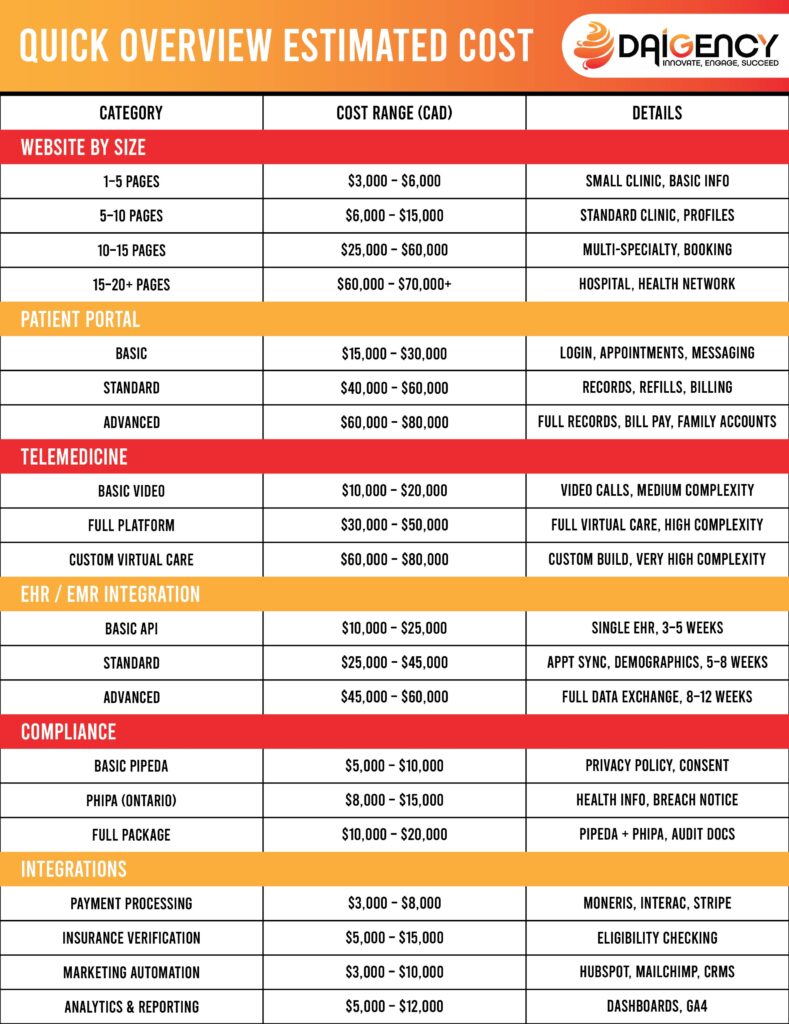
Note: These are estimated ranges. Your actual cost depends on project complexity, team location, and specific requirements.
Final Thoughts:
Overall, healthcare websites are now an essential part of the healthcare sector. However, building a healthcare website involves several factors, from selecting the right features and design to choosing the best technology. Building a healthcare website in Canada is a serious investment but it is also one of the most important steps you can take for your clinic’s growth and patient trust. The costs vary depending on your size, features, and compliance requirements, but one thing is consistent across every project: cutting corners on a healthcare website always costs more in the long run, whether through compliance penalties, security breaches, or poor patient experience.
We hope this guide helps you understand the factors to consider during healthcare website development, its estimated costs, and the essential features your website needs.
Now, it is your turn to consider these cost impacting factors, find the estimated cost of your website development, and consider hiring experienced website development companies to turn your vision into reality.
“Investing in the right digital foundation today saves your clinic from costly problems tomorrow.”
How Daigency Helps Healthcare Succeed Digitally
Daigency is a full-service digital agency specializing in building professional, compliant, and high-performing websites for businesses across North America.
From small clinics to large hospital networks, Daigency has helped healthcare providers navigate the complexities of PIPEDA compliance, EHR integration, patient portal development, and telehealth platforms. We combine technical precision with clean, modern design to deliver websites that work as hard as the teams behind them.
Ready to start your healthcare website development project? Schedule a consultation with Daigency to discuss your requirements and receive a detailed, compliance ready proposal tailored to your organization’s clinical, regulatory, and operational needs.
Frequently Asked Question
- How much does a healthcare website cost in Canada?
A healthcare website in Canada typically costs between CAD $3,000 and $80,000+, depending on the size, features, and compliance requirements of your project.
- Do healthcare websites in Canada need to be PIPEDA compliant?
Yes. Any healthcare website collecting patient data in Canada must comply with PIPEDA. Provincial laws like PHIPA in Ontario and HIA in Alberta may also apply.
- How long does it take to build a healthcare website in Canada?
A basic clinic website takes 4–8 weeks. A mid-level website with a patient portal or booking system takes 8–16 weeks. A full telehealth platform can take 4–6 months or more.
- What features does a healthcare website need?
At minimum, a healthcare website needs secure contact forms, a privacy policy, and PIPEDA compliance. Growing clinics also need online booking, patient portals, and mobile-friendly design.
- Can I use WordPress for a healthcare website in Canada?
Yes. WordPress is one of the most popular platforms for healthcare websites in Canada. With the right HIPAA-compliant plugins and proper security setup, it can meet Canadian healthcare standards.
Additionally Guidelines:
Explore our related guides to learn more about digital marketing, SEO, and proven strategies for attracting more users.
- Best Affordable SEO Packages for Small Businesses in 2026
- Wix vs WordPress vs Squarespace: 2026 Breakdown
- How to Rank Website on Google in 2026
- What Does Local SEO Actually Cost?
- Best Free SEO Tools in 2026
- SEO, AEO and GEO Explained in 2026
- Why Digital Marketing Is Essential for USA Businesses in 2026
- Digital Marketing Strategies for Small Businesses in a Low Budget
- Cleaning Website Development Cost in Houston (2026 Pricing, Features & Timeline)
- How to Start a Nonprofit Organization with No Money
- The Ultimate Colour Guide for 10 Different Industries in 2026