
Quick answer: In 2026, the grocery app development cost usually ranges from $20,000 to $250,000+.
- Simple / MVP App: A single-store app costs around $20,000–$45,000.
- Mid-Size App: Features online checkout, live delivery tracking, payment integration, and an admin dashboard for $45,000–$90,000.
- Multi-Vendor / Quick-Commerce: Advanced platform with real-time inventory, complex delivery logistics, and multiple dashboards ranges from $90,000–$250,000+.
If you have been comparing quotes for grocery app development, you may have noticed that an app development company can give you a very different price from another. One agency may quote $30,000, while another may suggest $150,000 or more. This does not always mean that one company is overcharging.
A grocery ordering app, grocery shopping app, and large grocery marketplace can require very different levels of mobile app development and custom app development.
The global grocery delivery app market is growing fast too — from $4.3 billion in 2025 to a projected $12.4 billion by 2034 (12.5% CAGR). So you’re not entering a shrinking space, whatever tier you start at.
The real app development cost depends on what you are building. A basic grocery store app may only need a product catalog, product search, shopping cart, secure checkout, digital payments, and order management. A larger grocery delivery platform may also need vendor management, a delivery partner app, real-time inventory, GPS tracking, order assignment, delivery zones, and a scalable backend.
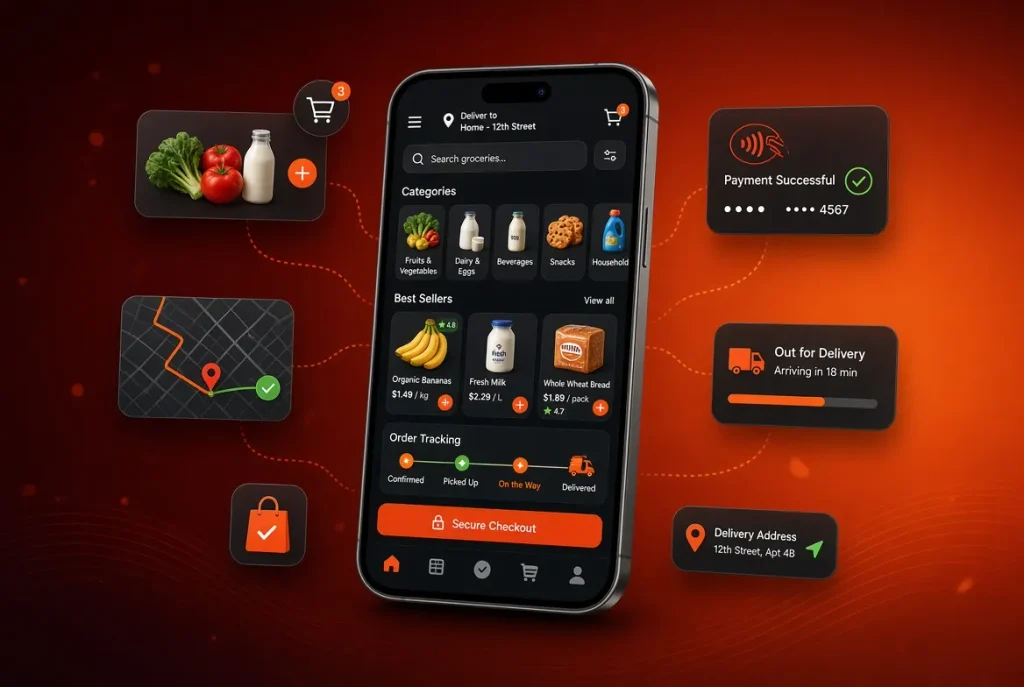
This guide breaks down the grocery app cost 2026 including app development budget for different app types, features , development timeline, ongoing expenses, and practical ways to reduce your initial development investment without hurting the customer experience.
Cost Breakdown by App Type
| App Type | Cost Range | Timeline |
| Single-store MVP | $20,000 – $45,000 | 2–4 months |
| Mid-level delivery app | $45,000 – $90,000 | 4–6 months |
| Multi-vendor marketplace | $70,000 – $180,000 | 6–9 months |
| Quick-commerce / dark-store platform | $100,000 – $250,000+ | 8–14 months |
These are not random numbers. They mainly show how much app complexity and feature complexity your project has.
A single-store app normally connects one store with its customers. A multi-store grocery app or grocery marketplace app has to handle several stores, vendors, customers, and delivery staff. It may also need vendor dashboard, admin panel, delivery management, and inventory synchronization.
This is why a grocery delivery business can spend much more on development than a small grocery business that only wants a basic grocery mobile app.
What Actually Moves the Price
Forget the long feature lists for a moment. In real projects, a few main things decide the final development cost estimate.
How Many User Types Does the App Need to Serve?
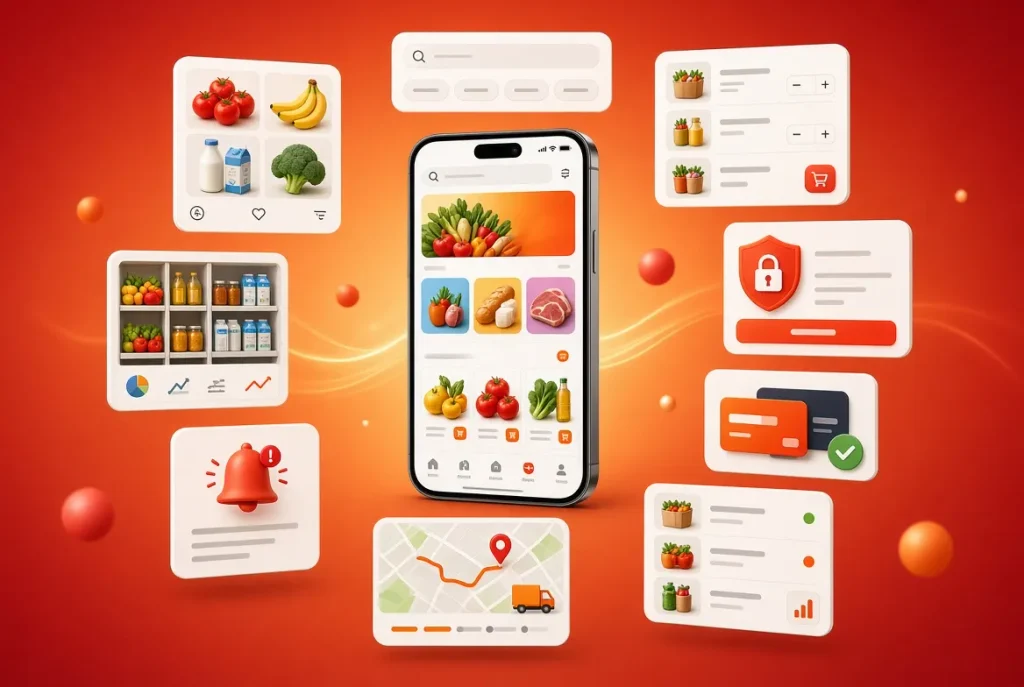
A customer app by itself is much simpler. Once you add a delivery partner app, rider app, vendor dashboard, and admin dashboard, you are building several connected parts that need to work together.
For example, customers place orders, vendors manage products, riders receive delivery tasks, and administrators monitor the whole system. All these parts depend on backend development, a database, and proper API integration.
This is one of the main reasons why two grocery projects with similar-looking mobile screens can have very different prices.
Does Inventory Update Live?
Inventory management is another important cost factor. If the app only updates stock once or twice a day, the system is easier to build.
But real-time inventory is more complex. When a customer orders the last available product, the product availability needs to change quickly. This requires proper inventory synchronization between the grocery app, store system, and backend infrastructure.
For a grocery marketplace, this becomes even more important because different stores may have different stock levels.
Are You Building Native Apps for iOS and Android Separately?
You also need to decide between native app development and cross-platform development.
Native iOS app development and Android app development normally require separate development work. A grocery startup can instead use Flutter or React Native for cross-platform development and share much of the same codebase.
The right choice depends on your technology stack, project requirements, and app development budget. Cross-platform development can reduce mobile development work when the project does not require many platform-specific features.
Where Is Your Development Team Based?
Development location also affects the final price. A development team in the US or Western Europe may charge around $100–$200 per hour, while teams in Eastern Europe, South Asia, or Latin America may often charge around $25–$75 per hour.
Developer rates are only one part of the decision. When choosing mobile app development services, it is also useful to check whether the team has experience with grocery technology, ecommerce platform development, inventory systems, and delivery logistics.
What You’re Actually Paying For, Feature by Feature
| Feature | Typical Cost |
| Login & profiles | $1,500 – $4,000 |
| Product catalog & search | $3,500 – $9,000 |
| Cart & checkout | $3,000 – $8,000 |
| Payment gateway integration | $3,000 – $8,000 |
| Order management | $3,500 – $9,000 |
| Live delivery tracking | $5,000 – $15,000 |
| Push notifications | $1,500 – $4,000 |
| Admin dashboard | $5,000 – $15,000 |
| Vendor/store dashboard | $6,000 – $18,000 |
| AI recommendations / smart substitutions | $8,000 – $25,000 |
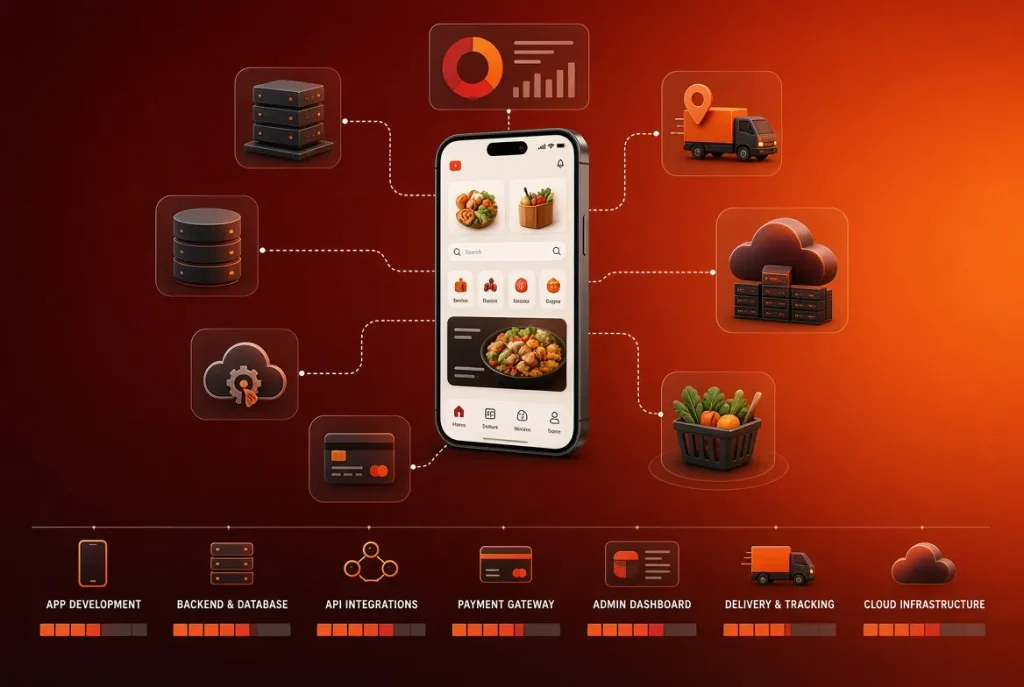
A few of these features are connected behind the scenes. For example, shopping cart, online checkout, and payment gateway features depend on the same backend systems and database.
The same is true for order tracking, delivery tracking, location services, and GPS-based features. They may look like separate features to the customer, but they often share backend infrastructure and third-party integrations.
What About an Instacart-Style App?
If your goal is similar to Instacart, you are looking at a three-sided grocery marketplace with customers, stores, and shoppers or delivery workers.
A functional MVP for this type of grocery delivery app development can start around $70,000–$100,000. It needs important features such as order assignment, substitutions, store management, and payouts.
A more polished and scalable version can reach $120,000–$250,000+.
The biggest development challenges are usually not the customer-facing screens. They are inventory synchronization with partner stores and creating a reliable system for order assignment and delivery management.
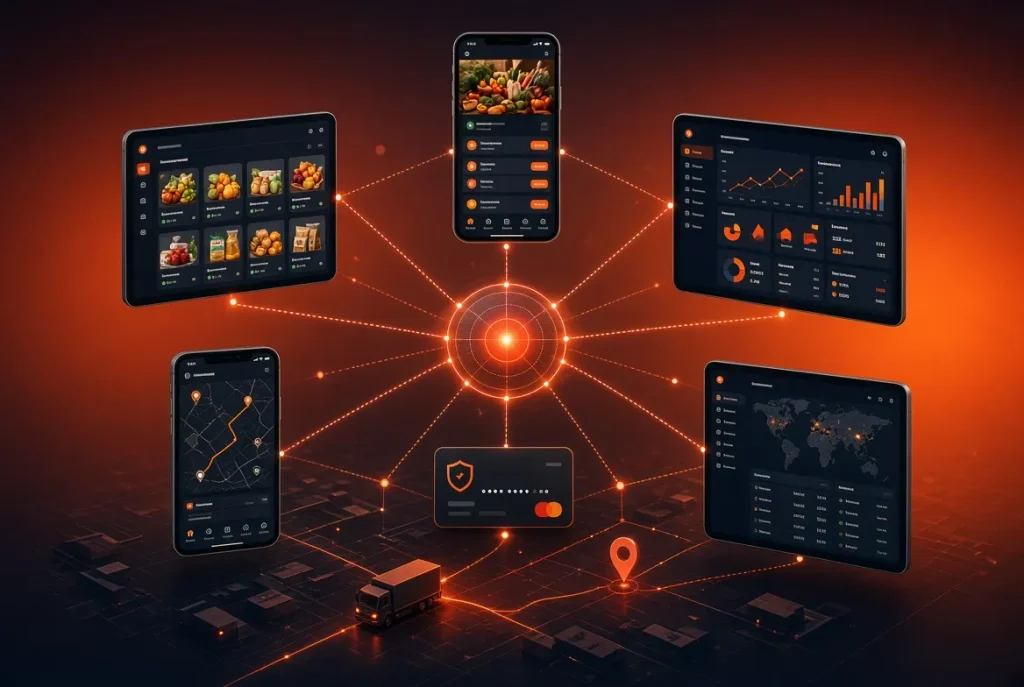
These systems become even more important when the business offers same-day delivery, fast delivery, multiple delivery slots, or a large number of stores.
Should You Build the Full App or Start With an MVP?
For many businesses, MVP development is a practical way to start. An MVP, or minimum viable product, gives a grocery startup the basic features needed to test the idea before spending a large amount on the complete platform.
Grocery businesses can learn a lot from real customers. You may discover that customers prefer scheduled orders instead of on-demand delivery. You may also find that price, delivery speed, or product availability matters more than expected.
Finding these things through a smaller grocery app MVP can cost much less than building every feature from the beginning.
A realistic MVP covers:
- Account creation and login
- Product browsing and search
- Product categories and basic product filters
- Product details and product availability
- Shopping cart and online checkout
- One payment method working reliably
- Basic order status updates
- A simple admin panel to manage products and orders
For the first version, you may not need AI-powered ordering, loyalty programs, a complex vendor system, or advanced automation.
Budget: roughly $20,000–$45,000, with an app development time of around 2–4 months.
Once you have real order data, you can decide which features should come next.
So, you should not simply add every number in the table and expect that total to be your final invoice.
Ongoing Costs Nobody Mentions Until After Launch
The initial grocery app development cost is not the only expense. Your app also needs ongoing services and updates after launch.
- Cloud hosting and cloud infrastructure — scales with your order volume, not fixed. Both AWS and Google Cloud publish pay-as-you-go calculators so you can model this before committing to an architecture.
- Payment processing fees — usually 2.9% + $0.30 per successful transaction on platforms like Stripe, with extra charges for international cards or currency conversion.
- Maps and location API usage — live tracking and location-based delivery features can increase API usage.
- SMS and notification services — SMS notifications and push notifications can create ongoing costs as your customer base grows.
- App store deployment and operating system updates — both iOS and Android apps need updates over time.
- Maintenance and updates — bugs, security improvements, compatibility changes, and new requirements need regular attention.
You should also plan for security, app security, data privacy, and privacy compliance, especially when your grocery mobile app handles customer accounts, addresses, payments, and order information.
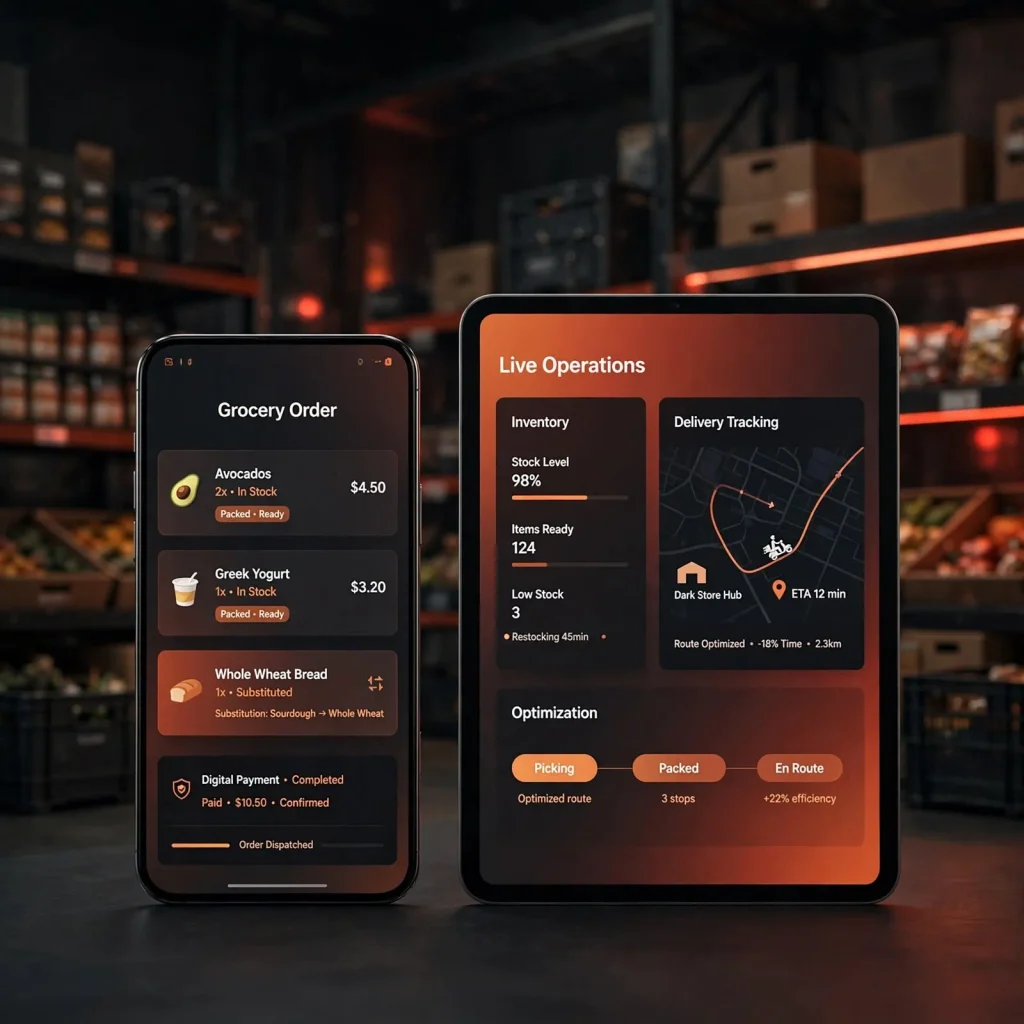
A practical rule of thumb is to set aside around 15–20% of your original build cost each year for maintenance, bug fixes, and smaller feature additions.
How Grocery Apps Actually Make Money
A grocery app can use more than one revenue model. The right model depends on whether you operate a single store, a marketplace, or a larger digital grocery platform.
Common options include:
- Delivery fees based on order size, distance, or delivery speed
- Vendor commissions from partner stores
- Subscription plans that offer free or discounted delivery
- In-app advertising for brands that want more visibility
- Service fees added to qualifying orders
- Featured listings that help products or stores appear more prominently

These options support different approaches to grocery app monetization. A single-store supermarket app may mainly use delivery fees and product sales, while a multi-vendor platform can combine vendor commissions, subscriptions, service fees, and advertising.
Features That Can Increase Future Costs
As your grocery business grows, you may decide to add more advanced grocery technology.
Features such as smart substitutions, product recommendations, AI recommendations, artificial intelligence, personalized recommendations, demand forecasting, smart search, and voice search can require additional development work.
A larger enterprise grocery platform may also need advanced business intelligence, sales analytics, and customer analytics to understand buying behavior and improve operations.
For businesses moving from traditional stores toward digital transformation, these features can become part of a larger digital commerce strategy. However, they do not always need to be included in the first version.
Final Thought
There is no single grocery app development price because there is no single type of grocery app.
A basic grocery ordering system for one store is very different from a large grocery management system, ecommerce platform, or grocery delivery ecosystem connecting customers, stores, vendors, and delivery partners.
The overall cost depends on your app complexity, technology stack, number of platforms, development team, integrations, and scalability requirements.
If your goal is online grocery shopping and online grocery delivery, start by deciding exactly what your customers need in version one. A focused MVP can help you test the grocery ecommerce idea before making a larger development investment.
Once the business starts generating real data, you can add advanced features such as loyalty programs, rewards programs, subscription orders, recurring orders, customer support, better analytics, and more advanced delivery tools.
The important thing is to build around the actual needs of your grocery startup and customers instead of paying for every possible feature on day one. At Daigency, we design and build scalable web solutions, custom apps, and brand identities that help businesses grow and dominate their online market.
Launch Your On-Demand Grocery Platform Fast in 2026
Transform your local store into a powerful online ordering platform with real-time tracking.
FAQs- Grocery App
- How much does a basic grocery app cost in 2026?A basic single-store MVP typically costs $20,000–$45,000 and takes 2–4 months, covering browsing, cart, checkout, payment, and basic order tracking.
- How much does an Instacart-like app cost?
A working three-sided marketplace MVP starts around $70,000–$100,000. A fully scaled version with automation and analytics can reach $250,000+.
- Is Flutter good enough for a grocery app?Yes, for the vast majority of grocery apps. It shares one codebase across iOS and Android and only becomes a limitation if you need very heavy native device features, which most grocery apps don't.
- What's the single biggest cost driver?
Real-time inventory synchronization across multiple stores is one of the biggest cost drivers because it requires complex backend development and continuous data updates.
- Can I really build a grocery app for under $25,000?Yes, if you keep it to one store, one payment method, and no live tracking. A simple app can focus on product browsing, ordering, checkout, and basic order status updates.